Quick diagnosis
Match the row to what you’re seeing, then jump to the fix.
| What you see | Likely cause | Confidence | How to confirm | What to do now | Urgency |
|---|---|---|---|---|---|
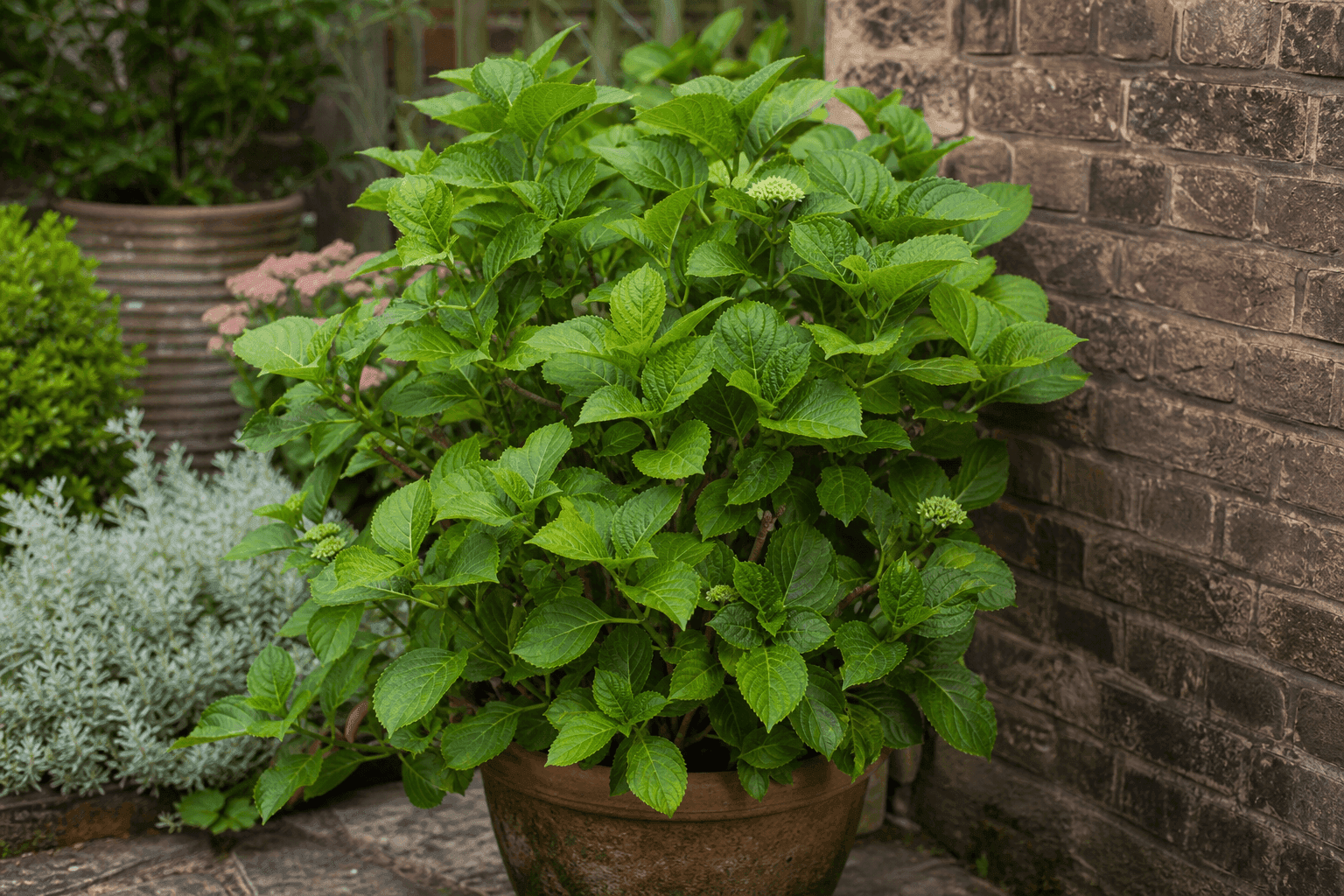
| Leaves emerge but the plant produces no flowers; lots of leafy growth | Wrong pruning time — flower buds removed | High | Check what type of hydrangea it is and when it was last pruned. | Avoid pruning mopheads and lacecaps after midsummer; leave paniculata and arborescens to late winter. | Low |
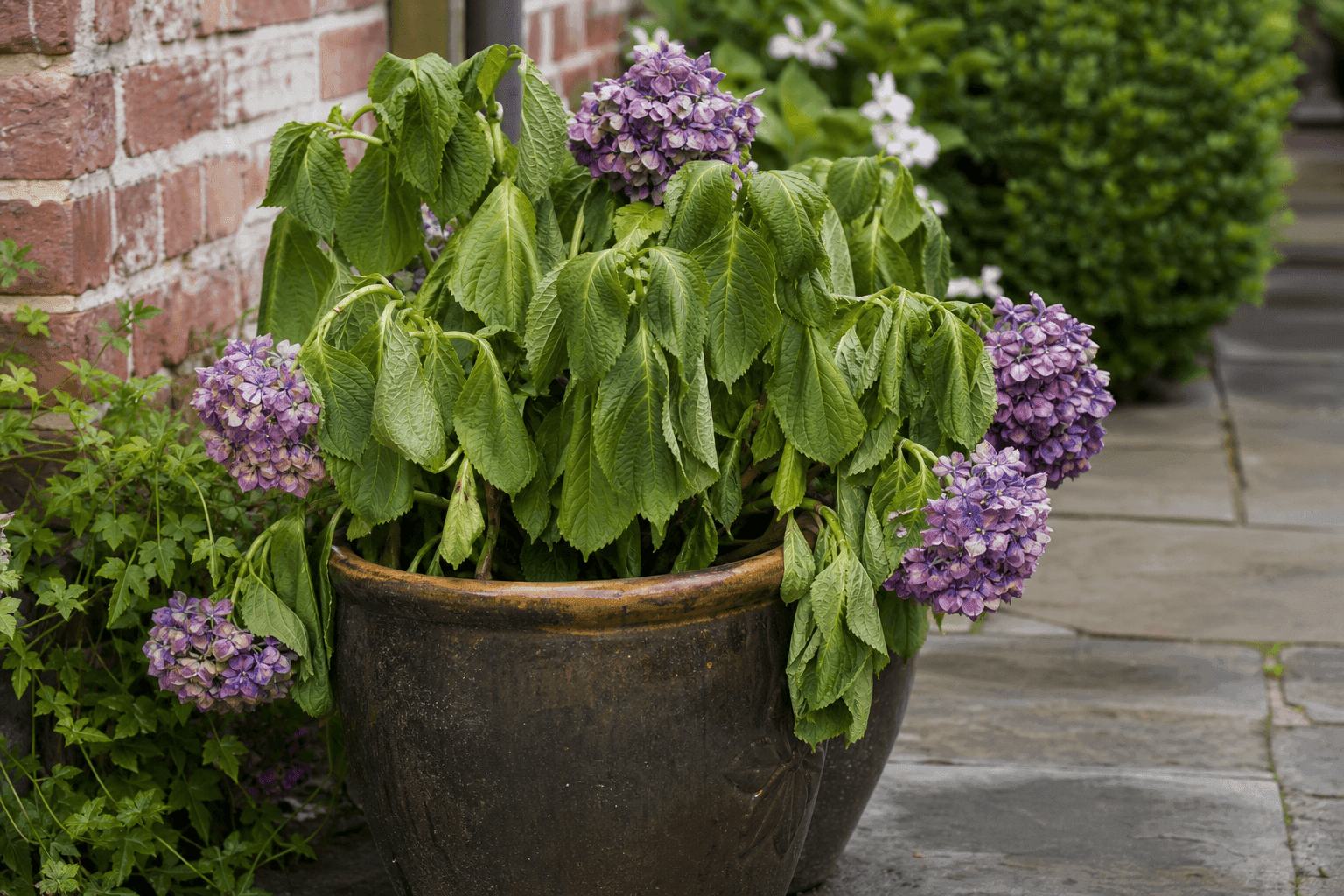
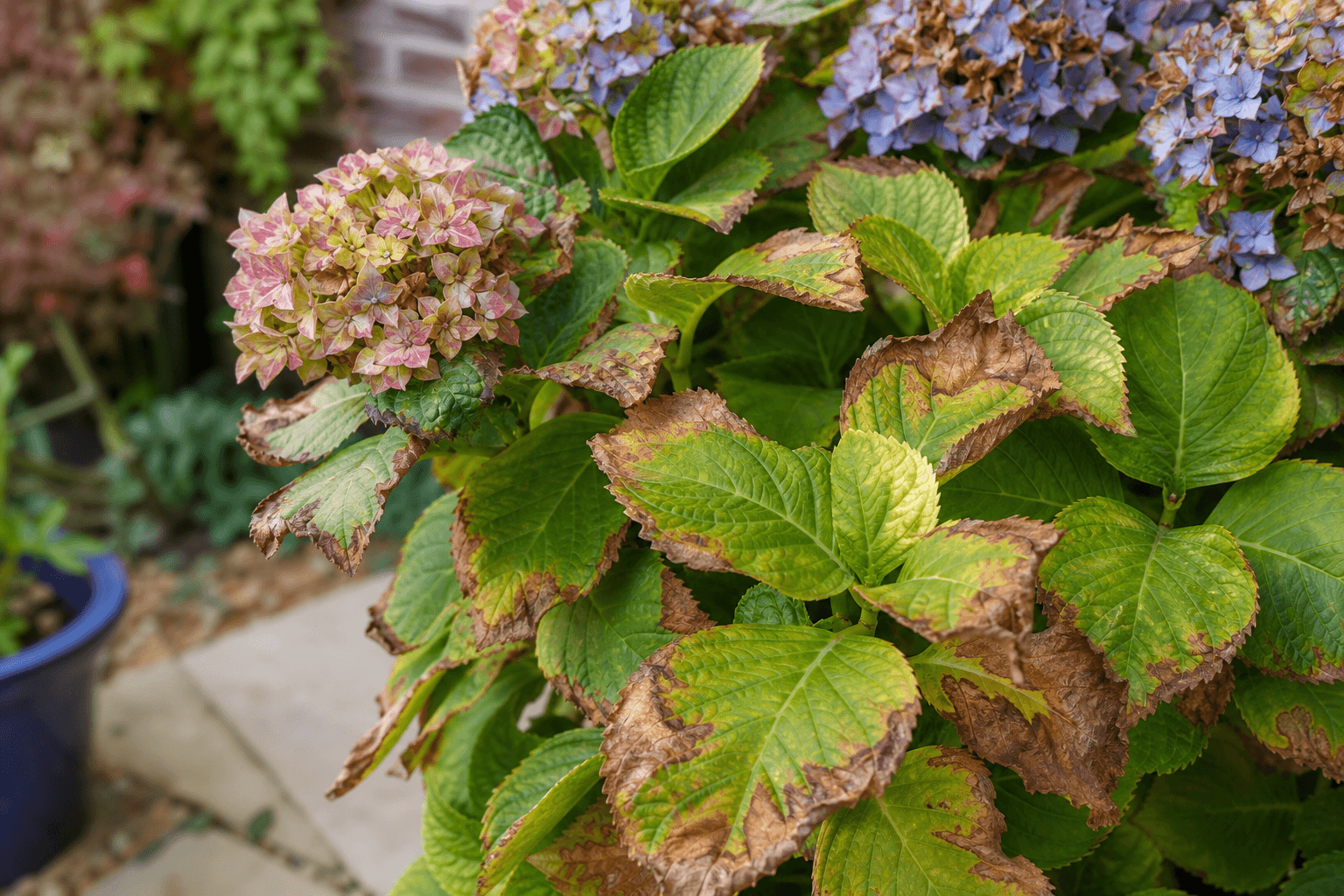
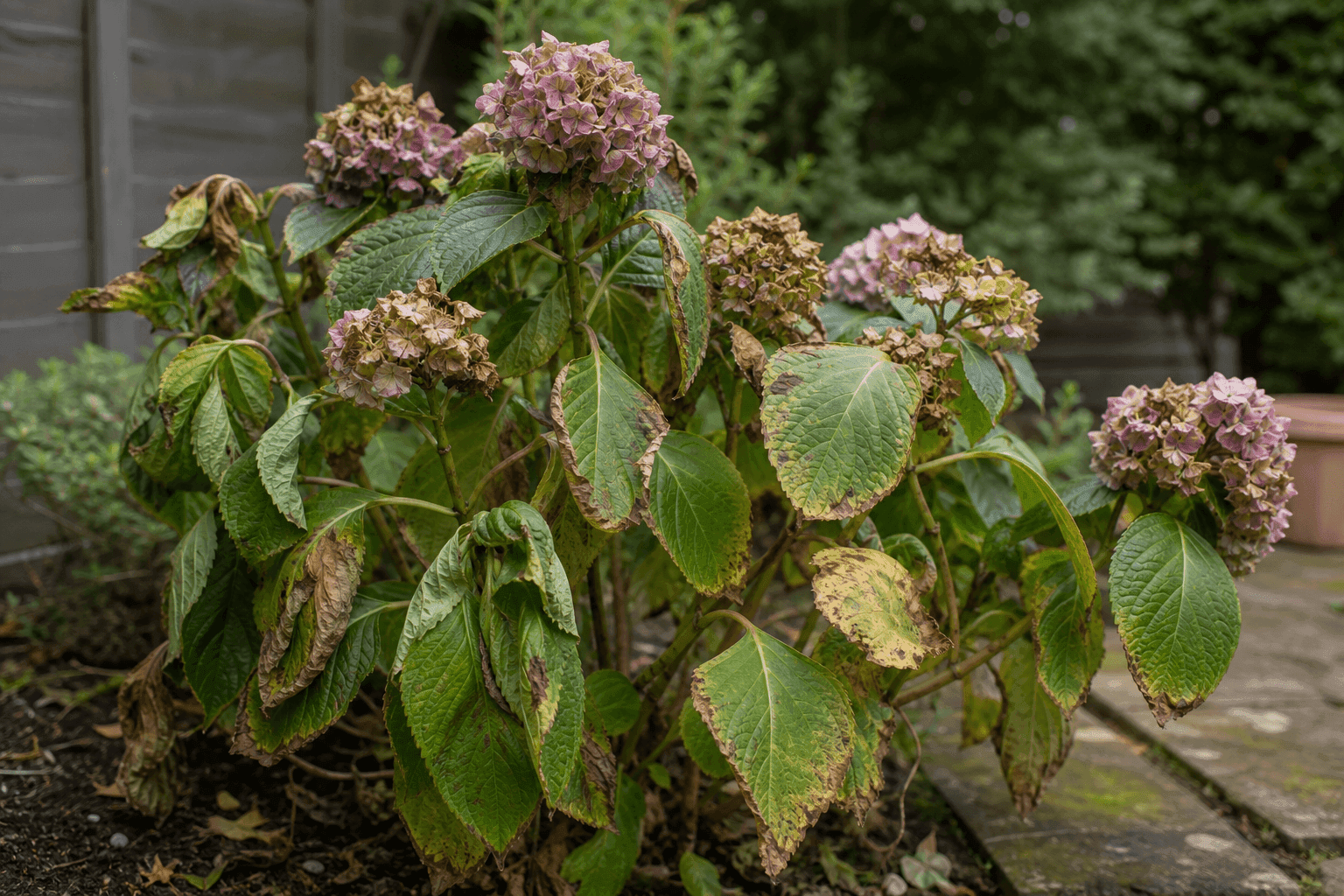
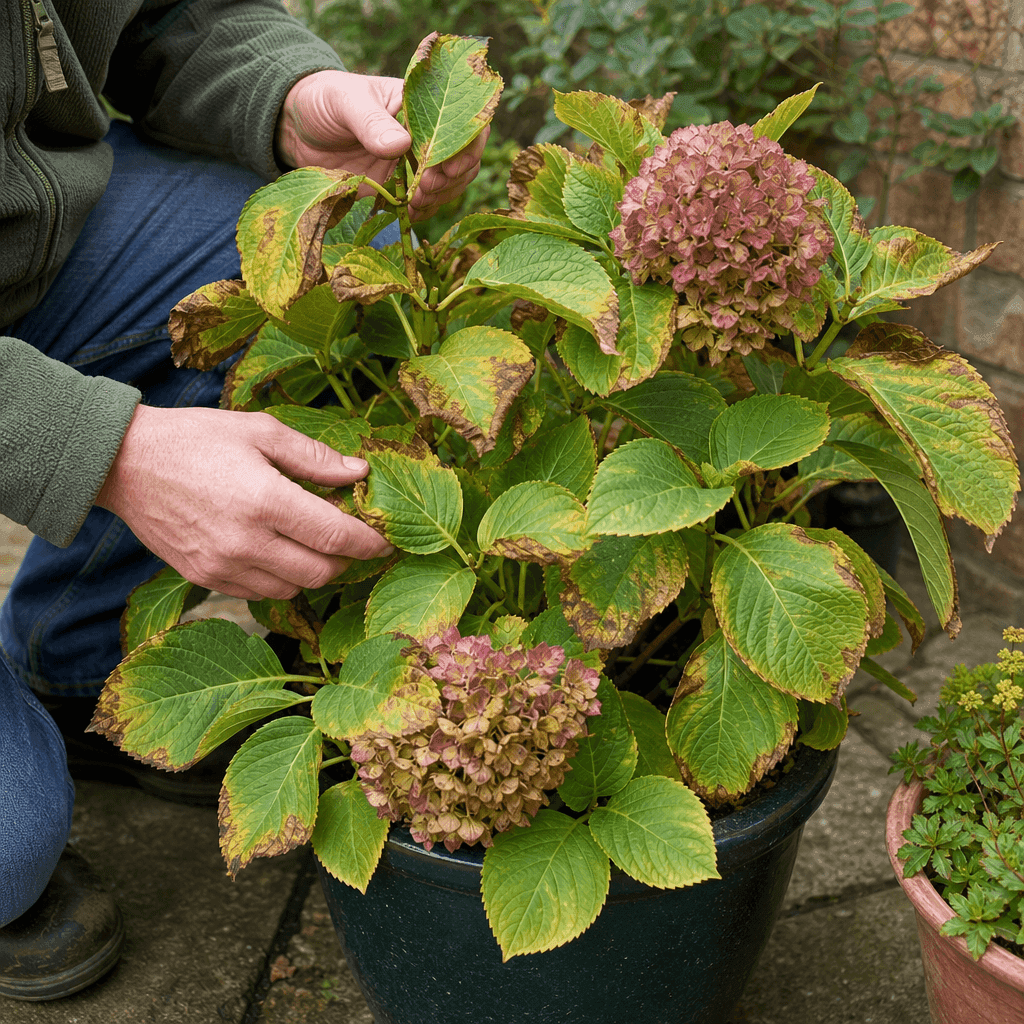
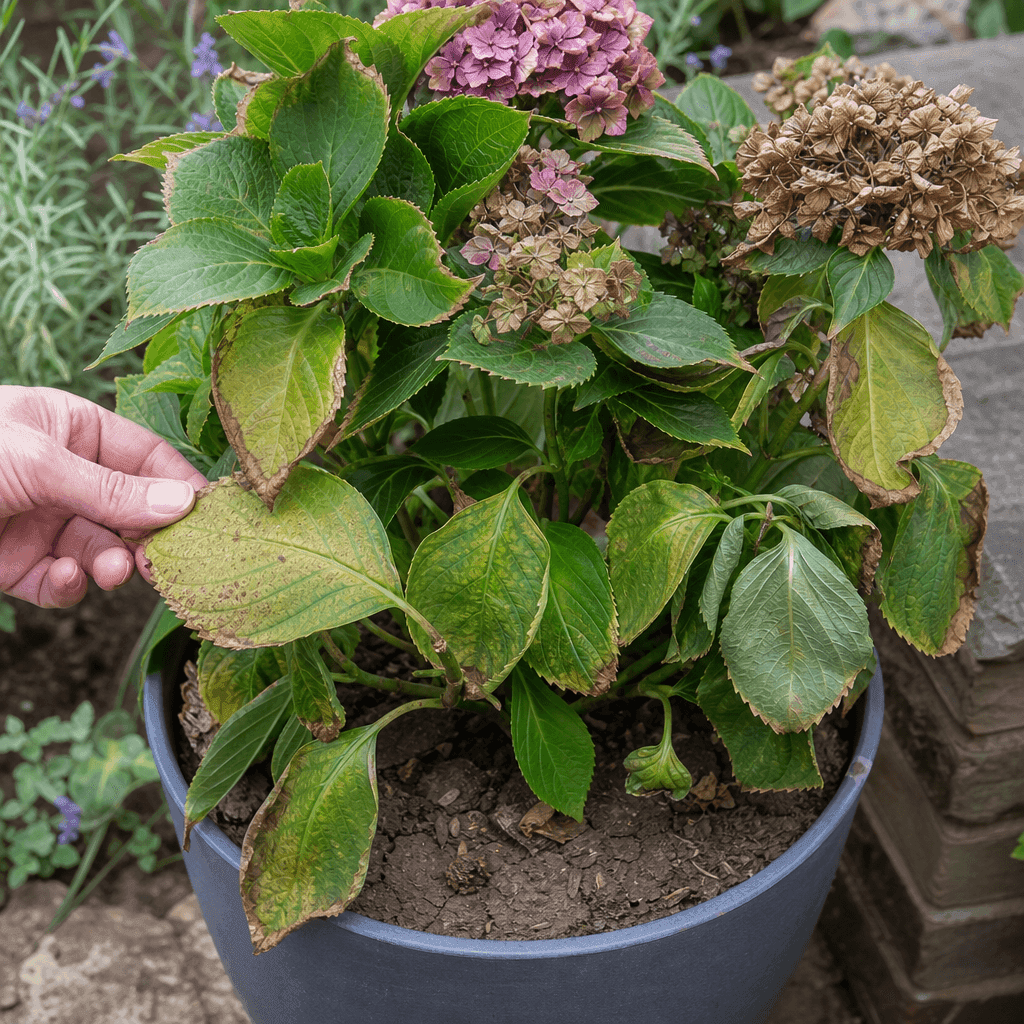
| Leaves wilt and scorch; stems dry and brittle from the tips down | Sustained drought stress | High | Soil is dry below 5 cm; recently planted or in a pot; no mulch. | Deep-water, apply a 5 cm mulch, and shade potted plants from afternoon sun. | High |
| Plant collapses despite wet soil; stems blacken from the base; roots brown and mushy | Phytophthora or Pythium root rot | Medium | Soil stays wet for days; stem base is dark and soft; roots smell and discolour. | Improve drainage urgently; remove badly rotted roots; repot if in a container. | High |
| New shoots blackened or wilted after a cold night; older wood unaffected | Late frost damage | Medium | Damage appeared after a frost warning; mainly affects soft new growth and flower buds. | Wait until frost risk passes, then prune blackened tips back to healthy buds. | Medium |
| Brown blotches on flowers or leaves with grey fuzzy mould; damage in damp, cool weather | Botrytis grey mould | Medium | Fuzzy grey fungal growth on affected tissue; worst in cool, wet or humid conditions. | Remove affected material, improve airflow, avoid overhead watering. | Medium |
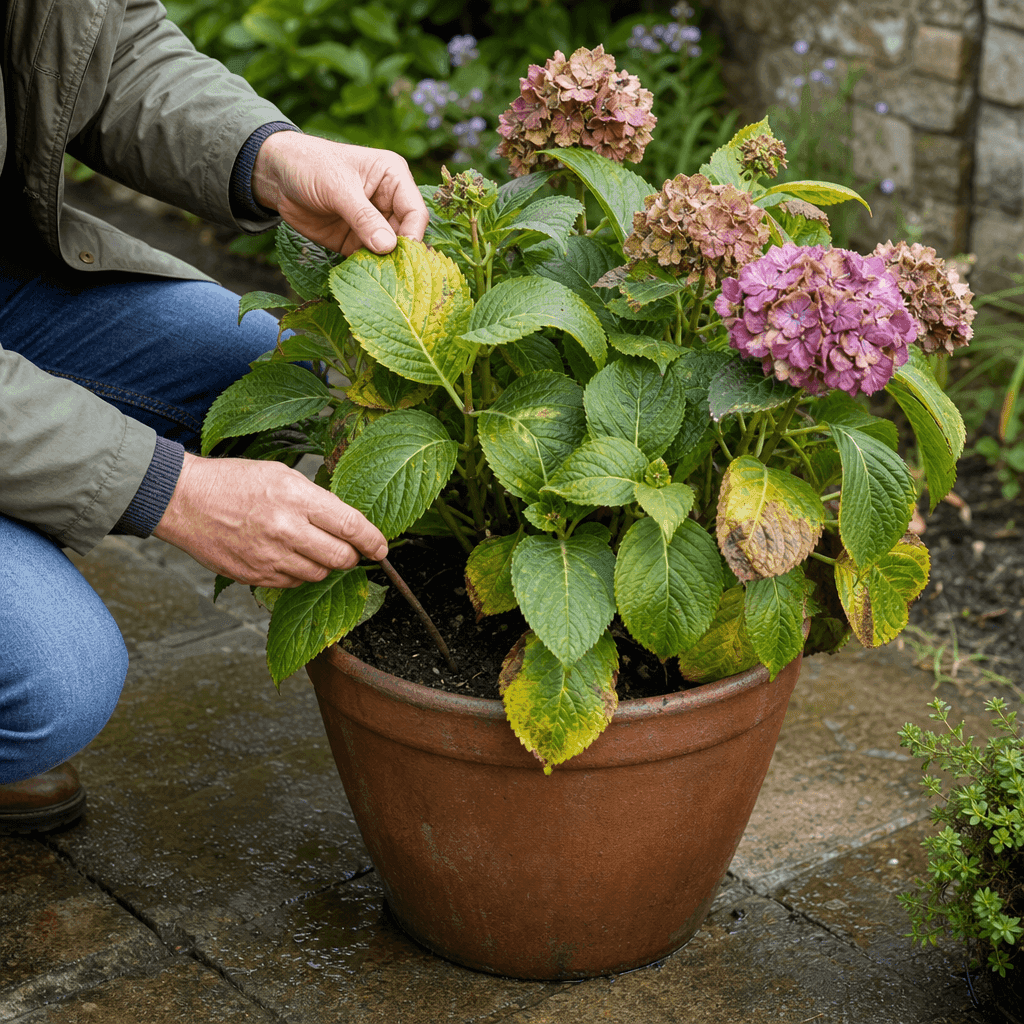
| Weak stems, pale leaves, small flowers or no flowers despite no pruning errors | Nutrient imbalance or compacted/exhausted soil | Medium | Plant not fed for years; heavy clay soil; pot-bound with exhausted compost. | Apply a balanced fertiliser or specialist shrub feed in spring; repot if pot-bound. | Low–medium |
The causes, in detail
Wrong pruning time or technique
Most likelyThe most common reason a hydrangea appears to be 'dying' — producing no flowers or only leaves — is incorrect pruning. If your shrub is leafing up well but blooms never arrive, see our dedicated guide to a hydrangea not flowering. Mophead and lacecap hydrangeas (Hydrangea macrophylla), mountain hydrangeas (H. serrata) and climbing hydrangeas (H. anomala petiolaris) flower on the previous year's wood. If these are cut hard in late winter or early spring, all the flower buds are removed. The RHS advises that H. macrophylla should be deadheaded in spring and only lightly tidied, leaving the old flowered stems to protect buds through winter. H. paniculata and H. arborescens flower on the current year's wood and can be pruned hard in late winter without losing flowers.
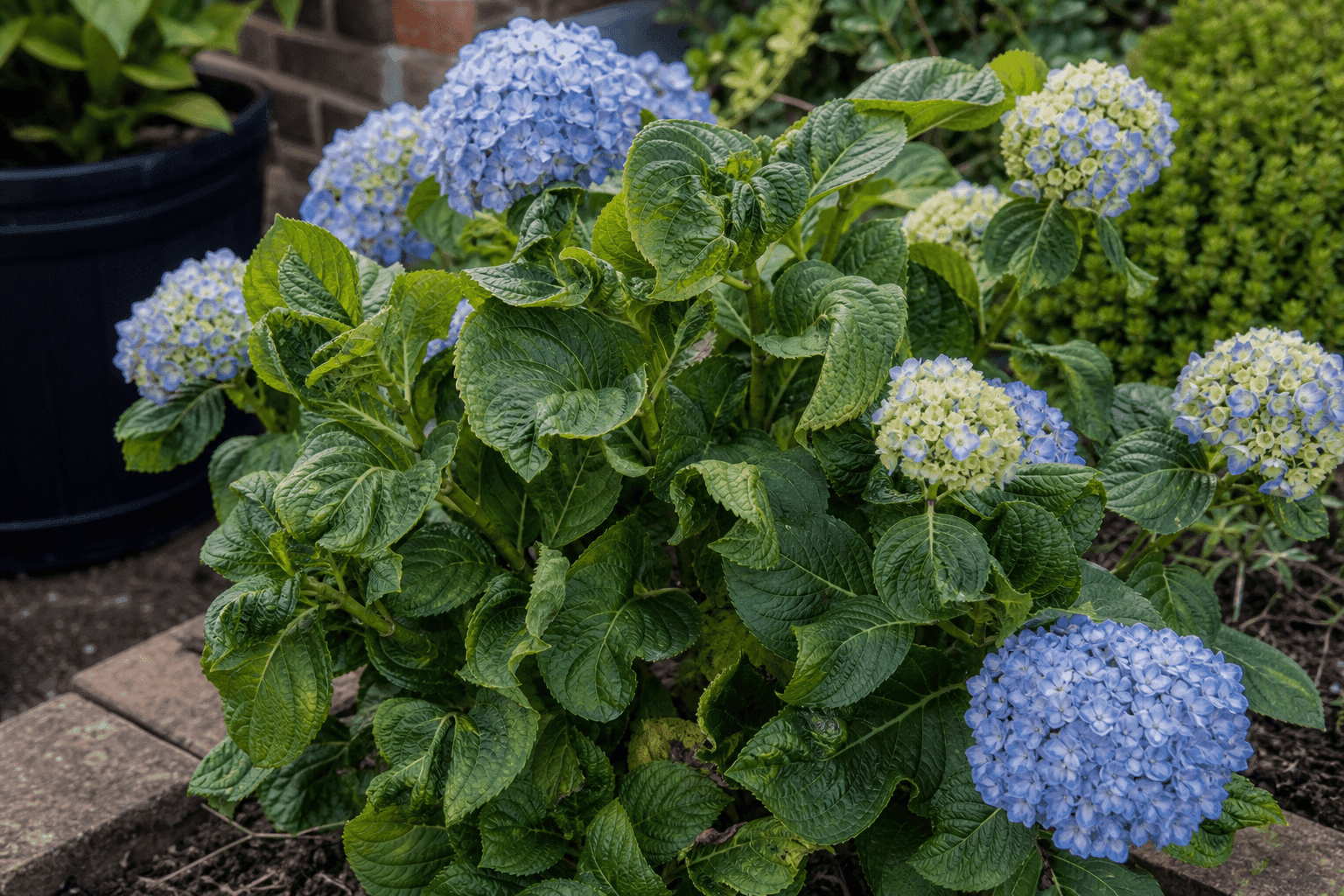
- Identify the hydrangea type — mophead and lacecap have large ball-shaped or flat-topped flowers.
- Check when it was pruned — cutting mopheads hard in autumn, winter or early spring removes next year's buds.
- The plant produces abundant leafy growth but no flowers — this is characteristic of over-pruning.
- Stop hard pruning mopheads and lacecaps — in spring, simply remove dead flowerheads and any dead or crossing stems.
- For H. paniculata and H. arborescens, prune to a low framework in late winter (February to early March) for the biggest flowerheads.
- If you are unsure of the type, prune lightly and observe where new buds form.
- A mis-pruned mophead will produce no flowers that season but should recover fully the following year.
Stop it coming back:Label hydrangeas with their type and pruning month when you plant them. H. macrophylla = prune lightly in spring, never in autumn. H. paniculata = prune hard in late winter.
hard prune a mophead or lacecap in autumn or winter — this removes the overwintering flower buds for next year.
Sustained drought and water stress
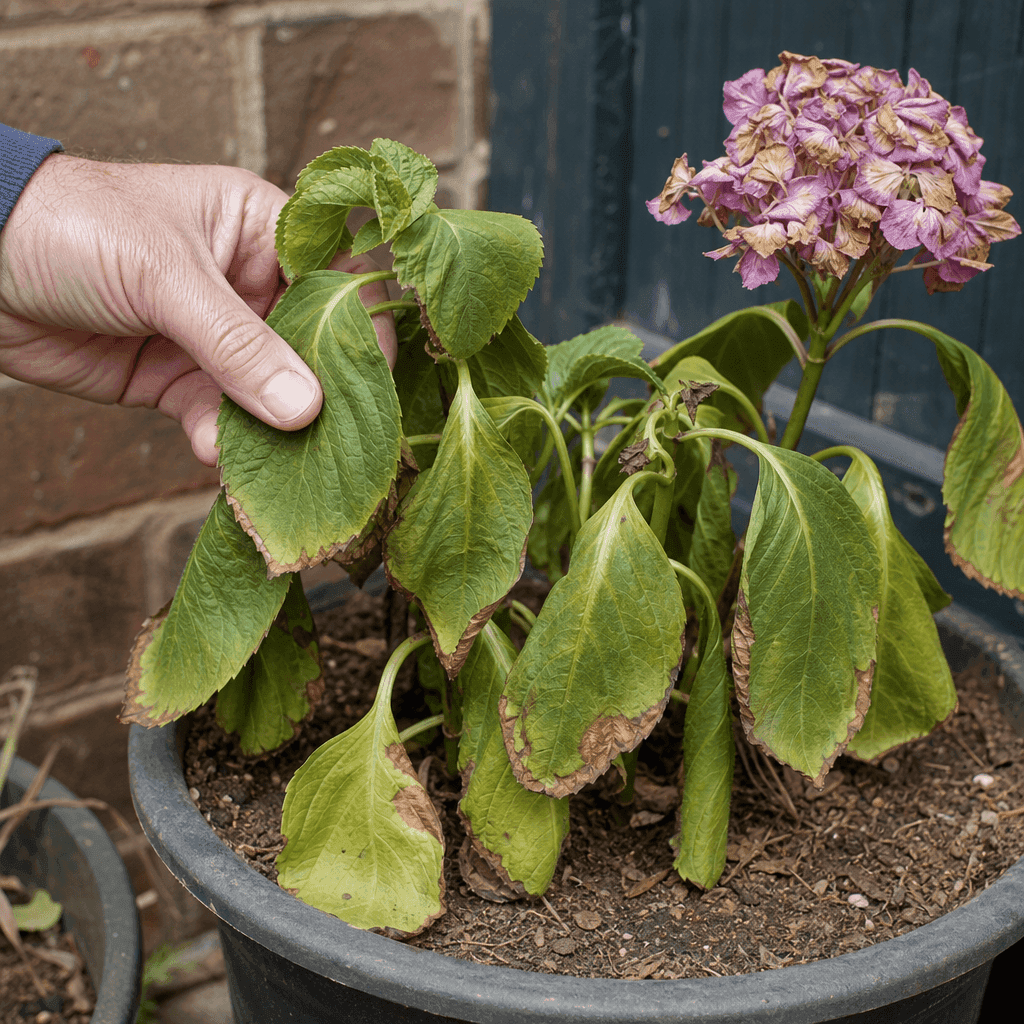
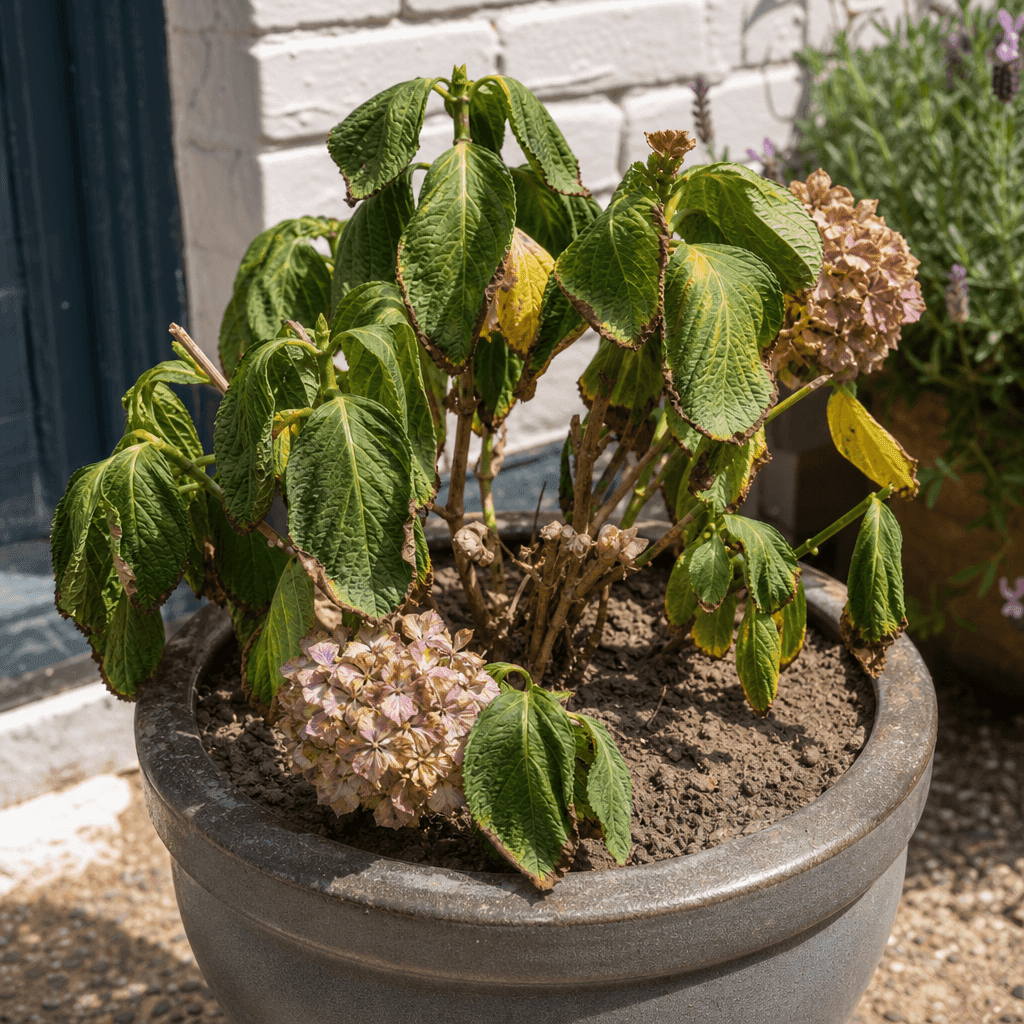
Most likelyHydrangeas are thirsty shrubs — the name means 'water vessel'. Sustained drought causes progressive decline: leaves wilt, tips brown, stems harden from the outside in, and eventually whole branches die back. If sudden flopping is your main symptom rather than overall decline, our guide to a wilting hydrangea walks through the quick checks. This is especially common in the first growing season after planting, in pots on sunny patios, in dry shade under tree canopies, or against south-facing walls. The RHS warns that 'shrubs often fail to flower after drought' and that newly planted hydrangeas need careful watering through their entire first season.
- The soil is dry more than 5 cm below the surface.
- The plant has been recently planted, is in a pot, or is in a dry, rain-shadowed spot.
- Wilting is worst in the afternoon and on the side facing the sun or prevailing wind.
- Water slowly and deeply at the base — a slow trickle for 10–15 minutes rather than a quick splash.
- For pots, water until it drains freely from the holes, pause, then water again.
- Apply a 5–8 cm mulch of garden compost, well-rotted bark or leaf mould over the root zone, kept clear of the stems.
- Newly planted hydrangeas need watering two to three times a week in dry weather for the whole first growing season.
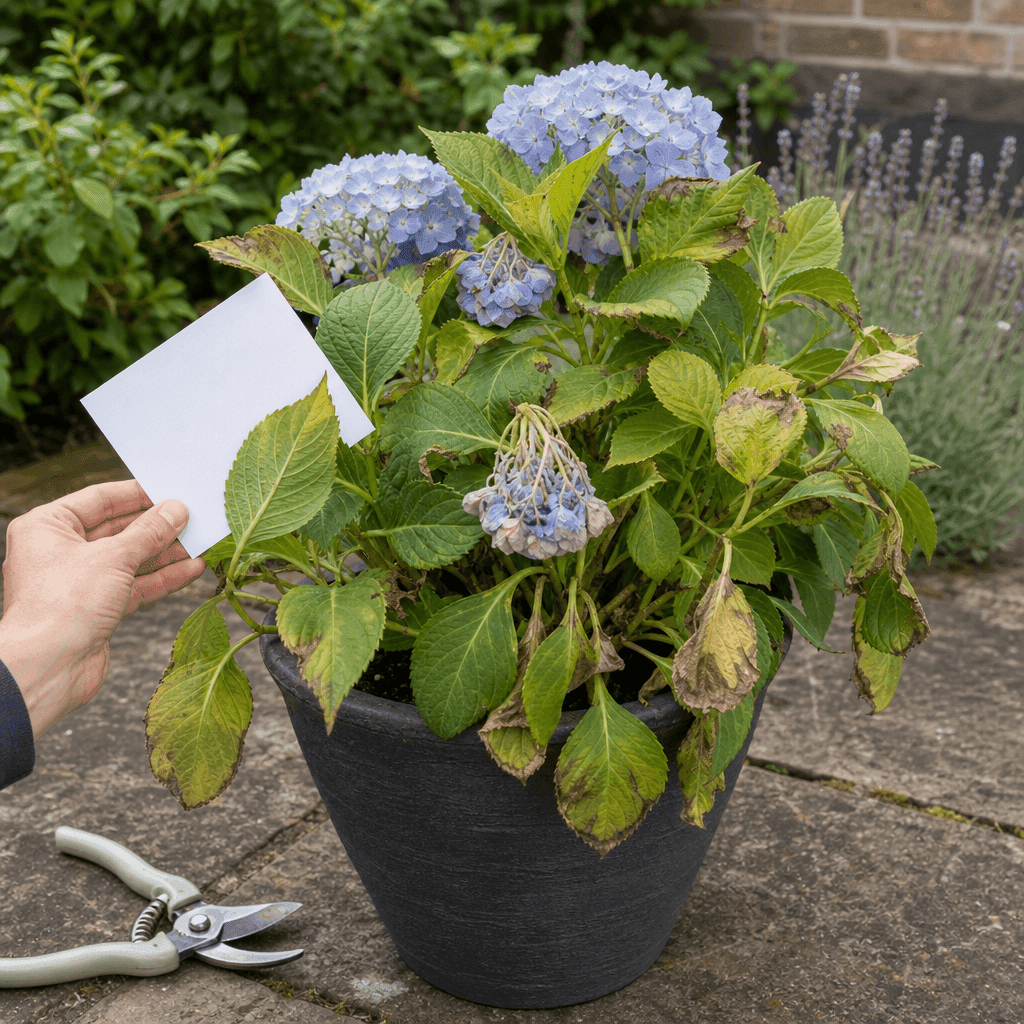
- Prune back dead tips to live wood once you are sure the drought is the cause and the plant has had time to respond.
Stop it coming back:A hydrangea can recover from moderate drought stress with deep watering and mulching, but stems that have died completely will not regrow.
assume drought recovery is complete within a few days — in severe cases it can take several weeks of steady moisture before new growth confirms recovery.
Phytophthora or Pythium root rot
PossibleRoot rot in hydrangeas is caused by water-mould pathogens, primarily Phytophthora spp. and Pythium spp., which thrive in cold, waterlogged conditions. The RHS describes Phytophthora root rot as a disease that kills roots and causes sudden collapse, often despite apparently adequate soil moisture. It is most common in heavy clay soil, compacted new-build ground, low spots where water sits, and containers without proper drainage. Tennessee State University Extension notes that Phytophthora and Pythium diseases are 'generally found where plants are in cold wet soils and/or overwatered'.
- The plant wilts and declines despite wet soil — soggy, cold or sour-smelling.
- The stem base is dark, soft or discoloured when scratched or cut.
- Roots are brown, black and mushy rather than pale and firm.
- Stop watering immediately and check drainage — clear blocked pot holes or improve surface drainage in the ground.
- For container plants: unpot, remove all dead mushy roots with clean, sharp scissors, allow roots to air briefly, then repot into fresh compost in a clean pot with clear drainage holes.
- For ground plants: improve drainage by breaking up compaction and working in coarse grit; in severe cases move the plant to a better-drained site.
- Avoid replanting another hydrangea in the same spot without improving drainage — the pathogen persists in the soil.
Stop it coming back:There is no chemical control available to UK amateur gardeners for Phytophthora. Early detection and drainage improvement are the only reliable strategies.
water a wilting hydrangea without first checking whether the soil is wet — if root rot is present, more water accelerates the damage.
Late frost damage to new growth and flower buds
PossibleHydrangeas are generally hardy across most of the UK, but late frosts in April and May can blacken or kill the soft new growth that carries the season's flower buds. Mophead and lacecap varieties are particularly vulnerable because their buds sit at the tips of the previous year's stems. The RHS notes that in exposed or frost-prone gardens this damage can look very dramatic — the whole plant may appear dead — but older wood usually survives and new growth will emerge.
- The blackening or wilting appeared after a frost warning or a temperature below zero.
- Damage is mainly on the soft new tips; woody older stems are unaffected when scratched.
- The timing is spring — typically March to May in the UK.
- Do not prune immediately if more frosts are forecast.
- Once temperatures are reliably above freezing, cut back blackened tips to healthy, pale buds or live wood.
- For potted hydrangeas, move to an unheated greenhouse, cold frame or sheltered wall during frost warnings.
- H. paniculata and H. arborescens flower on new wood and are more frost-forgiving — a late frost costs fewer blooms.
Stop it coming back:In frost-prone UK gardens, H. paniculata and H. arborescens are safer choices. For mopheads and lacecaps, leaving old flowered stems on through winter helps protect the buds below.
prune frost-damaged hydrangeas while further frosts are still likely — new growth stimulated by pruning is even more vulnerable.
Botrytis grey mould
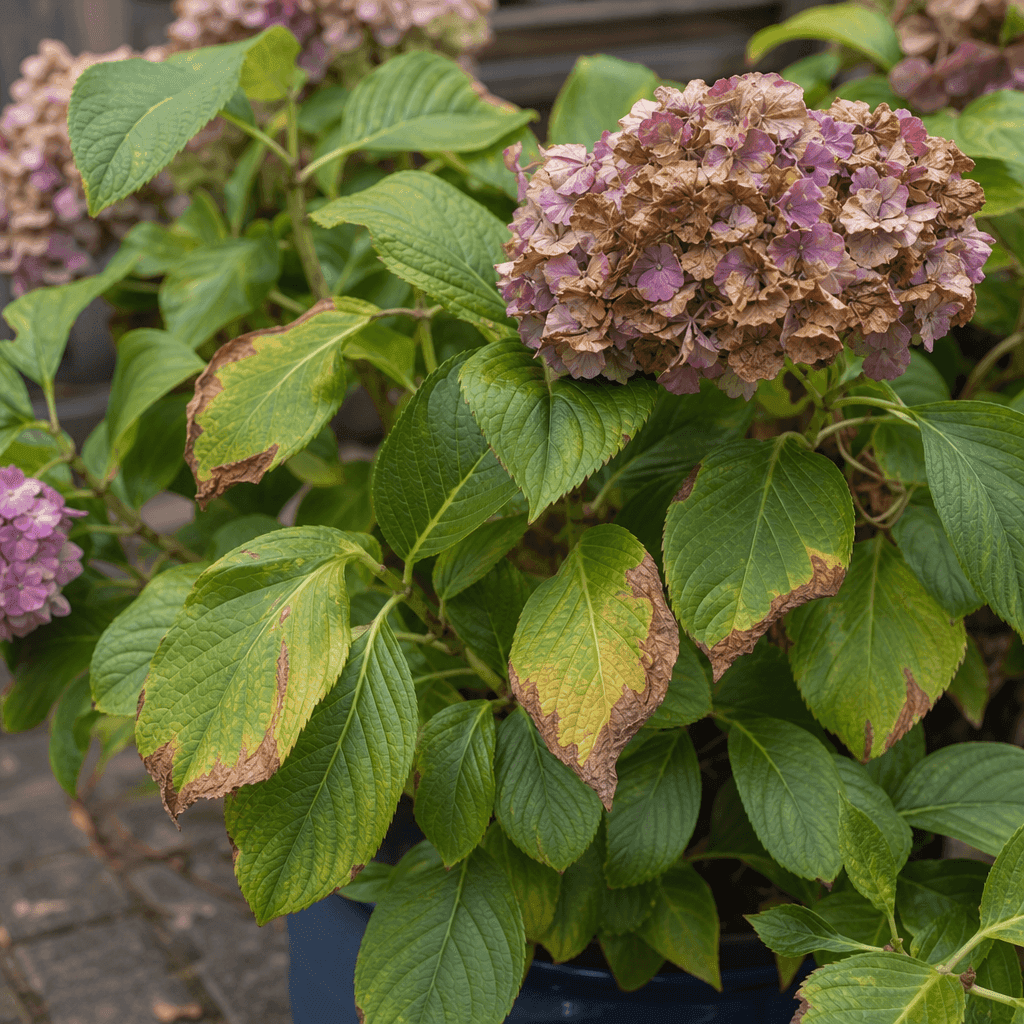
PossibleBotrytis cinerea (grey mould) causes brown blotches on hydrangea petals and leaves that expand rapidly in cool, humid, wet conditions. The University of Connecticut Home Garden Education Office describes it as producing 'brown, withered masses of flowers that may be covered with fuzzy gray fungal growth'. This is most damaging in UK conditions during wet summers, in still or sheltered positions, or when plants are watered overhead. The RHS lists botrytis as one of the diseases that can affect H. paniculata.
- Brown blotches on flowers or leaves with a grey, fuzzy fungal coating visible on the surface.
- Damage appeared or worsened during cool, damp or humid weather.
- Wet flower petals or dense, airless planting conditions preceded the outbreak.
- Remove all affected flowers, leaves and stems promptly — put in the bin, not on the compost heap.
- Improve airflow around the plant by thinning dense growth at the centre.
- Avoid overhead watering — water at the base only.
- Reduce excess nitrogen feeding, which promotes soft growth susceptible to botrytis.
Stop it coming back:Botrytis rarely kills a hydrangea but can ruin the flowers. Good airflow and base-only watering are the best prevention in wet UK summers.
leave affected flowers and leaves on the plant — they spread spores to healthy tissue.
Nutrient imbalance, exhausted soil or pot congestion
PossibleEstablished hydrangeas in the ground rarely need feeding, but a plant that has been in the same spot for many years may show weak, small-leaved growth if the soil has been depleted or compacted. Potted hydrangeas are more vulnerable — after two or more years in the same compost, nutrients are exhausted and roots fill the pot. Excess nitrogen, often from lawn fertiliser washing into beds, produces lush leafy growth at the expense of flowers.
- Pale, small leaves and weak stems with little flowering despite correct pruning.
- The plant is in a pot it has not been moved from in several years.
- Lawn fertiliser has been applied nearby or has washed into the bed.
- In the ground: apply a balanced granular shrub fertiliser (or specialist hydrangea feed) in spring, following the pack rate.
- Avoid lawn feed near hydrangeas — the high nitrogen encourages leaves, not flowers.
- For pots: repot every two to three years into fresh peat-free compost; choose a container one size larger.
- Top-dress in-ground plants with well-rotted garden compost annually.
over-feed with high-nitrogen fertiliser — it promotes leafy growth and reduces flowering in established shrubs.
Still not sure?
Work down these branches — the first one that matches is your answer.
What not to do
- Hard prune mophead or lacecap hydrangeas in autumn or winter — this removes next year's flower buds.
- Water automatically without checking the soil — in waterlogged ground, more water causes root rot.
- Assume a wilting plant needs water — check whether the soil is already wet before adding more.
- Give up on a hydrangea with dead-looking tips without first scratching the stem to check for live green wood underneath.
- Apply high-nitrogen lawn feed near hydrangeas — it encourages leaves and suppresses flowering.
Common questions
Why is my hydrangea dying after planting?
Newly planted hydrangeas most commonly fail due to a dry rootball that has not bonded with the surrounding soil, or waterlogging in heavy clay. Check that the original rootball (not just the surrounding backfill) is moist. If the soil is very wet, improve drainage before watering more.
Can I save a dying hydrangea?
Often yes. Scratch a stem near the base — if the tissue underneath is green or white, the plant is alive. Cut back dead wood to the first live bud or shoot, address the underlying cause (drought, root rot, pruning error), and give it a full growing season. Many apparently dead hydrangeas recover.
Why has my hydrangea got lots of leaves but no flowers?
The most common cause in the UK is cutting mophead or lacecap hydrangeas at the wrong time. These flower on last year's wood, and pruning in autumn, winter or early spring removes the flower buds. Leave them alone this year and adopt correct pruning next spring.
What does hydrangea root rot look like?
The plant wilts despite wet soil, the stem base may be dark and soft, and roots are brown, mushy and may smell sour. Root rot in hydrangeas is often caused by Phytophthora or Pythium, which thrive in cold, waterlogged conditions.
Should I cut back a dying hydrangea?
First scratch a stem to confirm live wood is present. Then prune dead material back to the first healthy bud or shoot. Avoid hard pruning a plant under stress from root rot or severe drought — fix the underlying problem first.
Why did my hydrangea die suddenly?
Sudden collapse in a hydrangea usually points to Phytophthora or Pythium root rot in waterlogged soil, severe drought, or frost damage to soft spring growth. Check the stem base and soil condition: a soft, dark stem in wet soil points to root rot; dry crumbly soil and brittle stems point to drought.
Do hydrangeas come back after dying back?
Yes — many hydrangeas that appear completely dead in winter or after frost damage have live buds lower down the stems. Scratch the stem to check; if there is green tissue beneath, cut back to that point and wait. Most hydrangeas regenerate reliably from the base.