Quick diagnosis
Match the row to what you’re seeing, then jump to the fix.
| What you see | Likely cause | Confidence | How to confirm | What to do now | Urgency |
|---|---|---|---|---|---|
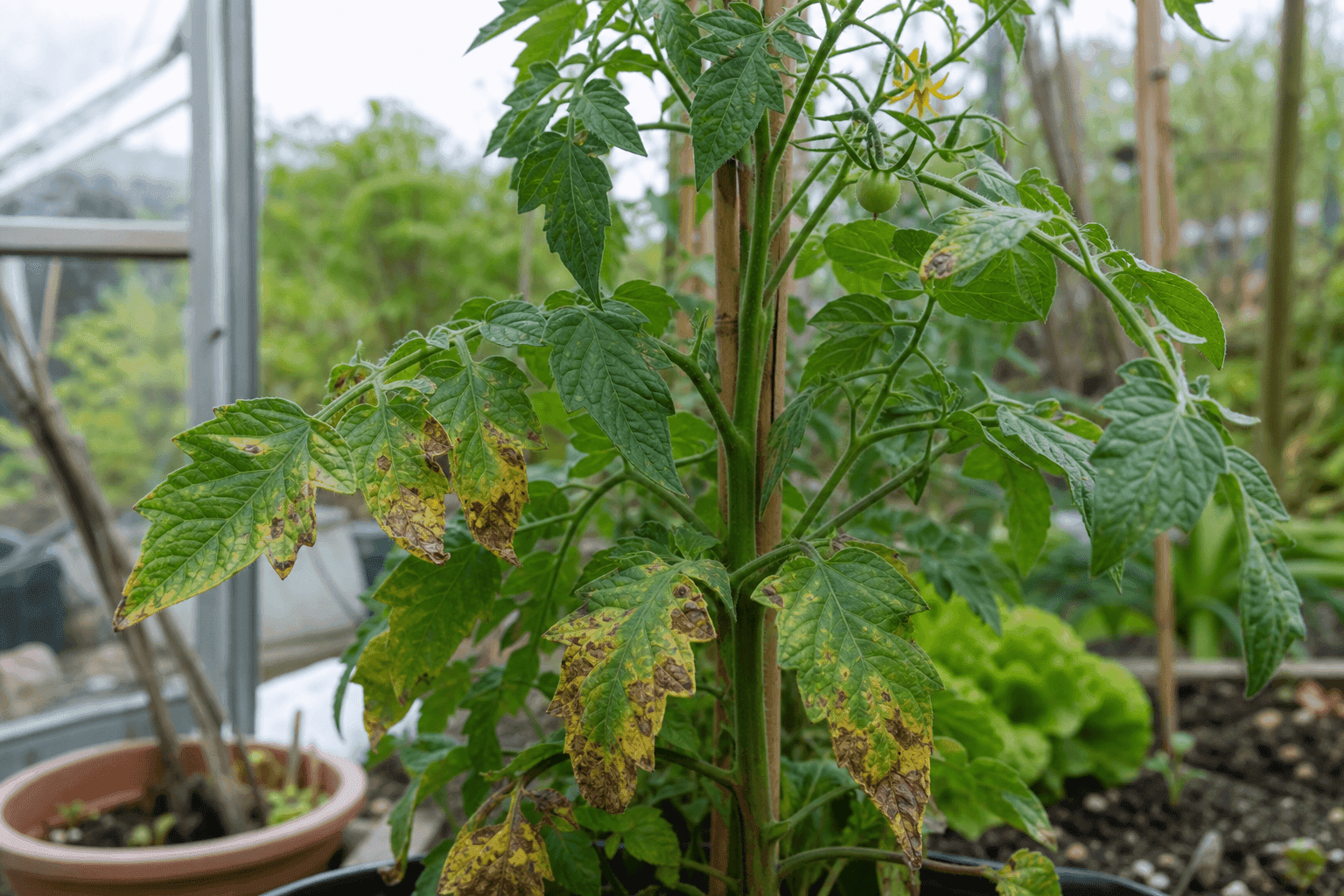
| Dark, watery patches spreading rapidly across leaves; brown rot on fruits | Tomato blight (Phytophthora infestans) | High | Patches spread fast in warm, wet weather (above 10°C, high humidity); white fungal growth visible on leaf undersides in humid conditions; outdoor plants at highest risk | Remove and bin all affected foliage immediately; if severe, cut down and remove all haulms; do not compost; check fruit | High |
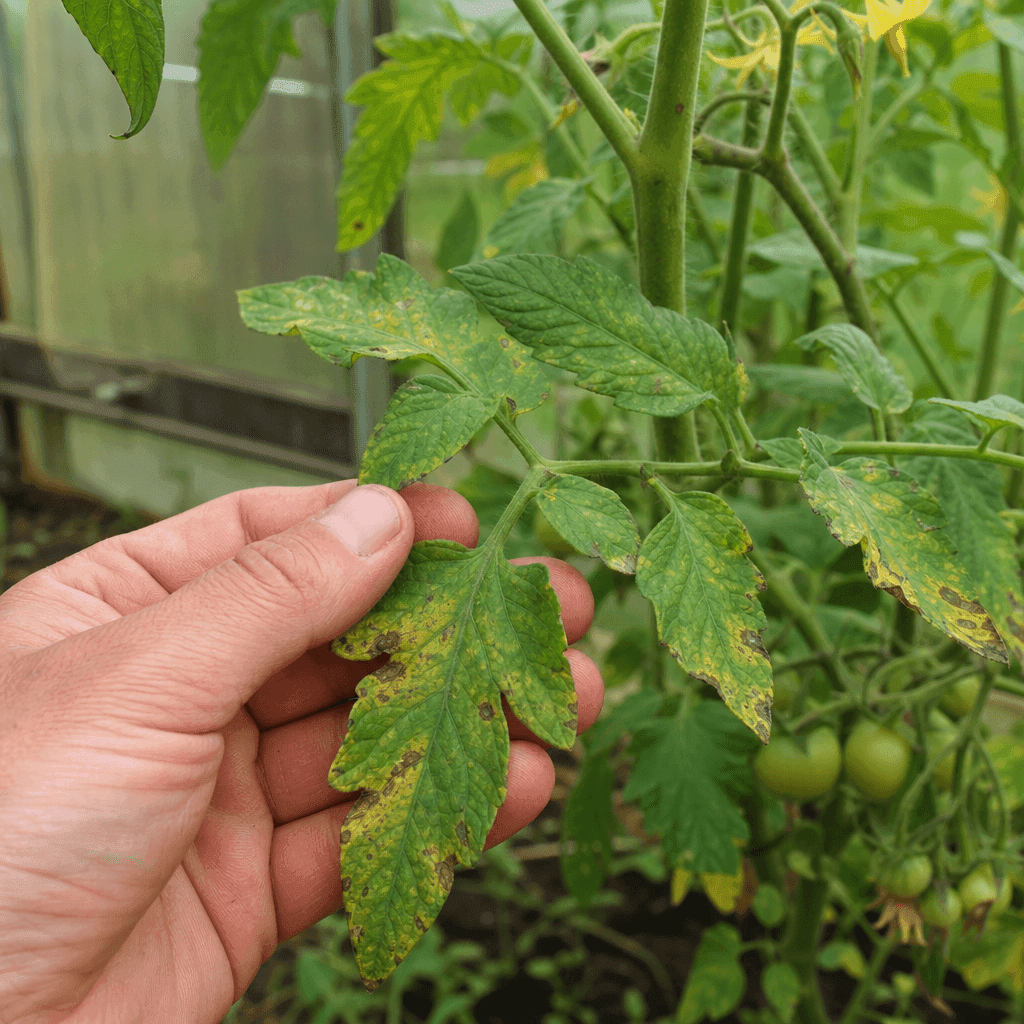
| Pale yellow patches on upper leaf surface; olive-brown mould on undersides | Tomato leaf mould (Fulvia fulva) | High | Velvety olive or brown mould on leaf undersides corresponding to yellow patches above; greenhouse plants mainly; worse when humidity is high | Remove badly affected leaves; open vents, improve airflow; avoid wetting foliage | Medium |
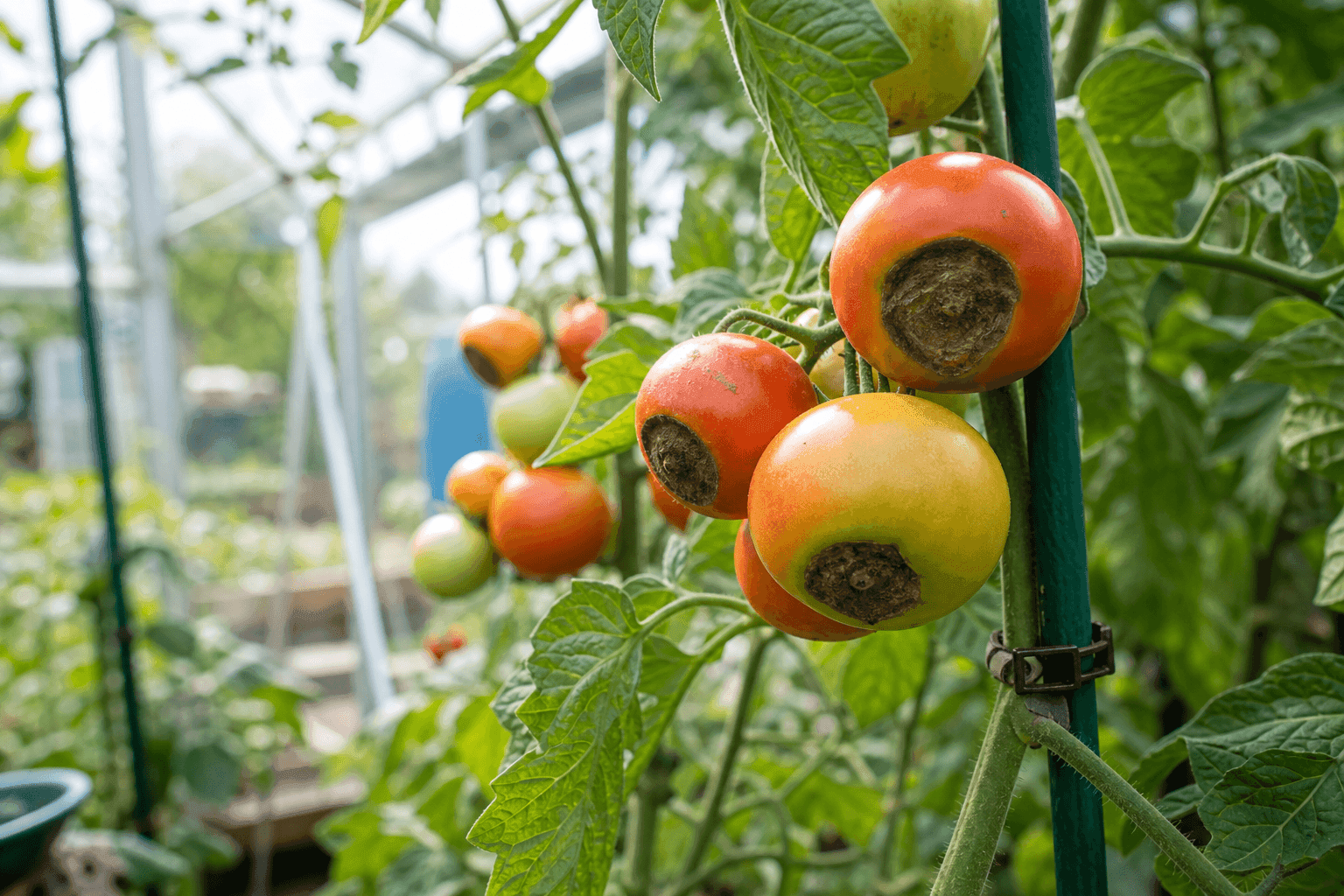
| Dark, sunken patch at the blossom end (bottom) of fruits | Blossom end rot (calcium uptake failure) | High | Circular, greenish-brown to black sunken patch at the end of the fruit; mainly affects first fruits of the season; plant otherwise looks healthy | Improve watering consistency; ensure feed contains calcium; do not remove the plant — subsequent fruits are usually unaffected | Medium |
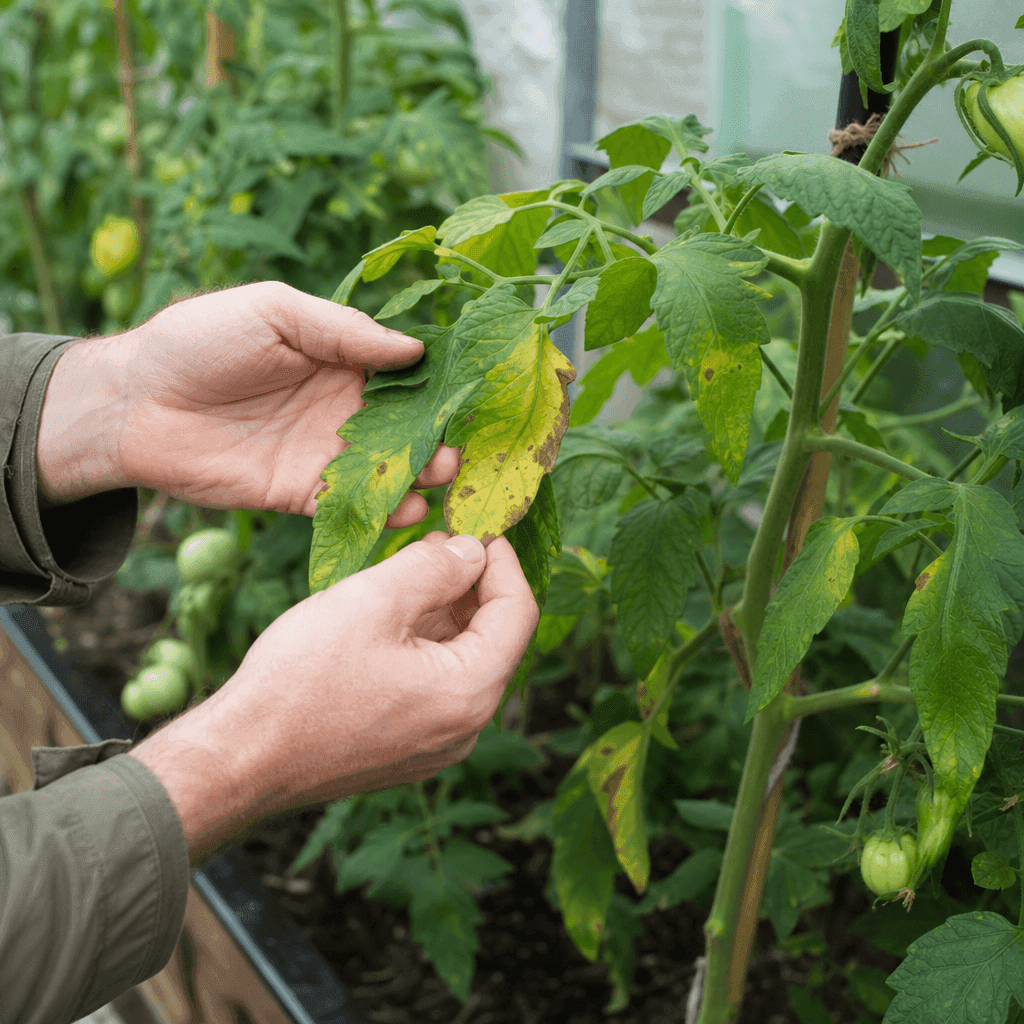
| Yellowing between the veins on older leaves; green veins remain visible | Magnesium deficiency | High | Interveinal yellowing starting on older (lower) leaves; plant otherwise growing normally; likely heavier-cropping plants in containers | Apply Epsom salts at 20g per litre as a foliar spray; ensure tomato feed contains magnesium | Low–medium |
| Leaves rolling upward or inward, especially on lower part of plant | Physiological leaf roll (not disease) | Medium | Rolled leaves remain green and firm; no spots or discolouration; often worse on warm days or after pinching out; plant is growing well | Usually no action needed — this is a normal stress response; ensure consistent watering and ventilation | Low |
| Fruits cracking or splitting, especially after dry periods followed by rain or heavy watering | Fruit splitting from irregular watering | Medium | Splits appear radially (from stalk) or circumferentially (around the equator); fruits were ripening when watering changed significantly | Water consistently; mulch the base; use a regular drip or consistent hand-watering schedule | Low |
| Tiny white flies rising from plants when disturbed; yellowing, sticky leaves | Glasshouse whitefly (Trialeurodes vaporariorum) | Medium | Clouds of tiny white flies; sticky honeydew on leaves; possible sooty mould; mainly greenhouse plants | Introduce parasitic wasp Encarsia formosa for biological control; use yellow sticky traps to monitor numbers | Medium |
The causes, in detail
Tomato blight (Phytophthora infestans)
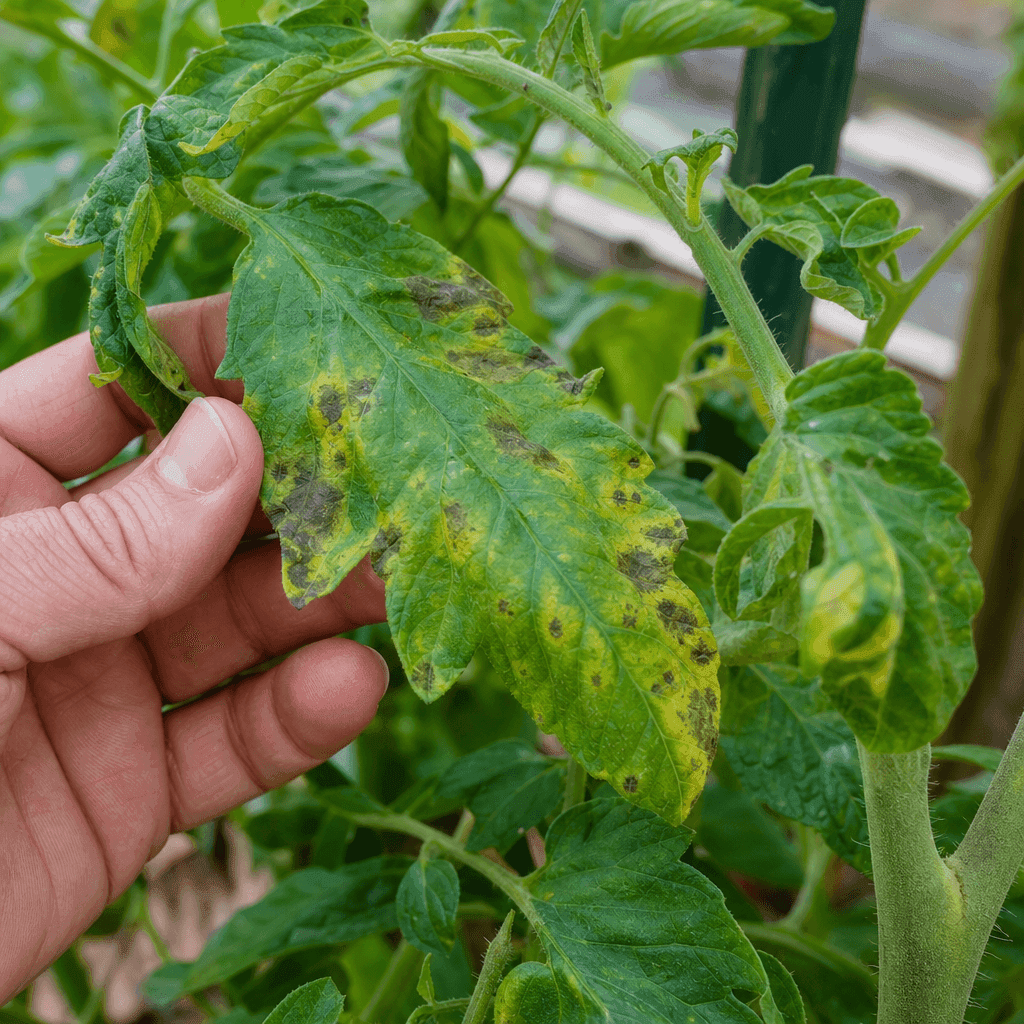
Most likelyTomato blight is caused by the same pathogen as potato late blight — Phytophthora infestans — and is the most destructive tomato disease for UK outdoor growers. The RHS notes that in some years it can cause almost total yield loss in susceptible cultivars grown outside. The initial symptom is rapidly spreading, watery rotting of leaves that collapse, shrivel and turn brown within days. In humid conditions, a fine white fungal growth is visible on the underside of infected leaves at the lesion edges. Blight risk is highest during the classic 'Smith Period' — two consecutive days of humidity above 90% at temperatures above 10°C.
- Dark, water-soaked patches that expand rapidly — within 24 to 48 hours.
- White or grey-white fungal growth on leaf undersides in humid weather.
- Brown, leathery rot developing on fruits.
- Outbreak follows warm (above 10°C), wet or very humid weather.
- Outdoor plants are far more vulnerable than well-ventilated greenhouse plants.
- Remove all blighted foliage immediately and bin it — do not compost infected material.
- If blight is widespread, cut down and remove all the haulm to reduce further spread to the fruit.
- Harvest any fruit showing the first sign of blight and allow to ripen indoors — some may still be usable.
- Check stored or ripening fruit regularly and remove any that start to show rot.
- Do not overhead water — water at soil level only.
- Next season, grow blight-tolerant varieties such as 'Ferline', 'Crimson Crush' or 'Koralik'.
Stop it coming back:There is no fully blight-proof outdoor tomato, but varieties bred for partial resistance significantly reduce losses. Plant in a sheltered, airy spot; stake and tie in plants promptly so air circulates; remove the lowest leaves touching the soil.
compost blighted foliage — Phytophthora spores survive in the compost heap and reinfect next year's crop. Always bin blighted material.
Tomato leaf mould (Fulvia fulva)
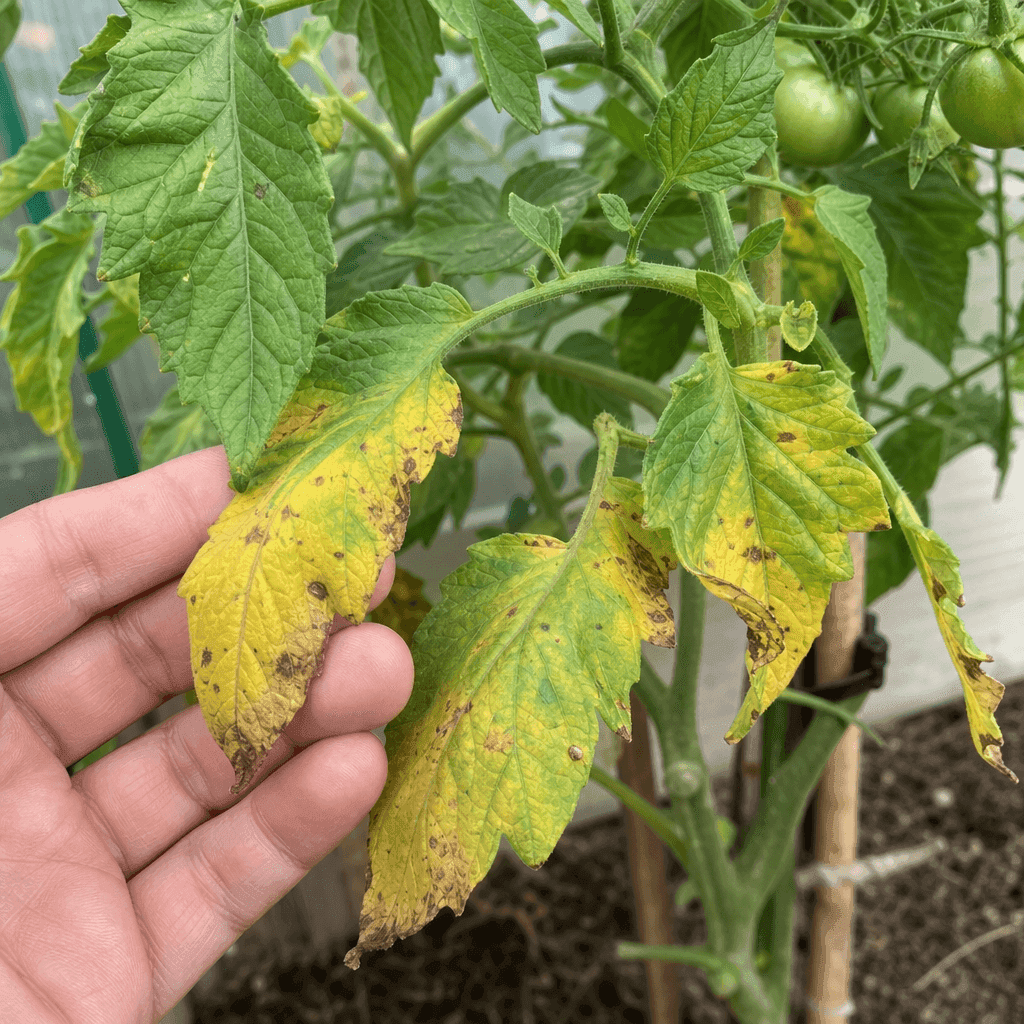
Most likelyTomato leaf mould is a fungal disease that mainly affects greenhouse-grown tomatoes — it is rarely seen on outdoor crops. The RHS notes it can develop rapidly to cause significant yield loss in poorly ventilated greenhouses. The distinctive symptom is pale yellow patches on the upper leaf surface with a corresponding velvety olive-brown or purple-brown mould on the underside. The disease spreads by spores in humid, still air. Warm greenhouses with high humidity and poor ventilation see the worst outbreaks.
- Pale, diffuse yellow patches on the upper leaf surface.
- Corresponding olive-green, brown or purplish velvety mould on the underside of the same patches.
- Plants are growing in a greenhouse or polytunnel with limited ventilation.
- Humidity inside the structure is consistently high.
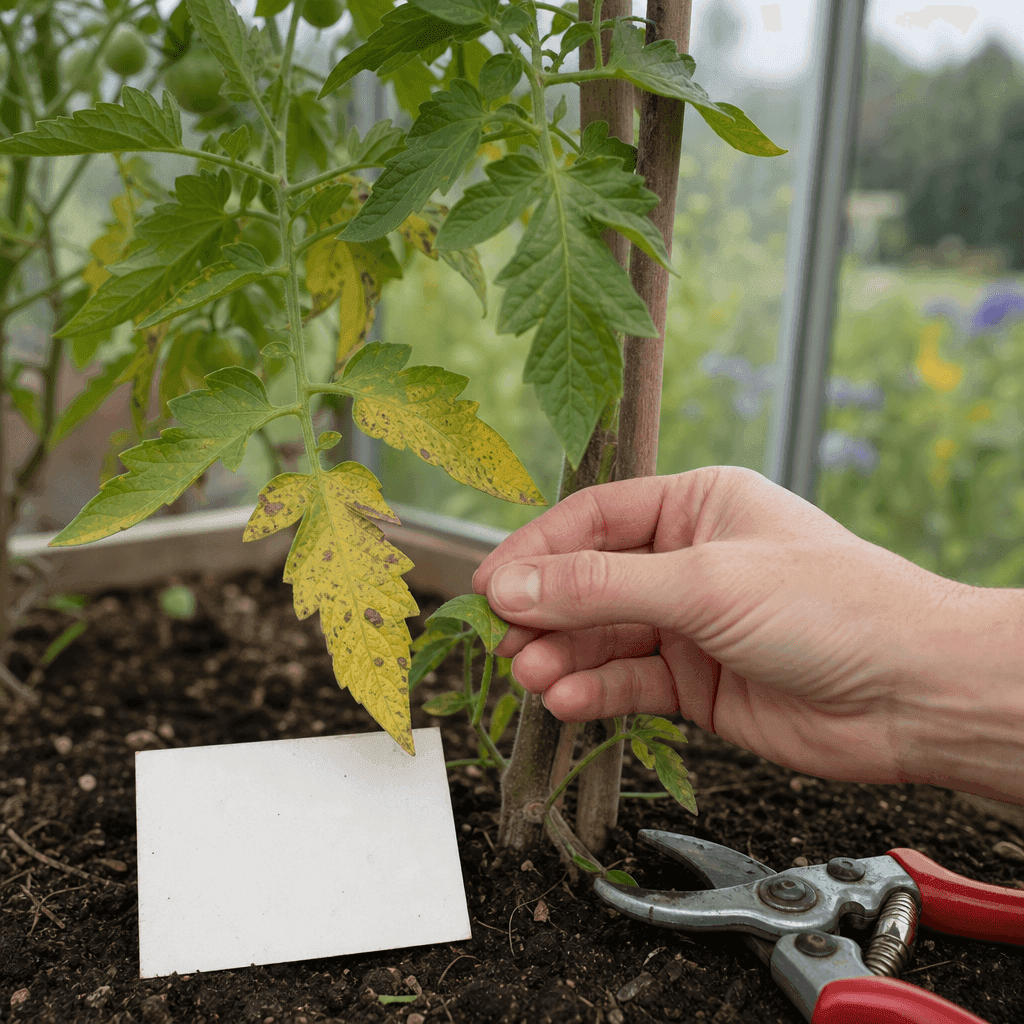
- Remove and bin all affected leaves immediately.
- Open vents, doors and windows to maximise airflow — this is the single most effective intervention.
- Avoid wetting foliage when watering; use drip irrigation or water carefully at the base.
- Space plants to allow air movement between them.
- Consider growing leaf mould-resistant varieties such as 'Ferline', 'Shirley' or 'Elegance'.
Stop it coming back:Ventilation is the key prevention measure. Even during cool or wet weather, maintain some airflow through the greenhouse. Leaf mould thrives in still, humid air above 20°C.
confuse leaf mould with blight — leaf mould is slow-progressing, mainly on greenhouse plants, and produces distinctive velvety mould on leaf undersides. Blight progresses much faster and also rots fruit.
Blossom end rot
Most likelyBlossom end rot appears as a dark, sunken, leathery patch at the blossom end (bottom) of the fruit. The RHS explains it is caused not by a calcium-deficient soil but by a failure of calcium to reach the developing fruit — often because irregular watering disrupts the water flow that carries calcium from roots to the distant fruits. It is most common on the first truss of the season, on plants grown in containers, and when a dry spell is followed by heavy watering. The plant is not diseased — subsequent trusses often develop normally once watering is regularised.
- Dark, sunken, circular patch at the blossom end (base, away from the stalk).
- The rest of the fruit may be unaffected and the plant looks healthy.
- Mainly affects the first fruits on the plant, or container-grown plants.
- Watering has been irregular — dry spells followed by excess watering.
- Improve watering consistency — water little and often rather than allowing the compost to dry then soaking.
- Mulch the base of outdoor plants to retain moisture and even out fluctuations.
- Ensure the tomato feed used contains calcium and magnesium (most proprietary tomato feeds do).
- Do not remove the plant — affected fruits can be discarded and subsequent trusses usually develop normally.
- For container plants, check that drainage is not excessive and increase watering frequency in warm weather.
Stop it coming back:For container-grown tomatoes, automated drip irrigation virtually eliminates blossom end rot. For border-grown plants, consistent hand-watering and mulching achieves the same result.
apply additional calcium spray (calcium chloride) as the first response — in most cases the issue is water uptake, not soil calcium levels. Fix the watering first.
Magnesium deficiency
Most likelyMagnesium deficiency is extremely common in UK tomato crops, particularly in container-grown plants that are fed regularly. The RHS notes that interveinal yellowing on older leaves is one of the most frequently observed nutrient problems on tomatoes. Tomato plants are heavy fruit producers and magnesium is mobilised from older leaves to support fruit development — this is a natural process that becomes a deficiency when soil or feed magnesium is insufficient. Regular tomato feeds help, but many do not contain enough magnesium, especially for heavily cropping plants.
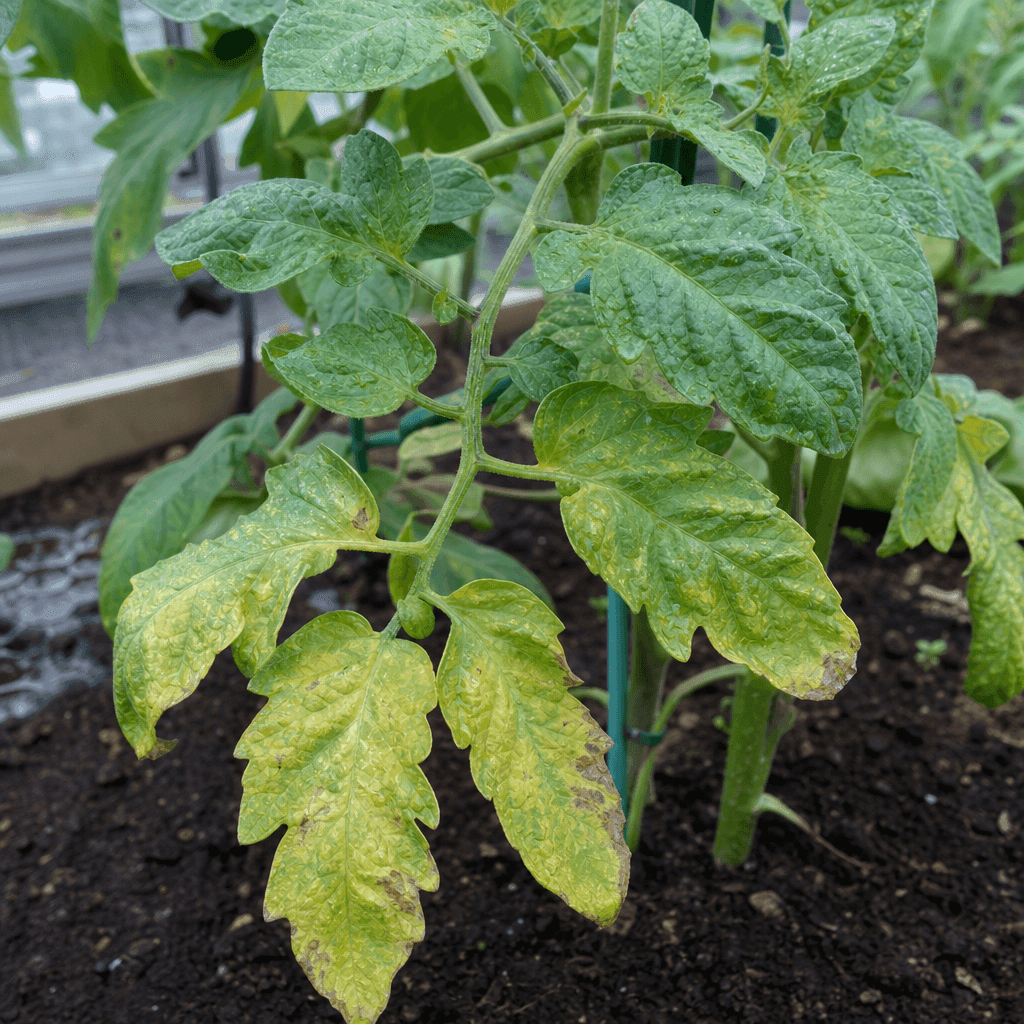
- Yellow discolouration between the green veins on older, lower leaves — the veins themselves remain green.
- Symptoms progress up the plant as the season continues.
- The plant is fruiting heavily.
- A standard tomato feed is being used but shows no improvement.
- Apply Epsom salts (magnesium sulphate) as a foliar spray — dissolve 20g per litre of water and spray onto affected leaves.
- Alternatively, water Epsom salts solution into the compost at 20–30g per 10 litres.
- Repeat every two to three weeks through the peak cropping season.
- Switch to a tomato feed that explicitly contains magnesium and trace elements.
Stop it coming back:Begin fortnightly Epsom salt sprays when the first truss of fruit sets, rather than waiting for symptoms to develop. This is particularly important for indeterminate (cordon) varieties grown in containers.
confuse magnesium deficiency with blight or leaf mould — magnesium deficiency causes slow yellowing between the veins on older leaves with no mould, no water-soaked patches and no rapid progression.
Physiological leaf roll
PossibleMany tomato growers mistake physiological leaf roll for a disease. The RHS notes that temperature fluctuation — warm days and cold nights — is the most common cause, especially in early summer. Leaves roll upward (primary leaflets curl inward towards the midrib) as a stress response. It can also follow heavy pruning (pinching out) or periods of very rapid growth. The rolled leaves remain green, firm and healthy — they are not yellowing, spotted or collapsing. The plant typically continues growing normally.
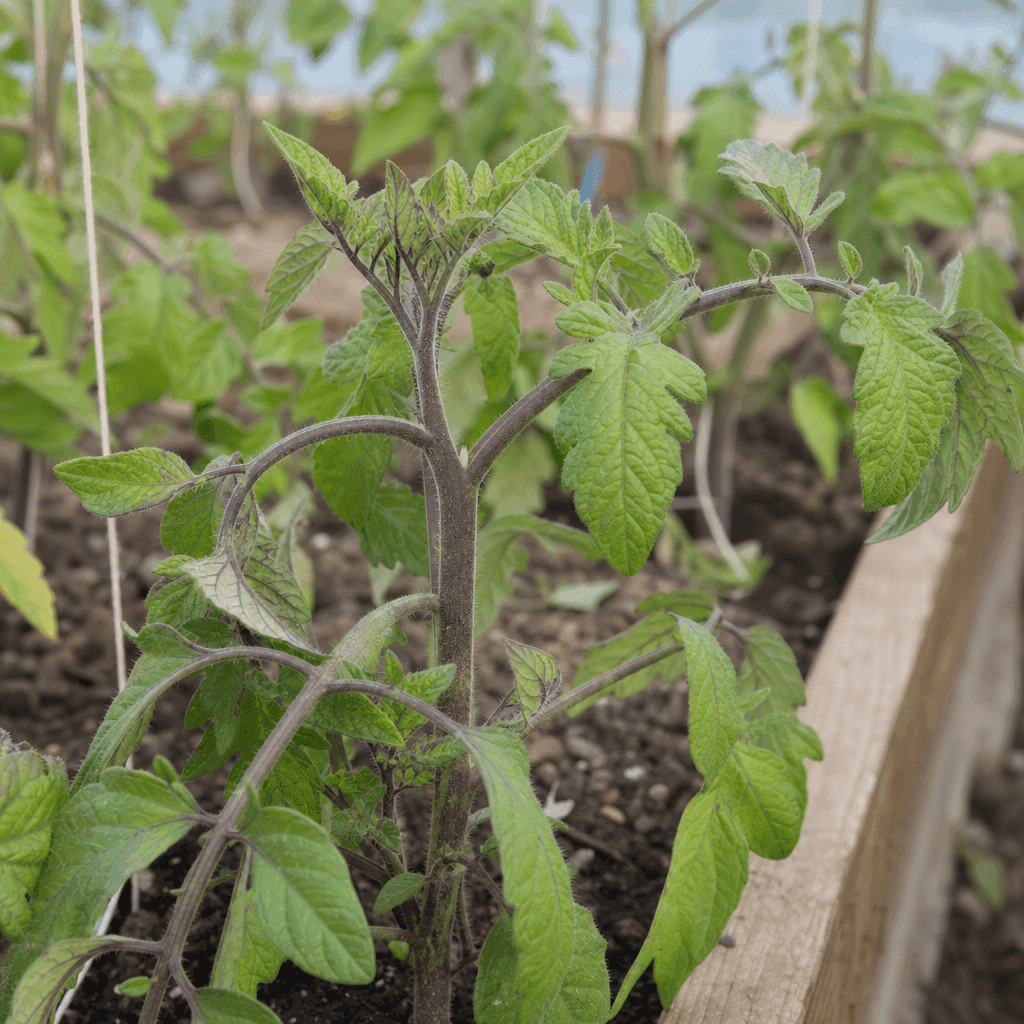
- Leaves roll upward or inward but remain fully green and firm.
- No spots, yellowing, mould or wilting.
- The plant is growing actively.
- Recent temperature swings, heavy pinching out, or very rapid growth.
- No treatment is required in most cases.
- Ensure consistent watering and avoid extreme fluctuations in temperature in greenhouses (ventilate on warm days).
- If leaf curl is severe and persistent alongside poor growth, check roots for waterlogging.
spray for disease or remove rolled leaves if physiological leaf roll is the cause — rolled, green, firm leaves are not diseased, and removing them reduces the plant's ability to ripen fruit.
Fruit splitting and cracking
PossibleTomato fruit splitting is caused by irregular water supply during the fruit ripening stage, as the RHS explains. When water uptake suddenly increases after a dry period — whether through rain, heavy irrigation, or moving a plant from dry to wet conditions — the inner flesh expands faster than the outer skin can accommodate. The result is radial splits from the stalk end, or circular 'concentric' cracks around the shoulder of the fruit. This is a physiological disorder, not a disease, and is common in UK outdoor crops in late summer when weather is unpredictable.
- Splits running from the stalk downward, or circular cracks around the shoulders.
- Occurred after a dry period followed by heavy rain or watering.
- Mainly affects ripening or near-ripe fruits.
- Indoor plants are less affected unless watering changed significantly.
- Water consistently and regularly — little and often is better than infrequent heavy soaking.
- Mulch the base of outdoor plants with 5–8cm of compost or straw to even out moisture fluctuations.
- Harvest fruits as soon as they are ripe to reduce the time at risk.
- Grow splitting-resistant varieties for next season — cherry types and 'Roma' style plum tomatoes tend to split less.
Stop it coming back:The RHS acknowledges that fruit splitting is difficult to prevent entirely in outdoor UK conditions because rainfall is out of the gardener's control. Consistent mulching and stake-and-tie management to keep plants upright are the most practical measures.
leave split fruits on the plant — they quickly rot and are at risk of secondary fungal infection. Harvest and use immediately or discard.
Glasshouse whitefly (Trialeurodes vaporariorum)
PossibleGlasshouse whitefly is one of the most troublesome pests of greenhouse tomatoes in the UK. The RHS notes that it is rarely a problem on outdoor tomatoes. The adults are tiny, white, moth-like insects that rise in clouds when the plant is disturbed. Both adults and nymphs feed by sucking sap from leaf undersides, causing yellowing, and excreting honeydew which encourages sooty mould. Populations build rapidly in warm greenhouses and can overwhelm a crop. Biological control using the parasitic wasp Encarsia formosa is the most effective management approach in greenhouses.
- Tiny white flies rise from the plant when touched.
- Sticky honeydew on leaf surfaces; possible sooty mould.
- Pale, yellowing leaves; slow growth.
- Plant is in a greenhouse or polytunnel.
- Introduce Encarsia formosa (parasitic wasp) as soon as the first whitefly is seen — it works best when populations are still low.
- Use yellow sticky traps to monitor adult populations.
- Remove badly infested lower leaves and dispose of them.
- Ensure ventilation is good to discourage the high temperatures whitefly prefer.
- If biological control is not available, use a pyrethrin-based spray in the evening as a last resort.
Stop it coming back:Introduce Encarsia formosa preventatively at planting time in the greenhouse — early biological control prevents populations from building to damaging levels. Available by mail order from biological control suppliers.
use broad-spectrum insecticides once Encarsia has been introduced — the parasitic wasp will be killed along with the whitefly, and the whitefly population will recover faster.
Still not sure?
Work down these branches — the first one that matches is your answer.
What not to do
- Compost blighted foliage or fruit — Phytophthora spores survive composting and can reinfect next season.
- Use broad-spectrum insecticides in the greenhouse if you have introduced biological controls.
- Water tomatoes on an irregular schedule — inconsistent moisture causes blossom end rot and fruit splitting.
- Ignore early signs of blight on outdoor crops — the disease spreads to fruit within days of leaf infection.
- Remove plants with blossom end rot — the condition usually self-corrects once watering is consistent.
Common questions
How do I know if my tomatoes have blight?
Blight causes dark, water-soaked patches that spread very fast — leaves can collapse within 48 hours in warm, humid conditions. A fine white fungal growth may be visible on the underside of infected leaves. It spreads rapidly in warm (above 10°C), wet weather. Leaf mould is slower and stays in the greenhouse; blight can hit outdoor crops in days.
What causes the dark patch on the bottom of my tomatoes?
This is blossom end rot — a dark, sunken, leathery patch at the base of the fruit opposite the stalk. It is caused by calcium failing to reach the developing fruit, usually because of irregular watering. It is not a disease and the plant does not need removing — correct the watering and subsequent fruits usually develop normally.
Why are my tomato leaves turning yellow?
The most common cause of yellowing on older, lower leaves is magnesium deficiency — the veins remain green while the tissue between them yellows. Apply Epsom salts (magnesium sulphate) as a foliar spray. Early blight, leaf mould and natural ageing of lower leaves can also cause yellowing, but these have different patterns.
How do I treat tomato leaf mould in a greenhouse?
Improve ventilation immediately — open all vents and doors during the day. Remove all affected leaves and bin them. Avoid wetting the foliage. In future seasons, grow leaf mould-resistant varieties such as 'Shirley', 'Elegance' or 'Ferline'.
Can tomatoes recover from blight?
If blight is caught very early and only a few leaves are affected, removing them promptly may save the plant and the fruit. But blight spreads fast — in warm, wet weather an outdoor plant can be destroyed within a week. If blight reaches the fruits they cannot be saved. Remove haulms and compost-bin them; harvest any firm green fruit to ripen indoors.
Why are my tomato fruits splitting?
Fruit splitting is caused by irregular water supply — a dry spell followed by heavy rain or watering causes the inner flesh to expand faster than the skin. Mulch the base and water consistently. Harvest fruits promptly when ripe to reduce the time at risk. Cherry tomatoes and plum varieties split less than large beefsteak types.
What is the best blight-resistant tomato variety for the UK?
The RHS and Which? Gardening recommend 'Ferline', 'Crimson Crush', 'Mountain Magic' and 'Koralik' (cherry type) as among the best blight-resistant outdoor tomatoes for UK conditions. No variety is completely immune, but these perform significantly better than susceptible types like 'Gardeners Delight' or 'Ailsa Craig' in wet seasons.
How do I control whitefly on greenhouse tomatoes?
The most effective control is biological: introduce the parasitic wasp Encarsia formosa as soon as the first whitefly is seen. Yellow sticky traps help monitor populations. Avoid broad-spectrum insecticides once Encarsia is in use — they destroy the biological control. Good greenhouse ventilation helps prevent populations building.