Quick diagnosis
Match the row to what you’re seeing, then jump to the fix.
| What you see | Likely cause | Confidence | How to confirm | What to do now | Urgency |
|---|---|---|---|---|---|
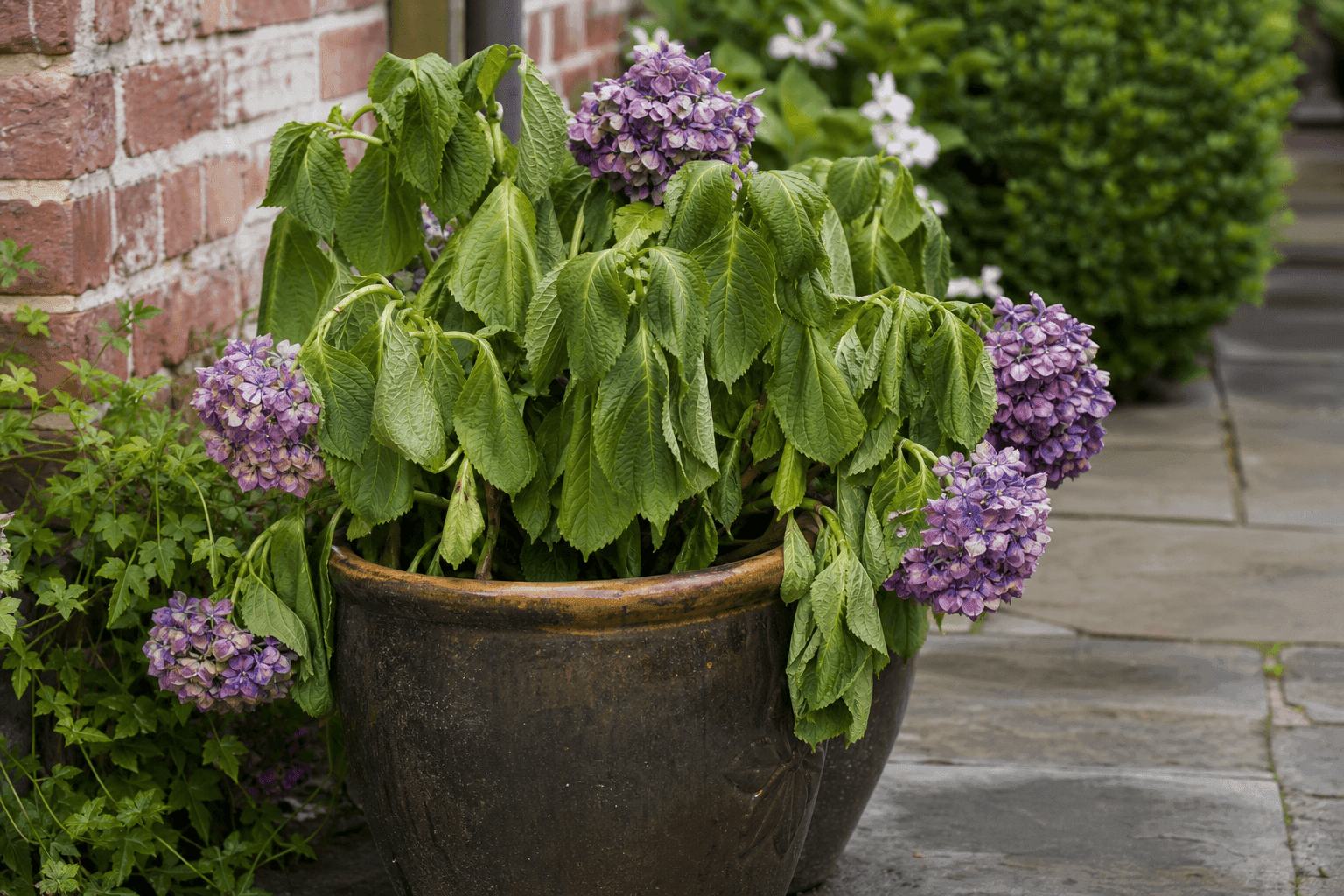
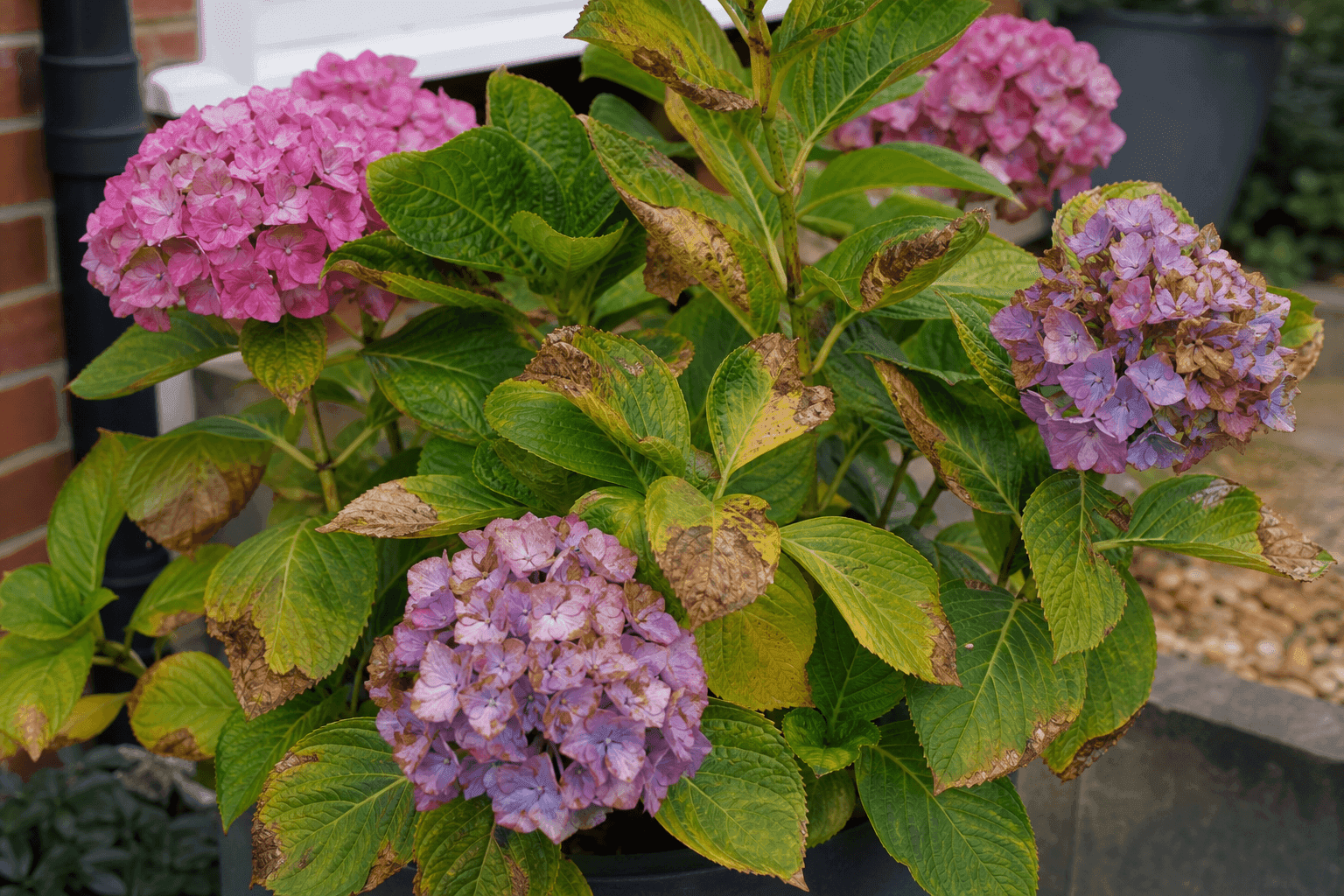
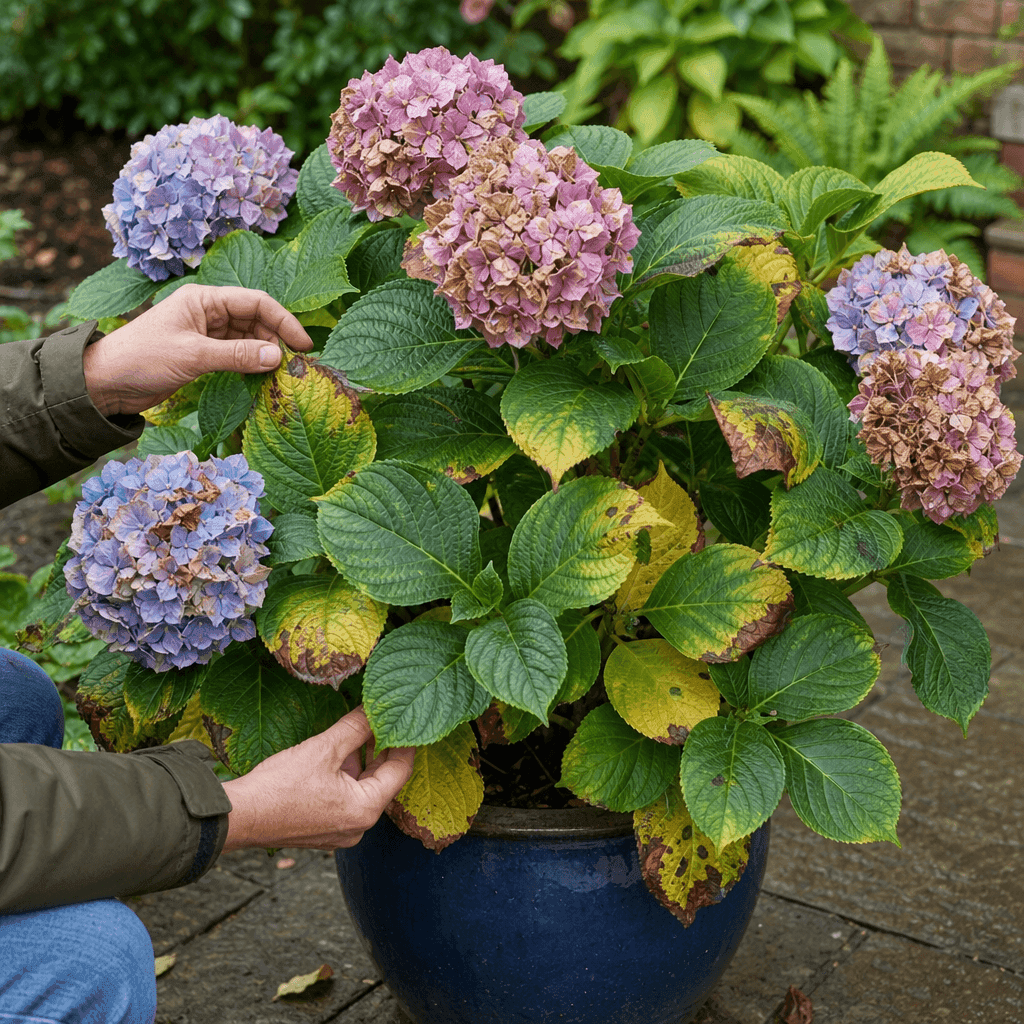
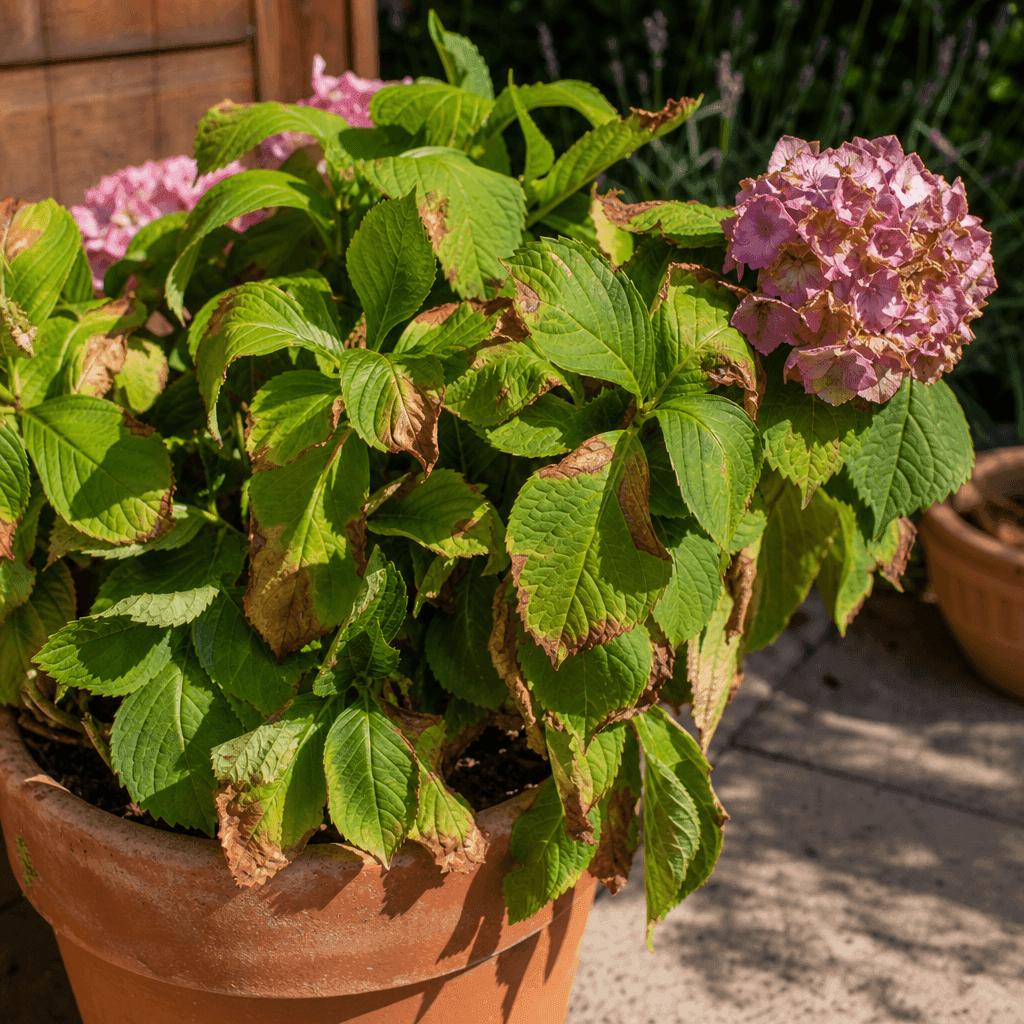
| Whole plant drooping, soil dry below the surface, pot feels light | Drought stress and underwatering | High | Soil dry at finger depth; plant perks up within a few hours of a thorough soak. | Deep-water the full root zone; mulch with organic matter; check daily in heat. | High |
| Healthy green leaves but no flowers, especially on mopheads or lacecaps | Wrong pruning time for the species | High | Plant was pruned in autumn or spring; it is a mophead (H. macrophylla) or lacecap. | Stop pruning mopheads and lacecaps in autumn/spring — they flower on old wood. | Low |
| White or grey powdery coating on upper leaf surfaces, sometimes curling | Powdery mildew | High | Powder rubs off with a finger; worst in dry, warm spells rather than wet weather. | Improve airflow; water consistently at the roots; remove worst affected shoots. | Low–medium |
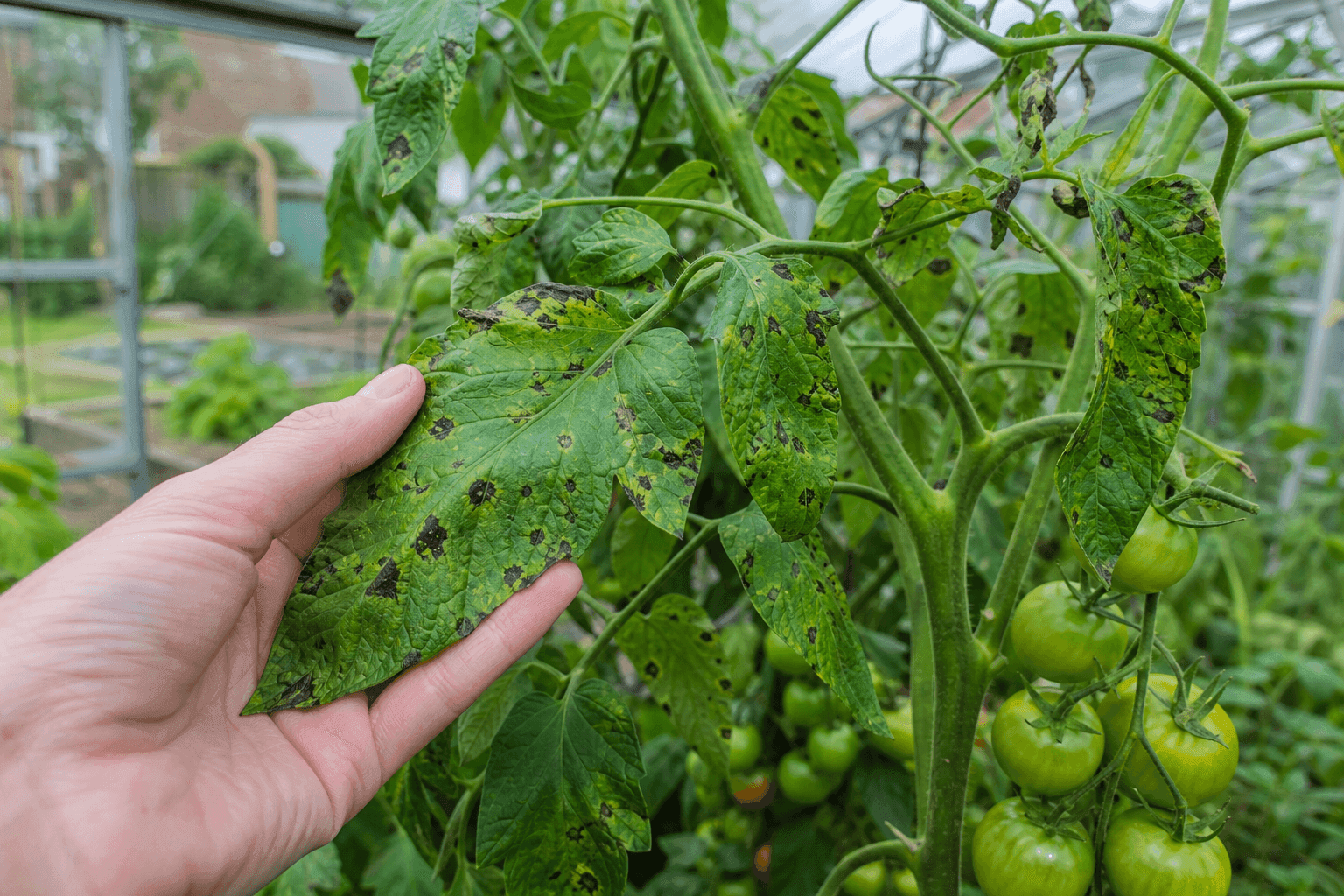
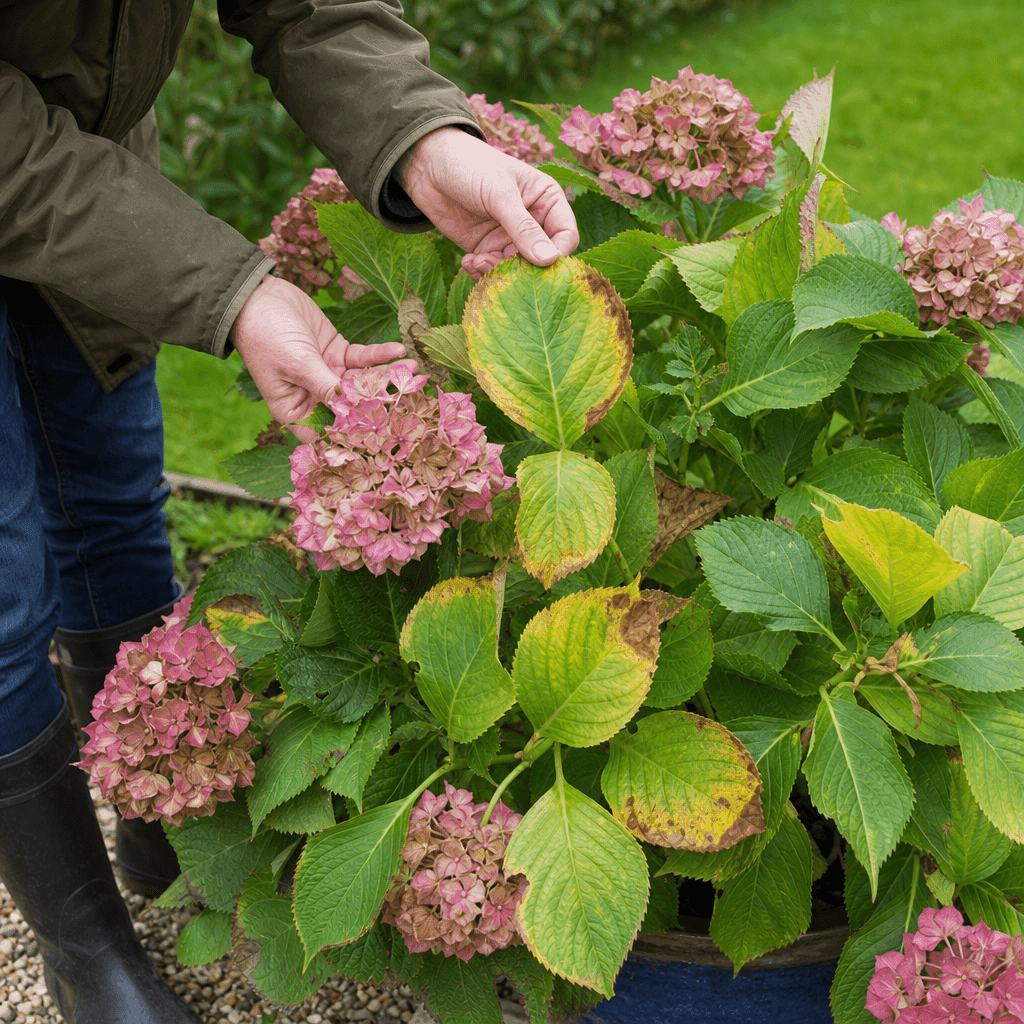
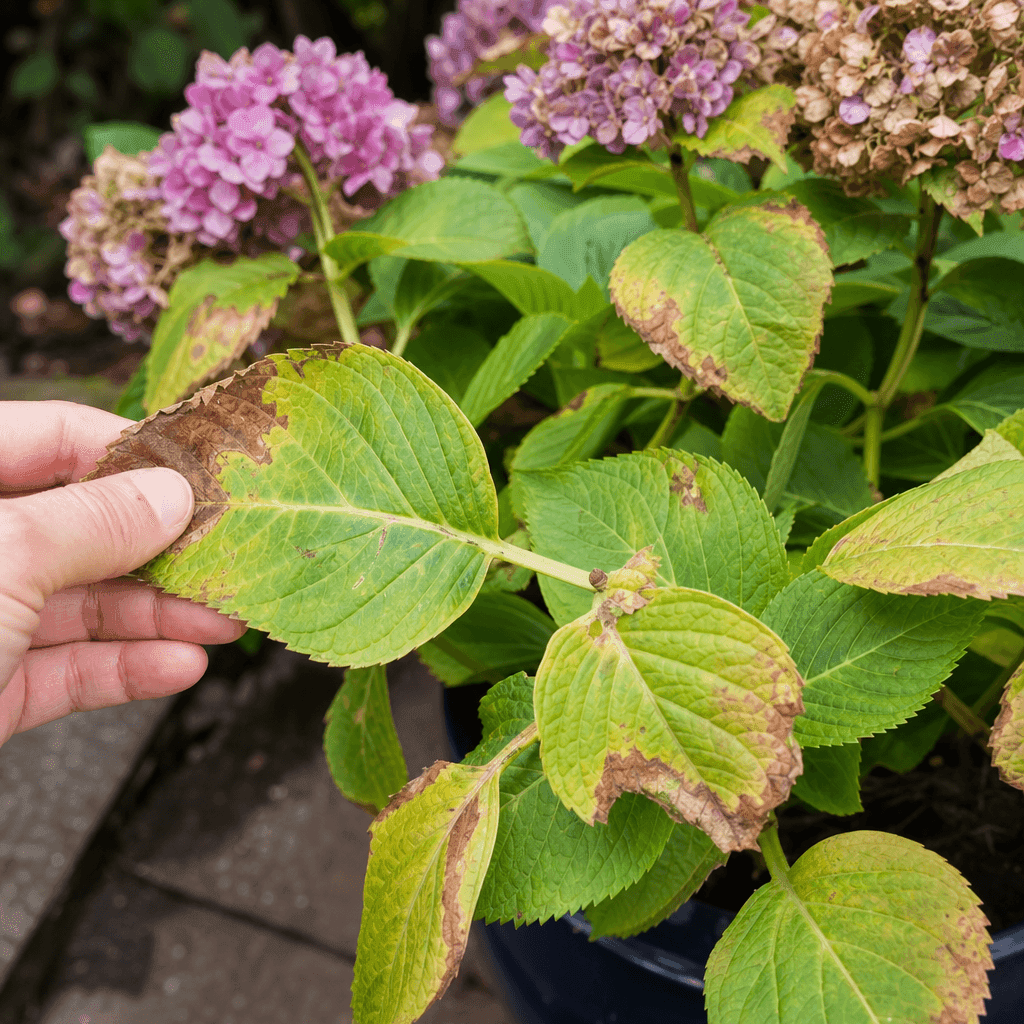
| Brown pockmarks and patches on flowers and leaves; grey fluffy mould in damp conditions | Botrytis (grey mould) | Medium | Fluffy grey mould visible in humid conditions; damage worse after cool, wet weather. | Improve ventilation; remove and bin affected flowers and leaves; avoid overhead watering. | Medium |
| White waxy flat blobs on stems and leaf undersides; sooty mould; weak growth | Hydrangea scale insects | Medium | White, waxy oval blobs fixed to stems — most visible in early summer; cannot be removed by wiping. | Remove badly infested stems; encourage natural predators; treat with suitable insecticide in crawler stage. | Medium |
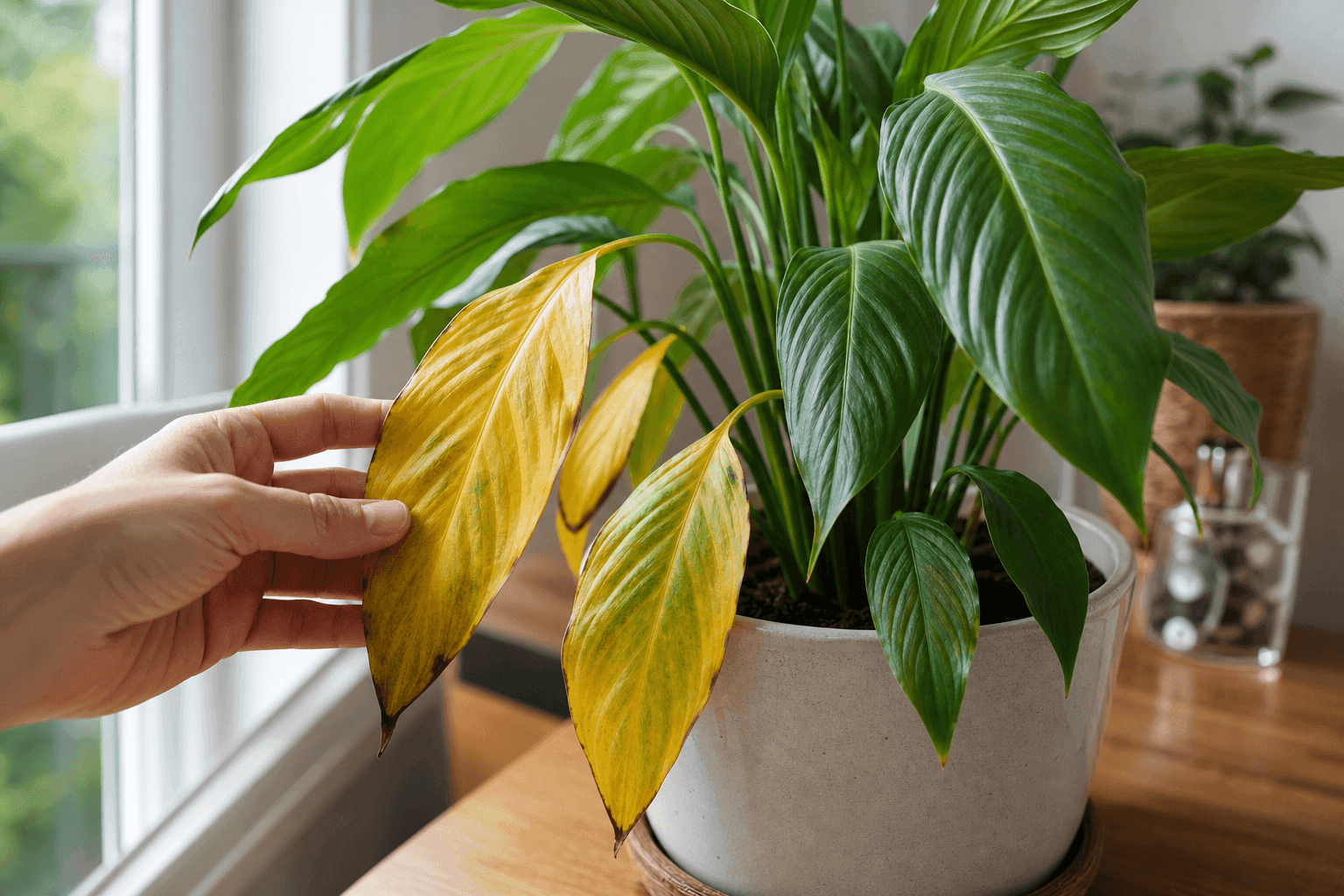
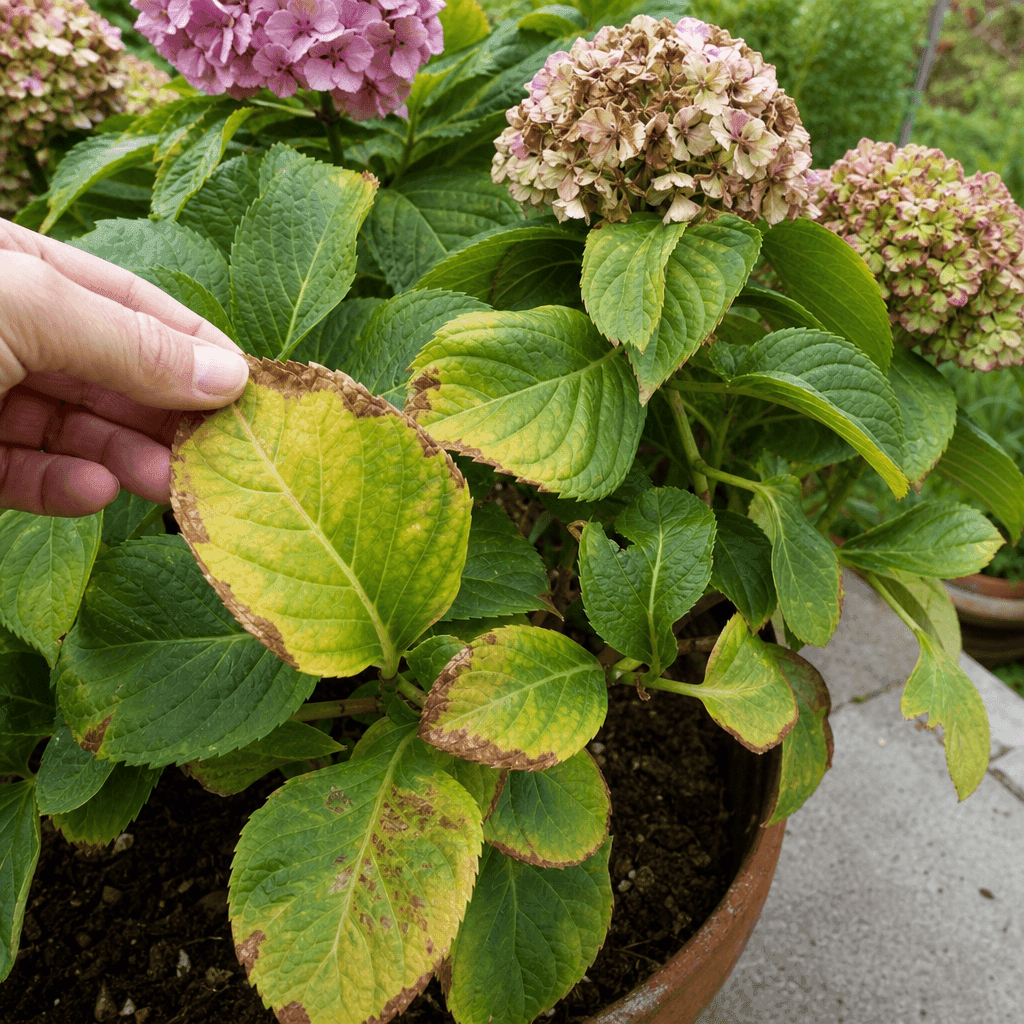
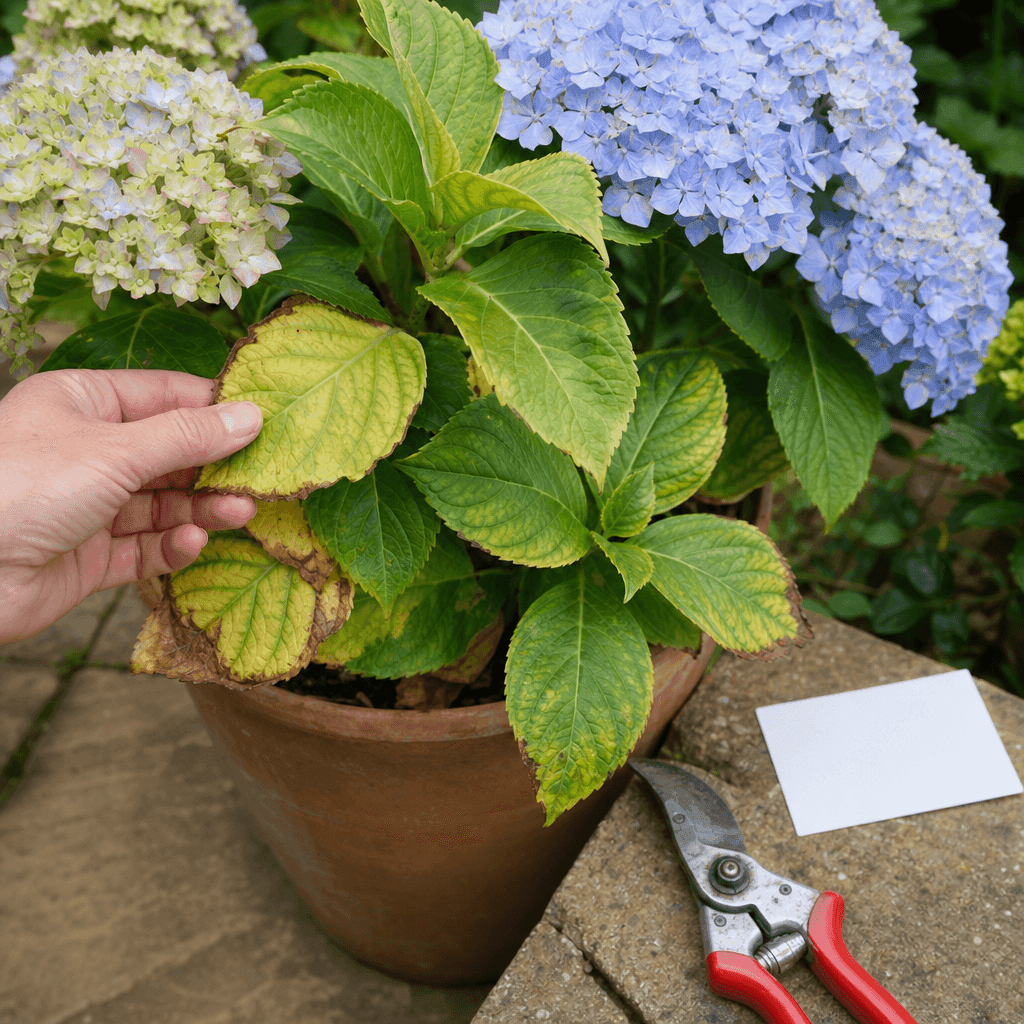
| Leaves yellowing between the veins; veins stay green; mainly on new leaves | Iron or manganese chlorosis | Medium | Interveinal yellowing on young leaves; plant is in alkaline soil or watered with hard tap water. | Apply sequestered iron; use ericaceous liquid feed; switch to rainwater in hard water areas. | Low–medium |
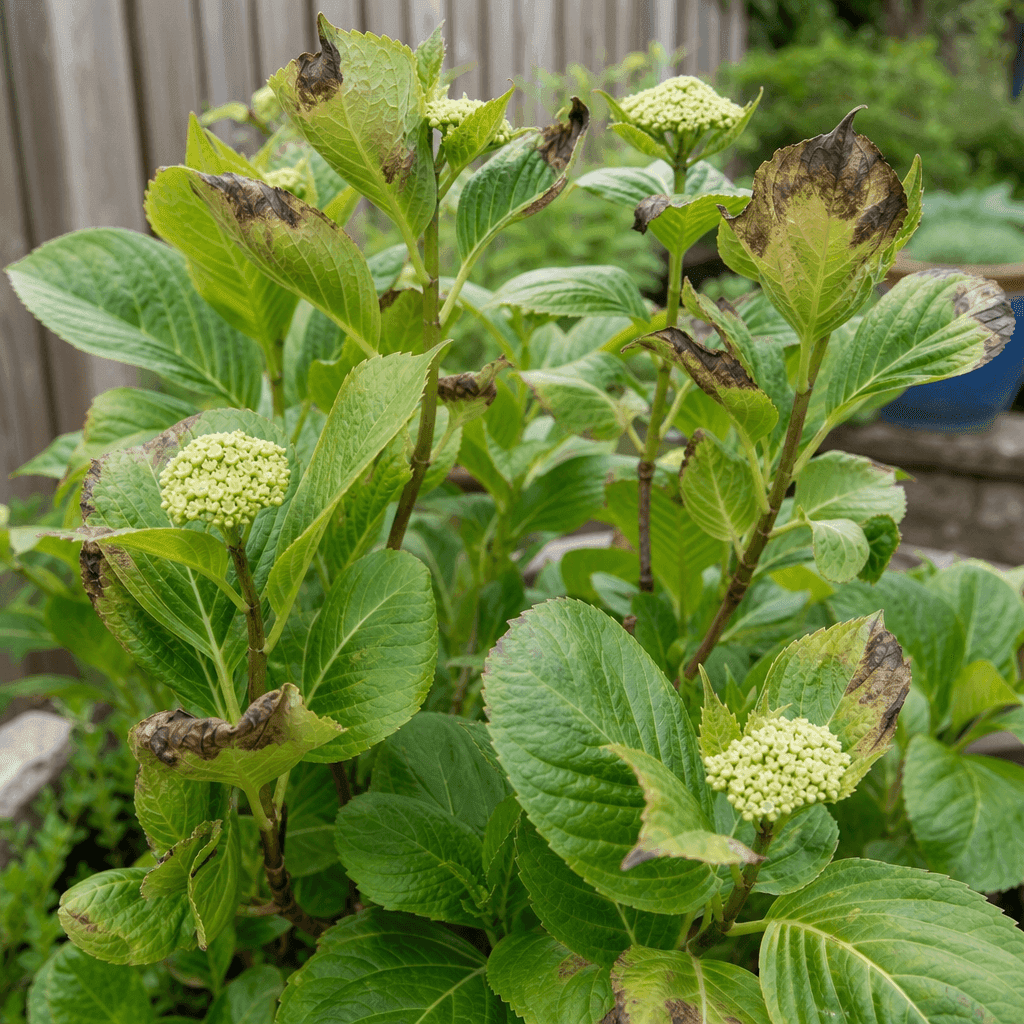
| New spring shoots blackened or wilted after a cold night | Frost damage | High | There was a recent frost; damage is on the soft new growth only. | Wait until frost risk passes; then cut blackened shoots to healthy buds. | Medium |
The causes, in detail
Drought stress and underwatering
Most likelyHydrangeas have large leaves that lose water rapidly in warm, windy or sunny conditions. The name itself means 'water vessel'. Drought wilt is the most common reason a UK hydrangea suddenly droops — it is particularly rapid in pots, grow bags, dry shade under trees, and against warm walls. Pyracantha.co.uk and Horticulture Magazine both note that wilting followed by leaf browning is most often a simple water problem, and that resolving it promptly usually prevents long-term damage.
- The soil is dry at finger depth below the surface.
- A potted plant feels very light when lifted.
- The compost has pulled away from the pot edge.
- The plant recovers noticeably within a few hours of a thorough watering.
- Water slowly at the base — soak the full root zone until it drains from the pot holes.
- Repeat the next day if the plant is still limp.
- Apply a 5 cm mulch of garden compost or bark to retain moisture.
- For potted plants, check daily in warm weather — containers dry out much faster than borders.
water automatically without checking the soil first — in wet soil, wilting has a different cause and more water makes it worse.
No flowers from wrong pruning
Most likelyThe most common reason a UK hydrangea produces lush leaves but no flowers is pruning at the wrong time. Mopheads (Hydrangea macrophylla) and lacecaps set their flower buds on the old wood they grew the previous summer — those buds sit on the stems through winter and open the following year. Pruning in autumn or spring removes them. The RHS pruning guide and Garden Ninja both explain that mopheads and lacecaps should be tidied in spring only by removing spent flowerheads and any dead or crossing wood, not cut back hard. H. paniculata and H. arborescens flower on this year's new growth and can be pruned in spring without losing flowers.
- The plant is a mophead or lacecap and was pruned hard in autumn or early spring.
- It produces healthy leafy growth but no flower buds form.
- Other hydrangeas nearby of the same type are also not flowering after being pruned similarly.
- In future, do not prune mopheads and lacecaps in autumn or hard in spring.
- Remove only the spent flowerheads (cutting to the first pair of healthy buds) in spring.
- Remove dead, damaged or crossing stems at the base only.
- If unsure of the variety, identify the species before pruning — H. paniculata and H. arborescens can take harder spring pruning.
Stop it coming back:A mophead or lacecap that was pruned at the wrong time will not flower that summer. It should flower the following year if left unpruned. Late frost and very exposed sites can also nip flower buds even on correctly pruned plants.
hard prune all hydrangeas in autumn — this removes next season's flower buds on old-wood varieties and may be unnecessary on most types.
Powdery mildew
Most likelyPowdery mildew on hydrangeas appears as a white or grey powdery coating on the upper surface of leaves and sometimes on shoots. Unlike most fungal diseases, it thrives in dry conditions with warm days and cool nights — according to Washington State University Extension, it is most prevalent when conditions are dry rather than wet. Drought-stressed hydrangeas are significantly more susceptible. The coating rubs off with a finger and can cause leaves to curl, brown and drop in severe cases.
- White or grey powdery patches on the upper leaf surface that can be rubbed off.
- Worse during dry spells and on plants that have been allowed to dry out at the roots.
- Most common on young growth.
- Improve watering consistency — drought stress is the primary trigger.
- Prune to improve airflow through the plant.
- Remove and bin badly affected shoots and leaves.
- Avoid high-nitrogen feeding that promotes soft, susceptible new growth.
assume mildew means the plant has been overwatered — powdery mildew thrives in dry conditions, so the fix is better watering, not less.
Botrytis grey mould
PossibleBotrytis cinerea (grey mould) causes brown pockmarks and patches on hydrangea flowers, buds and leaves, and in humid conditions produces a characteristic grey fluffy mould on the affected tissue. It thrives in cool, damp, still conditions — a particular risk for plants in sheltered spots, against walls, or in a crowded bed where air does not circulate. The University of Connecticut Extension notes that botrytis is encouraged by wounding, dead tissue, and poor airflow, and that infected flowers and leaves should be removed promptly.
- Brown spots or blotches on flowers and leaves, often water-soaked at first.
- Grey, fuzzy mould visible in humid conditions.
- Symptoms are worst after cool, damp weather or after flowers fade.
- Remove and bin all affected flowers and leaves immediately — do not compost.
- Improve airflow around the plant by reducing neighbouring planting or pruning crossing stems.
- Avoid wetting the flowers and leaves when watering — always water at the base.
- Space plants adequately when planting to allow air to circulate.
compost botrytis-affected material — the fungus can persist in home compost and reinfect plants.
Hydrangea scale insects
PossibleHydrangea scale (Pulvinaria hydrangeae) is a specific scale insect noted by the RHS as producing white, waxy, flat egg masses on stems and the undersides of leaves, most visible in early summer. The insects are sap-suckers and can cause loss of vigour, leaf drop, and — through honeydew production — encourage black sooty mould. The RHS describes the characteristic flat, white waxy blobs as sometimes being confused with disease symptoms. Plants in sheltered, south-facing positions with poor airflow are most at risk.
- White, waxy oval blobs are fixed to stems and cannot be wiped away easily.
- Sticky honeydew on leaves below affected stems.
- Black sooty mould may be present on lower leaves.
- Prune out heavily infested stems and bin them.
- Encourage natural predators — avoid insecticide use when beneficial insects are active.
- Apply a suitable systemic insecticide in late spring when the crawlers (mobile young) are active.
- Improve air circulation around the plant.
spray systemic insecticides when flowers are open — this harms pollinators. Treat in late spring before flowering or after flowering has finished.
Iron and manganese chlorosis
PossibleChlorosis — yellowing between the leaf veins with the veins themselves staying green — in hydrangeas is most often caused by iron or manganese deficiency linked to alkaline soil conditions or the build-up of calcium from hard tap water. Hydrangeas, especially Hydrangea macrophylla, prefer slightly acidic conditions. In alkaline conditions, even if iron and manganese are present in the soil, the plant cannot absorb them. Chlorosis is particularly common in the south-east, East Anglia and the East Midlands where hard water is prevalent.
- Yellowing is between the veins on new leaves, not the whole leaf.
- The plant is in chalky or clay soil, or has been watered with hard tap water for years.
- The plant is H. macrophylla or a lacecap rather than H. paniculata or H. arborescens.
- Apply a sequestered iron or chelated iron product following the label — this provides immediately available iron at any pH.
- Use an ericaceous liquid feed during the growing season.
- Mulch with acidic organic matter such as pine needles, composted bracken or ericaceous compost.
- In hard water areas, collect and use rainwater for watering.
- Avoid lime applications near susceptible plants.
add ordinary garden compost containing builders' rubble or lime-rich materials near a hydrangea — this can further raise the pH.
Frost damage on new spring growth
Most likelyIn the UK, a late frost in April or May can blacken the soft new growth of hydrangeas — including the flower buds that have swollen and begun to develop on old-wood varieties like mopheads and lacecaps. The RHS notes that while most hydrangeas are hardy across much of the UK, the flower buds of mopheads are particularly vulnerable once they begin to swell. In exposed gardens and frost pockets, this can be the primary reason for poor or absent flowering in some years.
- There was a recent frost or cold night (below 0°C).
- Damage is limited to the soft new growth — older, woodier stems are unaffected.
- Blackened or wilted tissue appeared suddenly overnight.
- Do not prune immediately if more frost is forecast.
- Once the risk has passed, cut blackened shoots back to healthy buds or live wood.
- Protect pot-grown hydrangeas by moving them to a sheltered spot, unheated greenhouse or cold frame when frost is forecast.
- In future, plant mopheads and lacecaps in a sheltered east or north-east facing position where morning sun does not thaw frozen tissue too quickly.
prune frost-damaged shoots while cold weather continues — wait until the risk has passed to avoid stimulating vulnerable new growth.
Still not sure?
Work down these branches — the first one that matches is your answer.
What not to do
- Prune mopheads or lacecaps hard in autumn — you will remove next year's flower buds.
- Assume wilting means underwatering without checking the soil — wet soil causes wilting too.
- Compost leaves or flowers affected by botrytis or scale insects.
- Spray insecticides when flowers are open — this kills pollinators.
- Apply lime or alkaline mulches near hydrangeas in hard water areas — chlorosis will worsen.
Common questions
Why is my hydrangea not flowering?
The most common reasons in the UK are pruning a mophead or lacecap at the wrong time (autumn or hard in spring, which removes flower buds set on last year's wood), a late frost that killed the flower buds in spring, or insufficient light. Identify the species before pruning — H. paniculata and H. arborescens can be pruned in spring; mopheads and lacecaps should not.
Why are my hydrangea leaves turning yellow?
Yellowing between the veins on new leaves points to iron or manganese chlorosis, usually caused by alkaline soil or hard tap water. General yellowing of older leaves may indicate natural ageing, overwatering or waterlogging. Check the soil moisture level and identify whether the pattern is on new or old growth.
What is the white powder on my hydrangea leaves?
It is almost certainly powdery mildew, a fungal disease that thrives in dry conditions. Unlike most fungal diseases, it is worst in dry spells rather than wet ones. The powder rubs off with a finger. Improve watering consistency and airflow to manage it.
Why does my hydrangea wilt even after I water it?
If the soil is wet when the plant is wilting, the cause is not drought but overwatering, waterlogging or root damage. Roots in oxygen-starved soil cannot transport water to the leaves, causing the same visual symptoms as drought. Check the soil is not waterlogged and that drainage holes are clear.
What are the white blobs on my hydrangea stems?
White, waxy flat blobs on the stems and undersides of leaves in early summer are almost certainly hydrangea scale (Pulvinaria hydrangeae). The RHS describes them as a distinctive pest of hydrangeas. Remove badly infested stems and treat with a suitable insecticide before or after flowering to avoid harming pollinators.
When should I prune hydrangeas in the UK?
It depends on the species. Mopheads (H. macrophylla) and lacecaps: tidy only in spring, removing old flowerheads down to the first pair of buds. H. paniculata: prune in early spring to encourage large flower heads. H. arborescens: cut back hard in early spring. H. petiolaris (climbing): minimal pruning only after flowering.
Can I save a hydrangea with frost damage?
Usually yes. Wait until the frost risk has passed, then cut blackened shoots back to healthy buds or live wood. Most hydrangea roots and woody stems survive even if the soft new growth is killed. H. paniculata and H. arborescens are especially forgiving as they flower on new growth produced that year.