Quick diagnosis
Match the row to what you’re seeing, then jump to the fix.
| What you see | Likely cause | Confidence | How to confirm | What to do now | Urgency |
|---|---|---|---|---|---|
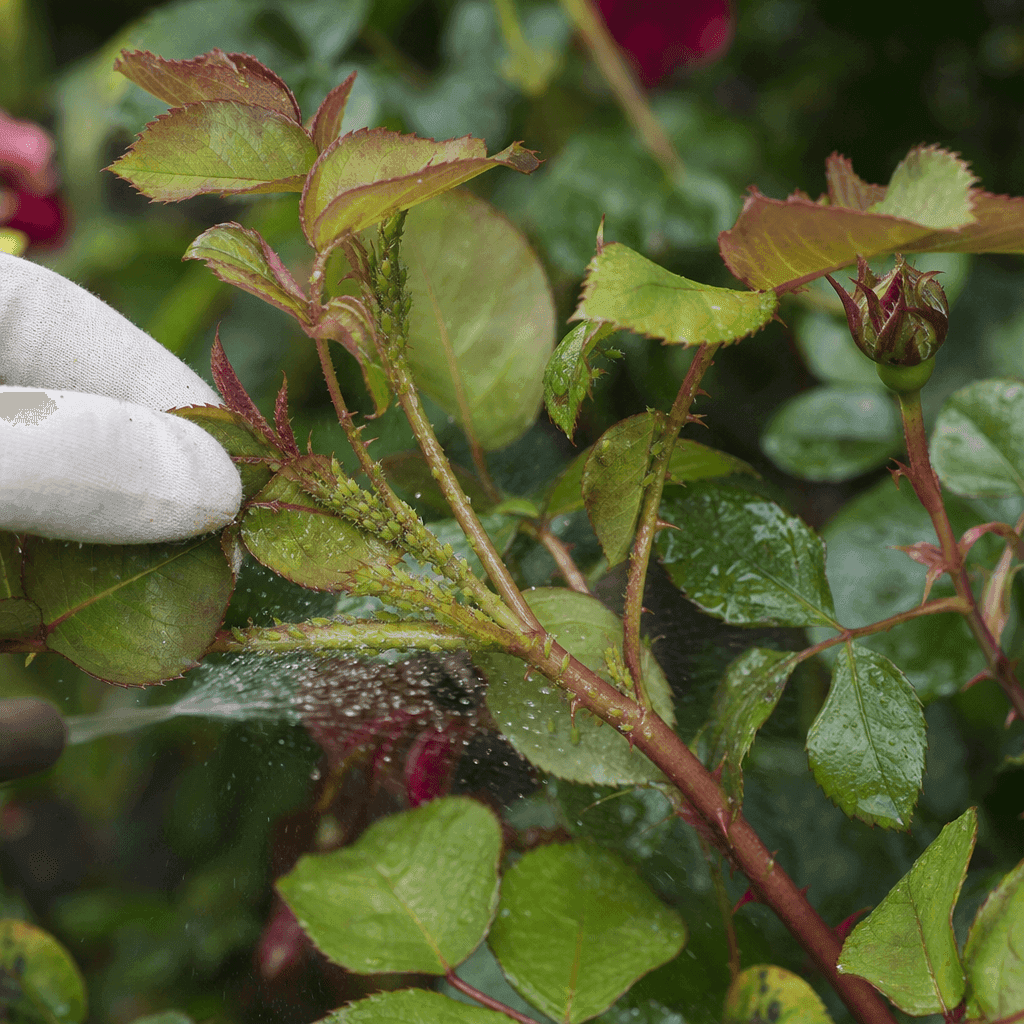
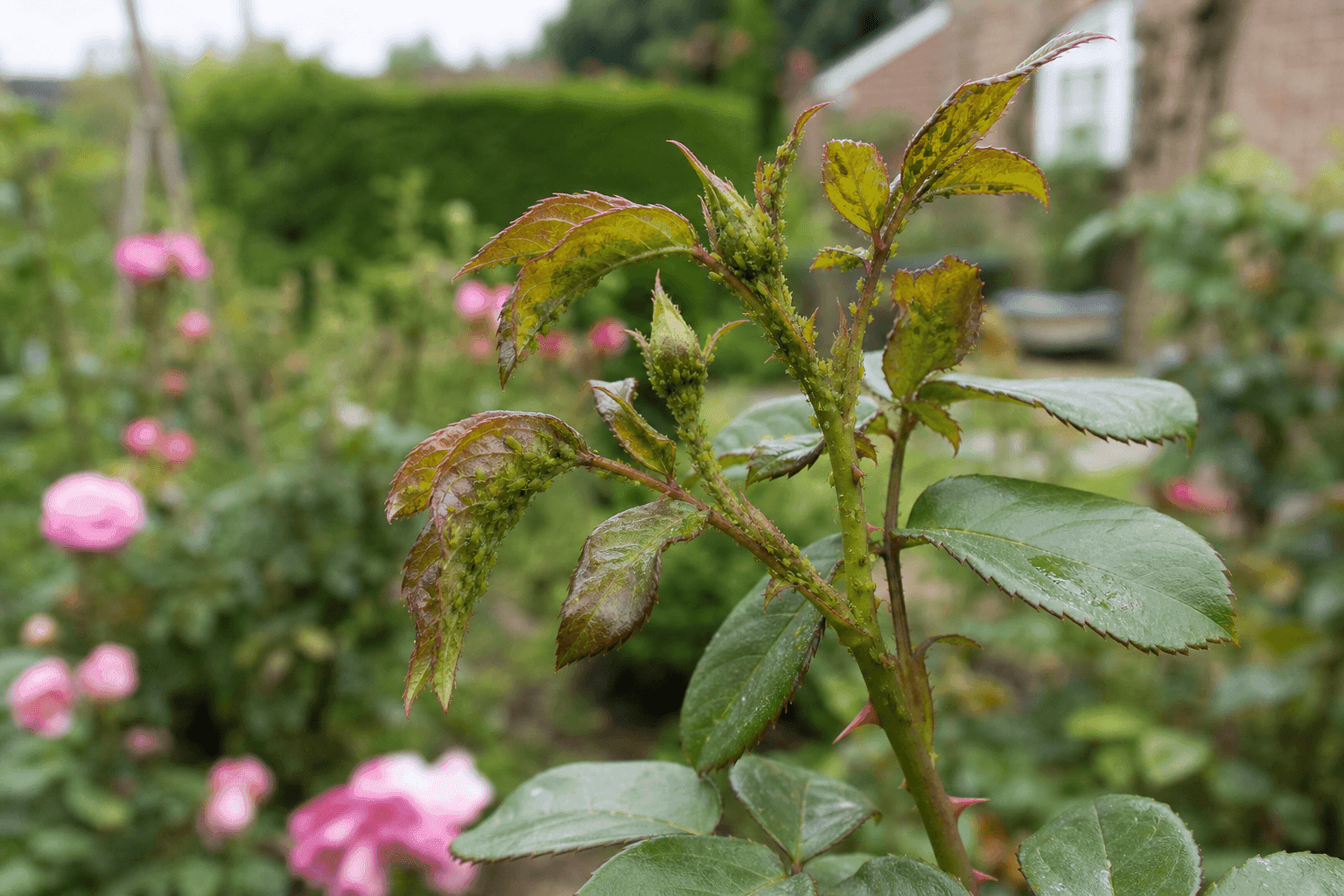
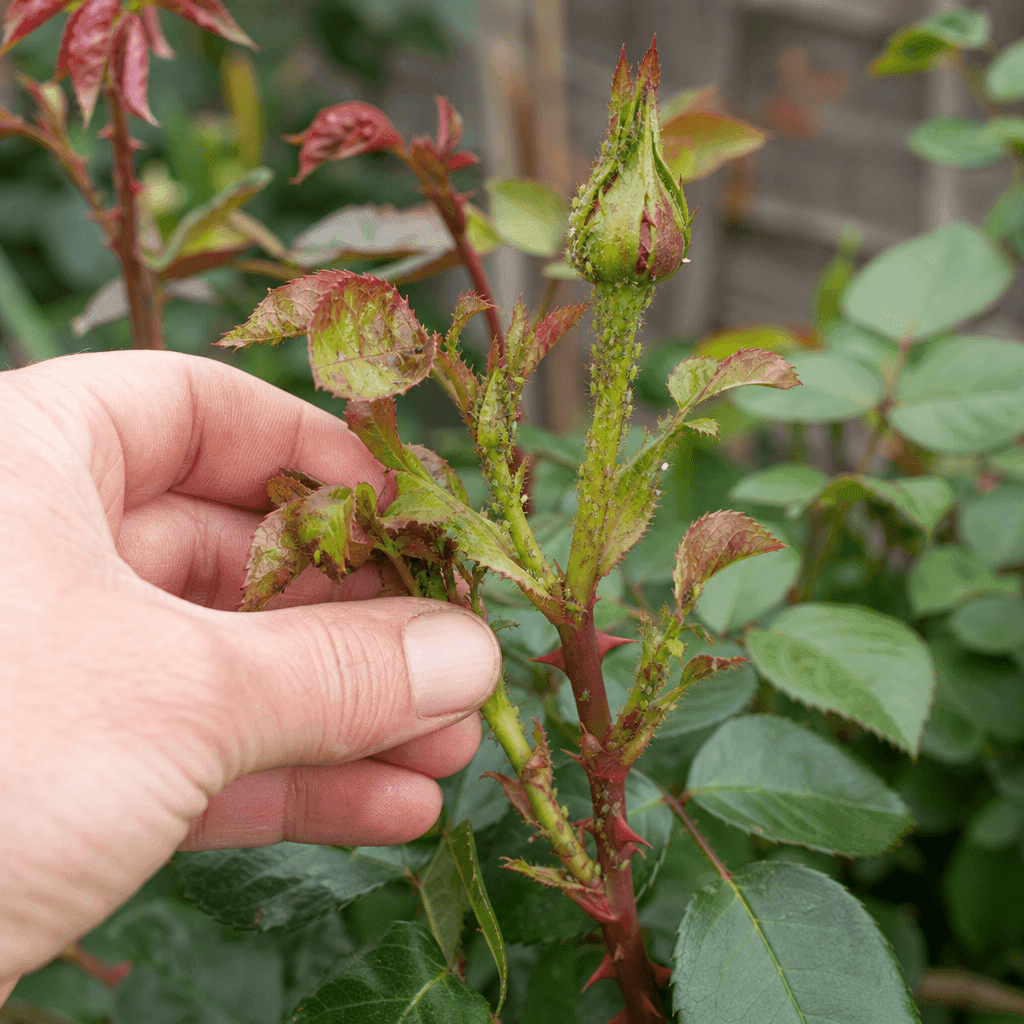
| Clusters of green, pink or brown soft insects on buds and shoot tips | Rose aphids (Macrosiphum rosae) | High | Insects are pear-shaped, slow-moving and squash easily; white cast skins nearby | Squash by hand or wash off with a firm jet of water; repeat every few days | Medium |
| Sticky leaves, shiny or sticky buds, ants patrolling the stems | Aphid honeydew attracting ants | High | Aphid colonies are present above the sticky area; black sooty mould may be developing | Control aphids first; rinse honeydew off with water; disrupt ant trails | Medium |
| Shoot tips distorted, buds curled or failing to open properly | Heavy aphid feeding damage | High | Dense colonies visible on the softest new growth and developing buds | Remove worst tips; use an insecticidal soap labelled for ornamentals if needed; spray in the evening | High |
| Aphid colonies alongside ladybird larvae, hoverfly larvae or lacewings | Natural predator control already active | High | Predatory larvae (alligator-like ladybird larvae, pale hoverfly larvae) are feeding in the colony | Avoid spraying; remove aphids by hand only where damage is unacceptable | Low |
| Fine pale stippling across the leaf surface; dusty appearance; thin webbing underneath | Spider mites (not aphids) | Medium | No visible clusters; webbing on undersides; worst in hot, dry, sheltered sites | Increase humidity around plant; wash leaf undersides with water; avoid broad insecticides | Medium |
| Brown, grey or white shell-like bumps fixed to stems and leaf ribs | Scale insects (not aphids) | Medium | Bumps do not move and do not squash like aphids; honeydew may be present below | Prune heavily infested stems; rub off light infestations with a damp cloth | Medium |
| Circular purple-black spots embedded in leaf tissue with yellow halos; no insect clusters | Rose black spot disease (not aphids) | Medium | Spots are flat and embedded — they cannot be wiped away; no pest colonies present | Remove and bin affected leaves; water at the base only; improve hygiene | Medium |
| White papery cast skins on new growth with no live insects visible | Recent aphid moult — colony likely still present | High | Live aphids are almost certainly still nearby on shoot tips or undersides | Search shoot tips and bud undersides for active colony; treat as for aphids | Low–medium |
The causes, in detail
Rose aphids — Macrosiphum rosae
Most likelyThe common rose aphid, Macrosiphum rosae, is the primary aphid species on UK roses and can reach 3.5 mm in length. The RHS describes it as a major pest of roses, forming dense colonies on shoot tips, flower buds and young leaves from April onwards. Colour varies from pink-red to pale green, often with a dark stripe. Winged forms spread the infestation. Cast white skins, sticky honeydew and ants farming the colony are reliable secondary signs. Aphids are among the most common garden pests across all plants, and a light infestation on a healthy rose is not urgent — natural predators including ladybird adults and larvae, hoverfly larvae, lacewing larvae and parasitic wasps often control colonies before significant damage occurs.
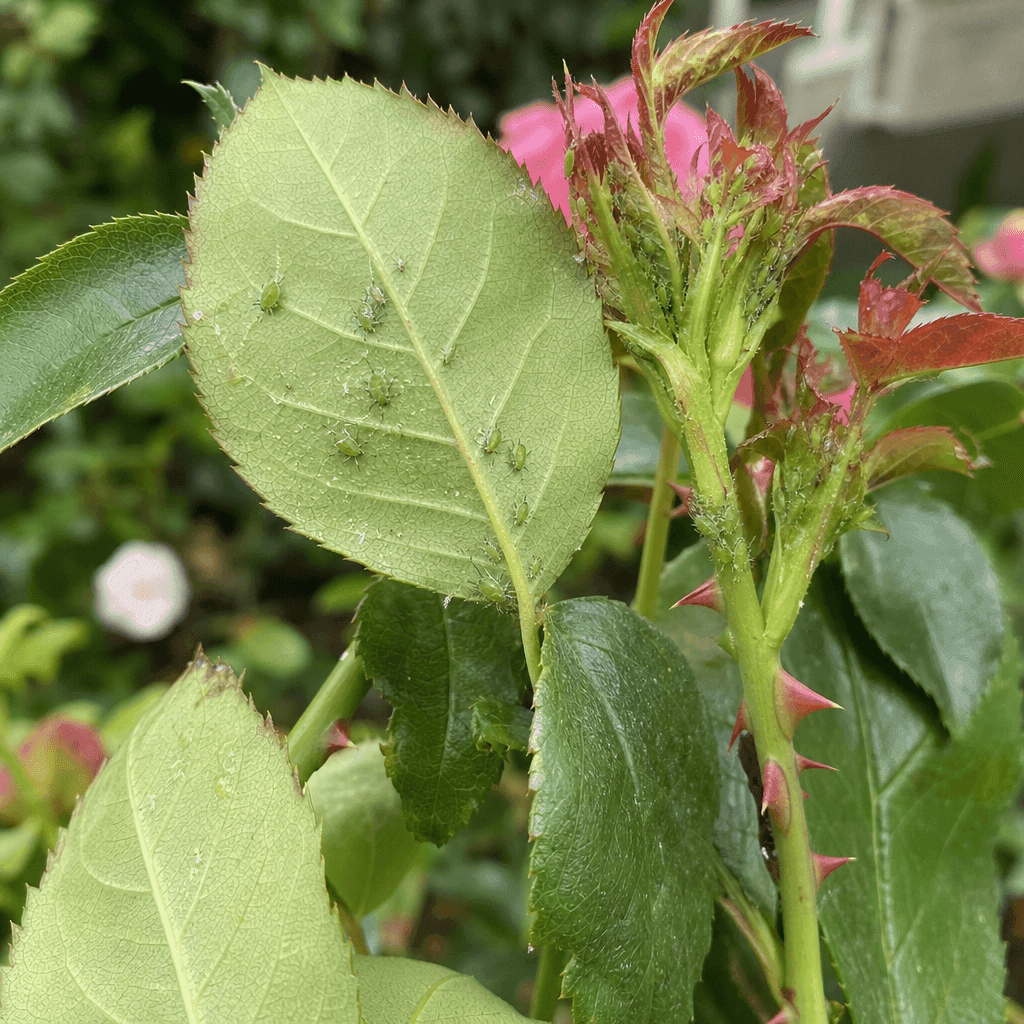
- Look at the softest new growth — aphids gather in groups and move slowly if disturbed.
- They are pear-shaped, soft-bodied and squash easily between finger and thumb.
- White cast skins around the colony are the remains of moults.
- Ants on the stems often indicate they are farming an aphid colony below for honeydew.
- Check undersides of young leaves as well as buds and shoot tips.
- For light infestations, run fingers along shoot tips and squash colonies, or use a firm jet of water from a hose — direct it upward at the undersides of shoots.
- Repeat every two to three days while new growth is still soft and the colony is active.
- Remove only the worst distorted growing tips if the rose can lose them without detriment.
- Grow companion plants nearby — single-flowered hardy annuals such as phacelia, limnanthes and pot marigold attract hoverflies whose larvae are effective aphid predators.
- If damage is heavy and natural predators have not arrived, use an insecticidal soap or fatty-acid spray labelled for ornamental plants, spraying in the evening to avoid foraging bees and covering the undersides of shoots.
Stop it coming back:An aphid-infested rose can look clean within one to two weeks once predators arrive and new growth hardens. Distorted leaves and buds will not fully straighten, but they can be pruned away after flowering.
use a broad-spectrum insecticide at the first sign of aphids — it kills the ladybirds, hoverflies and parasitic wasps that naturally suppress aphid populations, often causing a worse rebound infestation. Do not use washing-up liquid as a spray — it is a detergent that can scorch rose foliage.
Honeydew, ants and black sooty mould
Most likelyRose aphids excrete large quantities of sugary honeydew, which makes leaves and buds feel sticky and attracts ants. Ants actively protect aphid colonies from predators — disturbing ant trails reduces predator effectiveness. Over time, the black sooty mould fungus grows on honeydew deposits, making leaves look dirty. Other sap-suckers such as whitefly on roses produce honeydew in the same way, so confirm the culprit before treating. Sooty mould is primarily cosmetic and does not penetrate the leaf, but a heavy coating reduces photosynthesis. It is a symptom, not the primary problem.
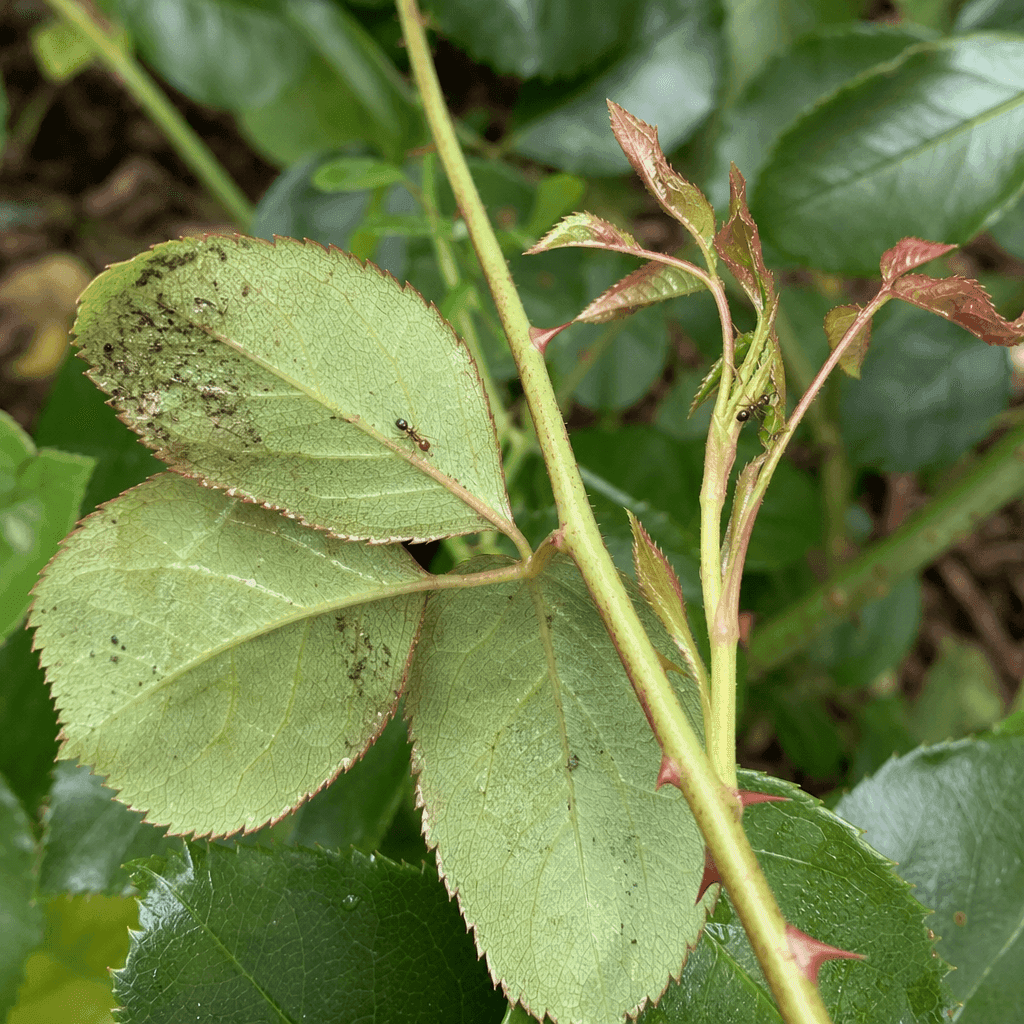
- Wipe a blackened area with a damp cloth — sooty mould smears or comes away, unlike rose black spot.
- Look above the sticky area for aphid or scale insect colonies.
- Black embedded circular spots on leaves are more likely a disease (rose black spot) than sooty mould.
- Control the aphids or scale insects first — sooty mould and honeydew resolve once the source is removed.
- Rinse leaves with clean water to remove honeydew and loose sooty mould.
- Disrupt ant trails with a sticky barrier on the rose stem or water — this allows predators to reach the aphid colony.
- Prune out badly congested or infested growth to improve airflow and access for predators.
treat sooty mould as a primary fungal disease — it is a consequence of sap-sucking insects, and fungicide is not the solution. Remove the aphids or scale first.
Heavy aphid feeding and distorted growth
Most likelyA large aphid colony on soft shoot tips injects saliva and extracts sap continuously, causing the growing tissue to distort. Young leaves curl, fail to expand properly, and buds may not open cleanly. This is distinct from the more patchy distortion of virus-infected roses. The damage is most obvious in May and June when rose growth is at its fastest and most vulnerable. Once the colony is controlled and growth hardens, new shoots produced after the infestation will look normal.
- Visible aphid colonies on the softest growth.
- Shoot tips curl inward and leaves are puckered or misshapen.
- Buds are sticky and some fail to open or are distorted inside.
- Remove the worst distorted tips if the rose can spare them — cut to a healthy bud below the affected section.
- Wash remaining colonies off with a firm jet of water.
- Where necessary, use an insecticidal soap or fatty-acid spray labelled for ornamental roses, applied in the evening.
- Encourage natural predators — avoid any pesticide if ladybird or hoverfly larvae are present.
assume all shoot distortion is aphid feeding — check for virus symptoms (mosaic mottling, unusual leaf shape even on clean young growth) before treating.
Spider mites on roses
PossibleGlasshouse red spider mite (Tetranychus urticae) causes fine pale stippling across the leaf surface that is easily mistaken for aphid damage from a distance. On closer inspection — and with a hand lens — tiny mites (less than 1 mm) and their fine webbing are visible on the undersides of leaves. Spider mites thrive in hot, dry, sheltered conditions: against south-facing walls, on patio plants and in greenhouses. They are a very different pest from aphids and do not respond to the same controls.
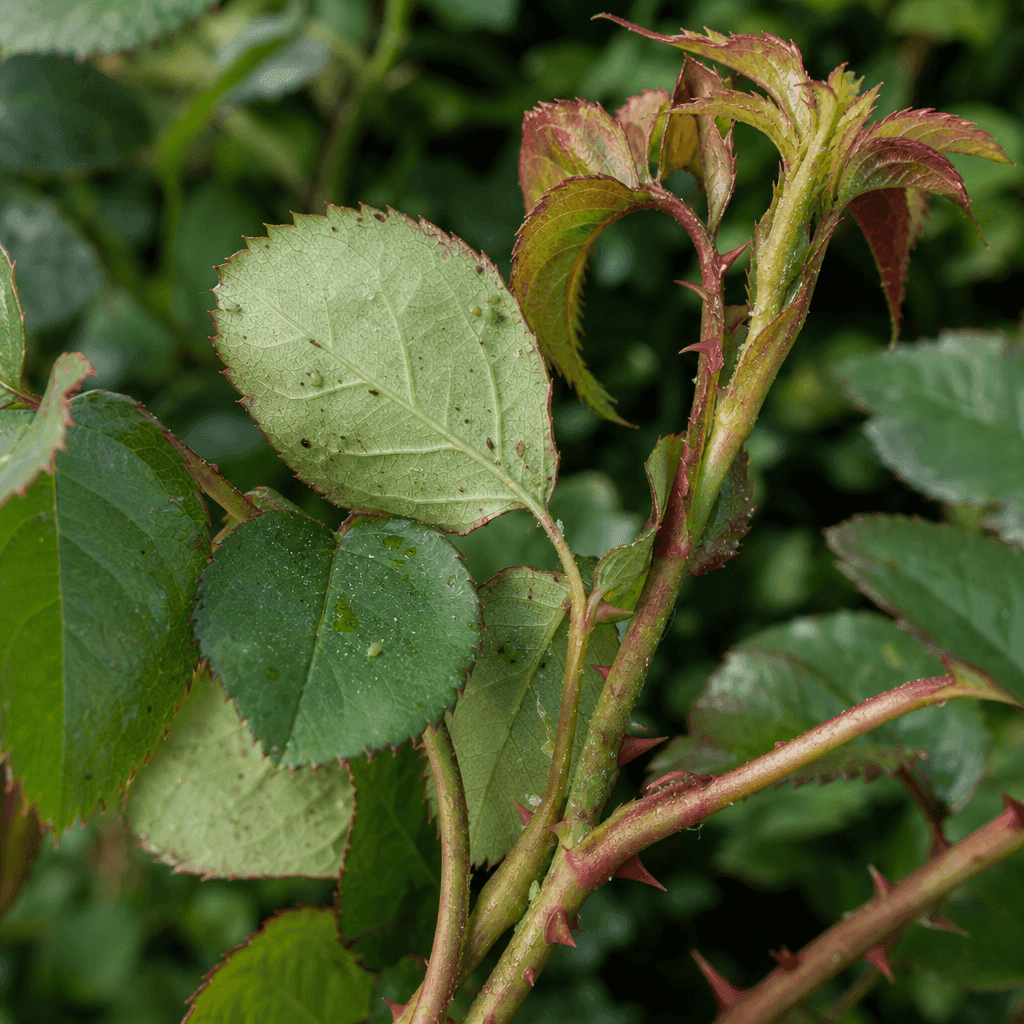
- Fine pale stippling across the upper leaf surface — no visible insect clusters.
- Thin, fine webbing on the undersides of leaves, especially around the midrib.
- Tiny pale or reddish mites visible with a hand lens on leaf undersides.
- Damage is worst in hot, dry, sheltered sites.
- Increase humidity around the plant — mites hate wet conditions.
- Wash leaf undersides regularly with a firm jet of water.
- Remove severely affected leaves.
- Avoid dry, dusty conditions and water the root zone consistently.
Stop it coming back:Mite damage can look alarming on badly affected plants. Recovery is slower than from aphids — expect several weeks of monitoring.
spray broad-spectrum insecticides — most do not control mites and can kill their natural predators, making a mite outbreak significantly worse.
Scale insects on roses
PossibleVarious scale insect species can affect roses, appearing as fixed brown, grey or white shell-like bumps on stems and sometimes on the undersides of leaf ribs. They do not cluster on new growth in the same visible way as aphids. Like aphids, scale insects suck sap and produce honeydew, and their populations can grow significantly if left unchecked. The RHS notes that in established infestations the scale will reduce plant vigour and lead to sooty mould deposits.
- Fixed shell-like bumps on stems that cannot be removed by wiping.
- Bumps do not move even when touched.
- Sticky honeydew or sooty mould on leaves below the infested stems.
- Prune out heavily infested stems and bin them.
- Rub off light infestations with a damp cloth or soft brush.
- Apply a suitable winter wash or contact insecticide targeting the mobile crawler stage in late spring.
confuse scale insects with lichen, corky bark or normal stem texture — scale insects are consistent in shape, slightly shiny and arranged along the stem.
Rose health and aphid vulnerability
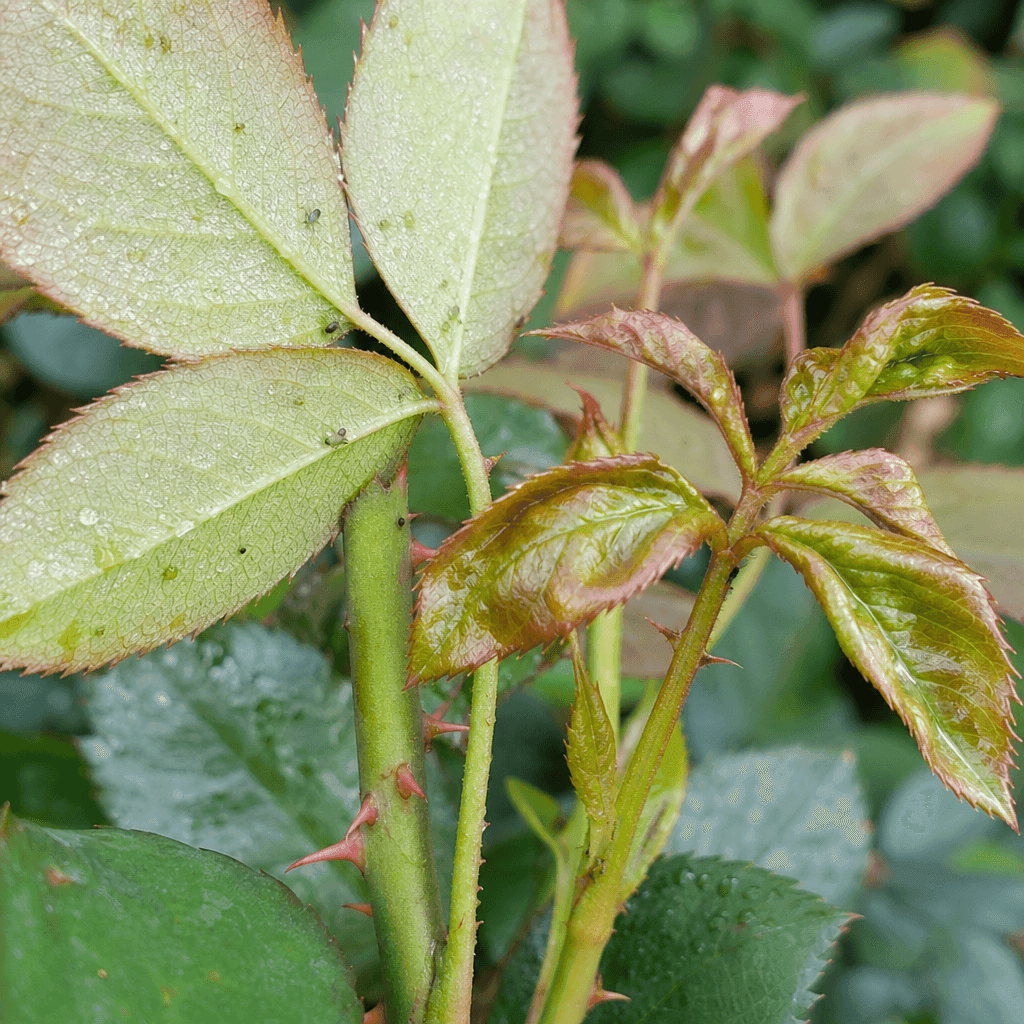
PossibleAphids strongly prefer soft, lush new growth, and roses pushed with excess nitrogen, cramped in pots, or stressed by drought can support heavier and more persistent infestations. A well-maintained rose in healthy soil with good airflow, appropriate pruning and consistent watering is inherently more resistant. The RHS Biodiversity pages note that encouraging natural enemies — by growing nectar-rich plants nearby and avoiding routine insecticide use — is the most effective long-term strategy for keeping aphid populations in check.
- The rose is being fed heavily with high-nitrogen fertiliser.
- Growth is unusually lush or soft.
- The rose is in a cramped position with poor airflow.
- Water roses deeply and consistently, especially in dry spells.
- Apply a 5 cm mulch of bark or garden compost in spring.
- Feed with a balanced rose fertiliser at the recommended rate — not more.
- Prune to an open structure that allows air to circulate.
- Grow nectar-rich single-flowered plants nearby to attract hoverflies and parasitic wasps.
apply high-nitrogen feed to 'boost' a struggling rose — excess nitrogen creates exactly the soft growth that aphids prefer.
Rose black spot — sometimes confused with aphid damage
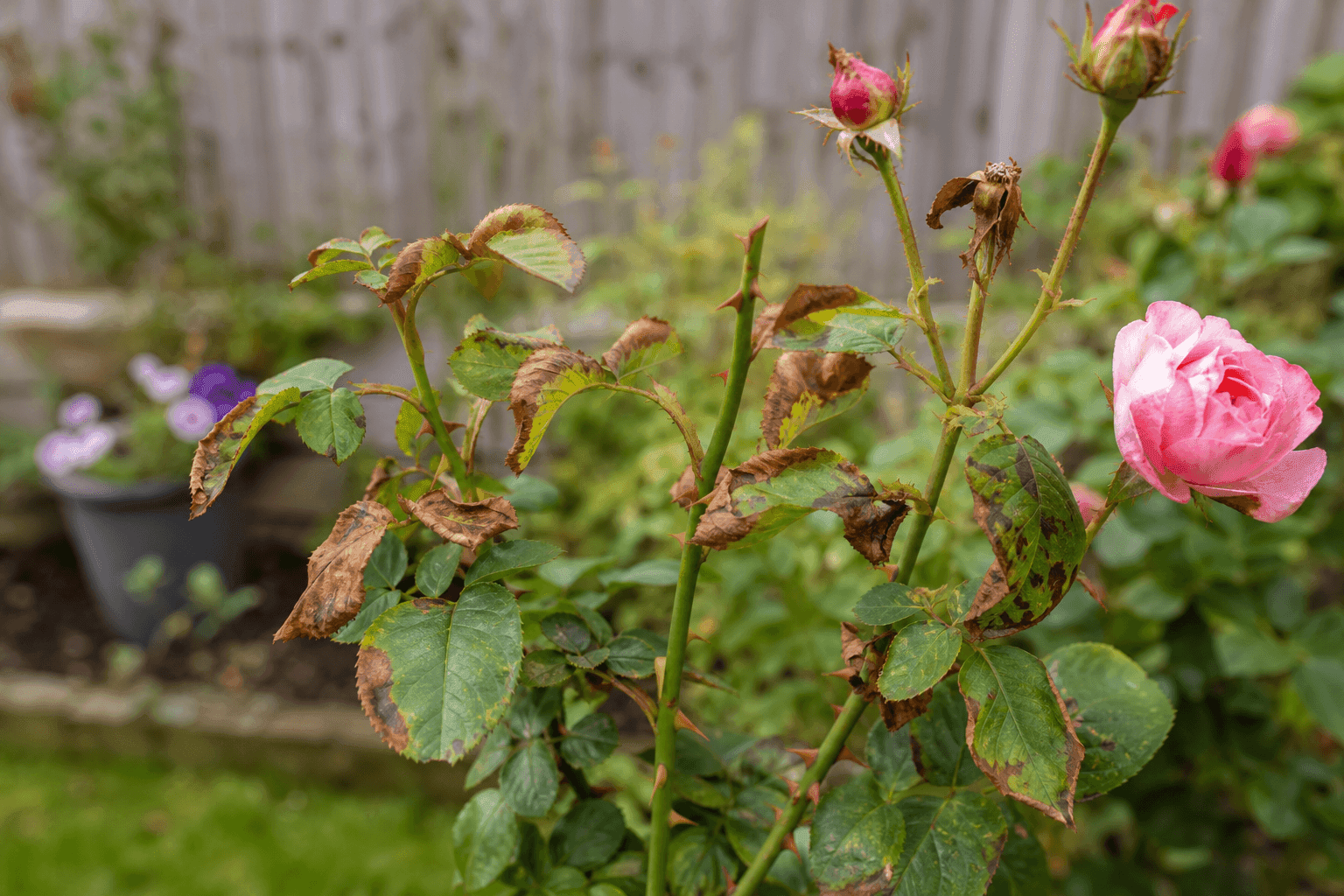
PossibleRose black spot (caused by Diplocarpon rosae) is frequently mentioned alongside aphids because both can cause leaf drop and general deterioration of the plant. However, the symptoms are quite different on inspection. Black spot produces flat, circular purple-black blotches embedded in the leaf tissue, usually with yellowing around them. If you are seeing rose leaves turning yellow with black spots, that is a disease pattern, not aphid feeding. The spots cannot be wiped away. There are no insect colonies. Black spot is primarily a disease of wet, cool conditions; aphids are most active in warm, dry spring weather.
- Spots are flat, circular, embedded in the leaf — they cannot be rubbed off.
- Yellow halos form around the spots.
- No aphid colonies, mites or insects are present on the plant.
- Damage is worse after wet weather.
- Remove and bin affected leaves from the plant and the ground.
- Clear fallen leaves from beneath the rose throughout the season.
- Water at the base to keep foliage dry.
- Improve airflow by pruning crossing and congested stems.
treat black spot as a pest problem — it will not respond to insecticides. And do not diagnose every spot or leaf blemish as aphid feeding without checking for insect colonies first.
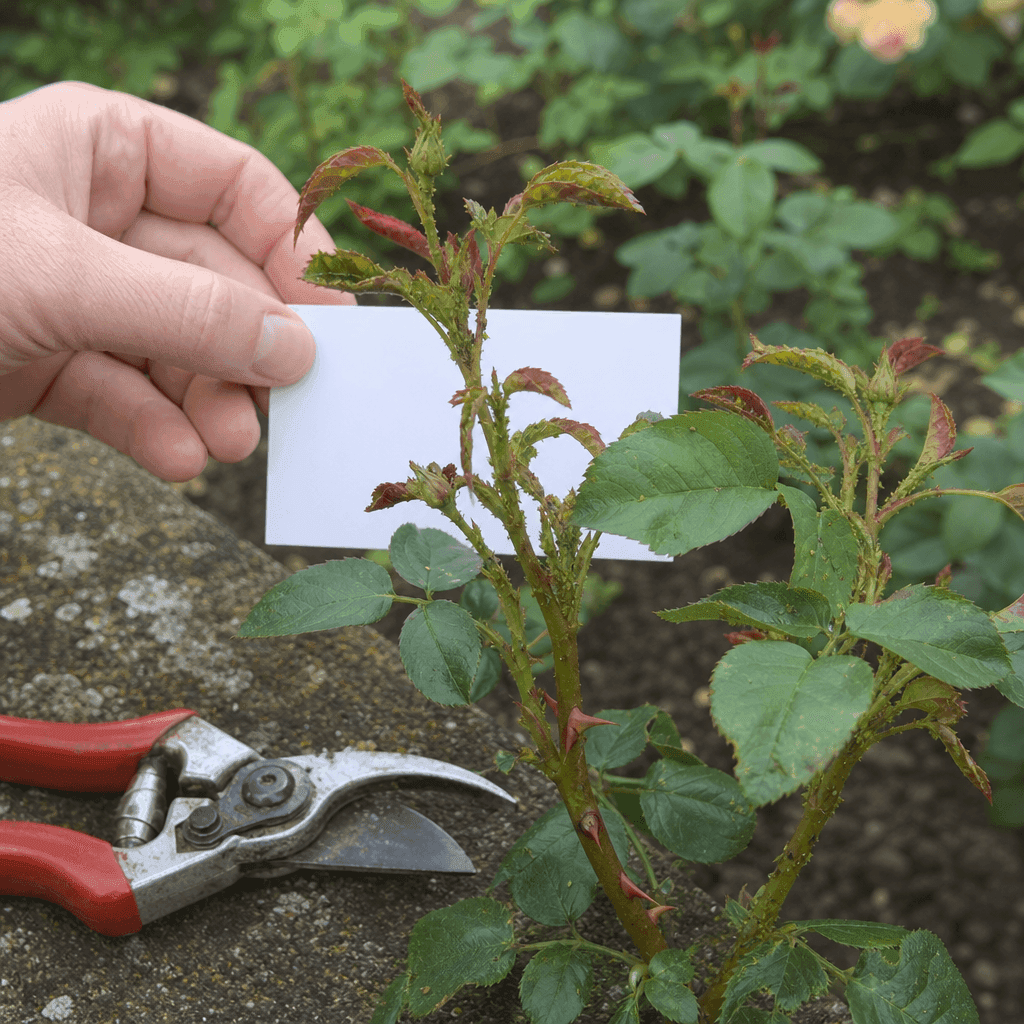
Still not sure?
Work down these branches — the first one that matches is your answer.
What not to do
- Spray broad-spectrum insecticides at the first aphid — they kill the ladybirds and hoverflies that control aphids naturally.
- Use washing-up liquid as a homemade aphid spray — it can scorch rose foliage.
- Spray when bees are active — always apply any insecticide in the evening.
- Assume every sticky or spotted rose has aphids — check for spider mites, scale and rose black spot.
- Feed roses heavily with high-nitrogen fertiliser — it creates the soft growth aphids prefer.
Common questions
Are aphids on roses serious?
Usually not on a healthy rose. Light infestations are common in spring and are often controlled naturally by ladybirds, hoverfly larvae and parasitic wasps within a week or two. Heavy infestations that distort shoots, prevent buds opening, or persist for more than two weeks are worth managing more actively.
How do I get rid of aphids on roses naturally?
Squash colonies by hand or wash them off with a firm jet of water aimed at the undersides of shoots. Repeat every two to three days while new growth is soft. Grow single-flowered nectar plants nearby to attract hoverflies and other predators. Avoid routine insecticide use so predator populations can build up. The same hand-removal and predator-friendly approach works for aphids on other plants too.
Can I use washing-up liquid on aphids on roses?
No — washing-up liquid is a detergent and can scorch rose foliage, damage the waxy cuticle, and harm beneficial insects. Use a product specifically labelled for plant pest control (insecticidal soap or fatty-acid spray) if you need a spray, applied in the evening.
What is the difference between aphids and spider mites on roses?
Aphids are visible soft-bodied insects, typically 1–3.5 mm, clustered on shoot tips and buds. Spider mites are tiny (less than 1 mm) and invisible to the naked eye, causing fine pale stippling and webbing on leaf undersides. They are more common in hot, dry, sheltered conditions.
Why are ants on my rose bush?
Ants are almost certainly farming an aphid colony for honeydew. They protect the aphids from predators like ladybirds. Disrupting the ant trail with a sticky barrier on the stem allows predators to reach and control the aphid colony more easily.
Do aphids spread rose black spot?
No. Rose black spot is a fungal disease spread by rain splash, not by aphids. However, a stressed rose — one weakened by heavy aphid feeding — may be less able to resist disease generally.
When do aphids appear on roses in the UK?
Rose aphids typically appear from April onwards as new rose growth emerges, with peak infestations in May and June. Numbers often decline naturally in July and August as growth hardens and predator populations increase.
Should I use a systemic insecticide for rose aphids?
Systemic insecticides are effective but should be a last resort. They are taken up by the whole plant, including flowers and pollen, which can harm pollinators. If you use one, choose a product approved for ornamental use and apply when flowers are not open. The RHS recommends physical removal and encouraging natural predators as the first approach.