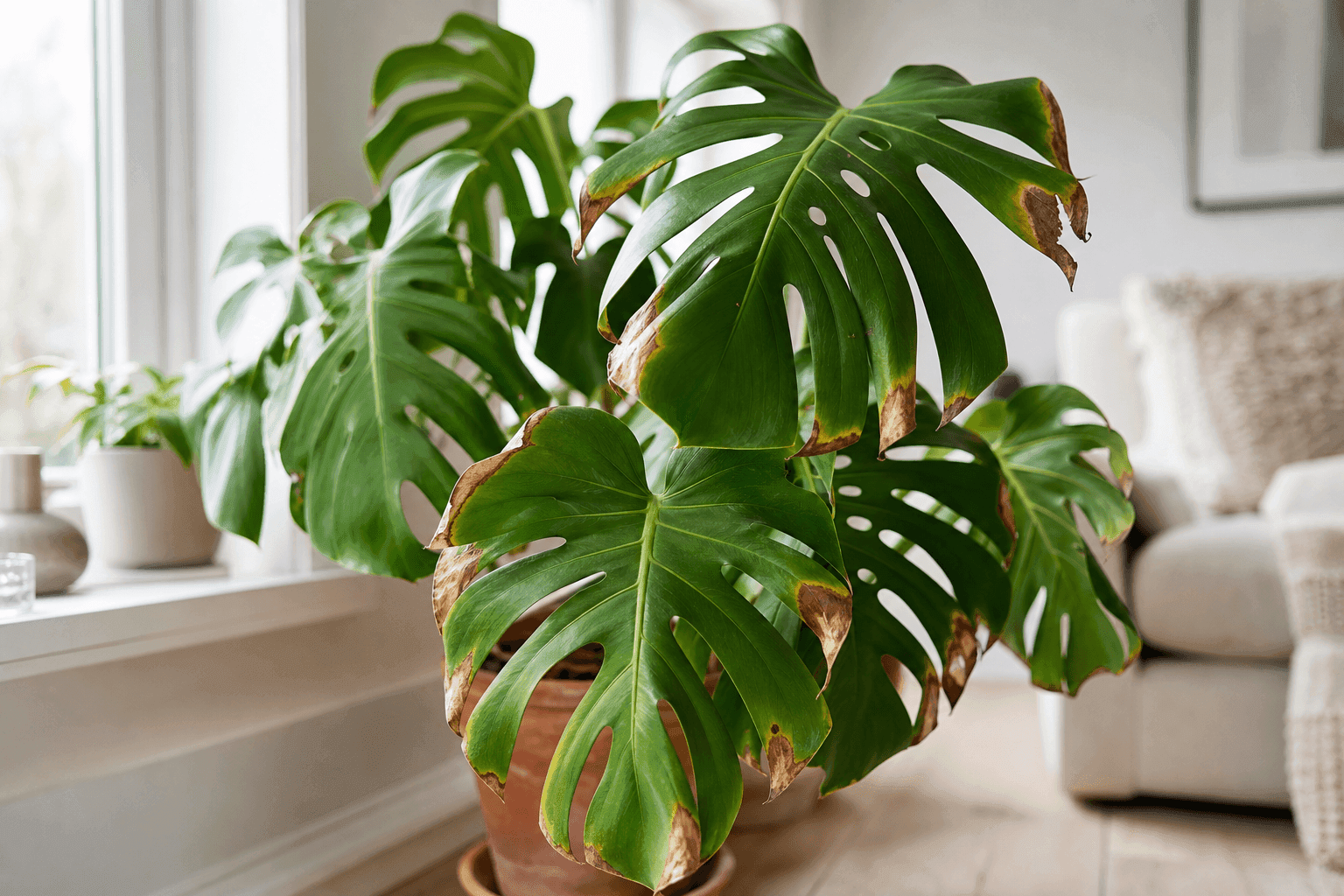
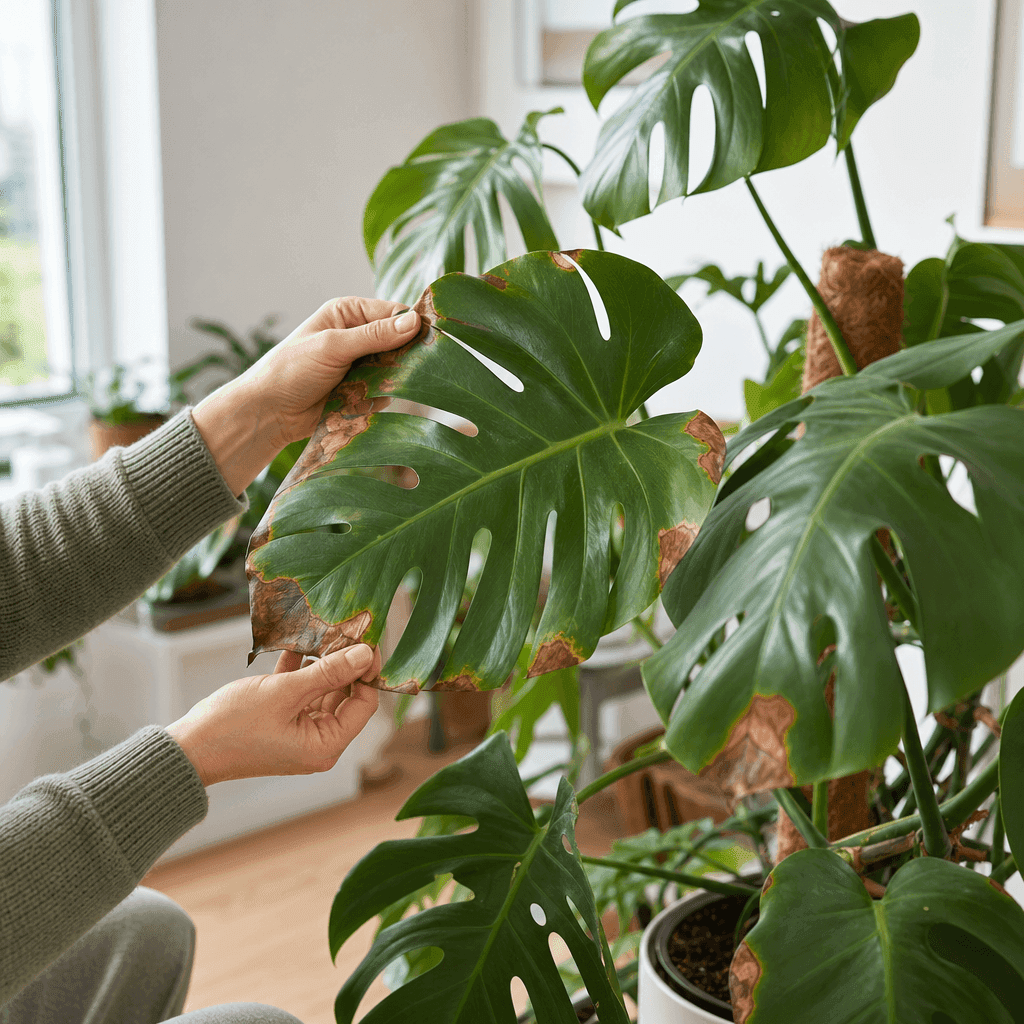
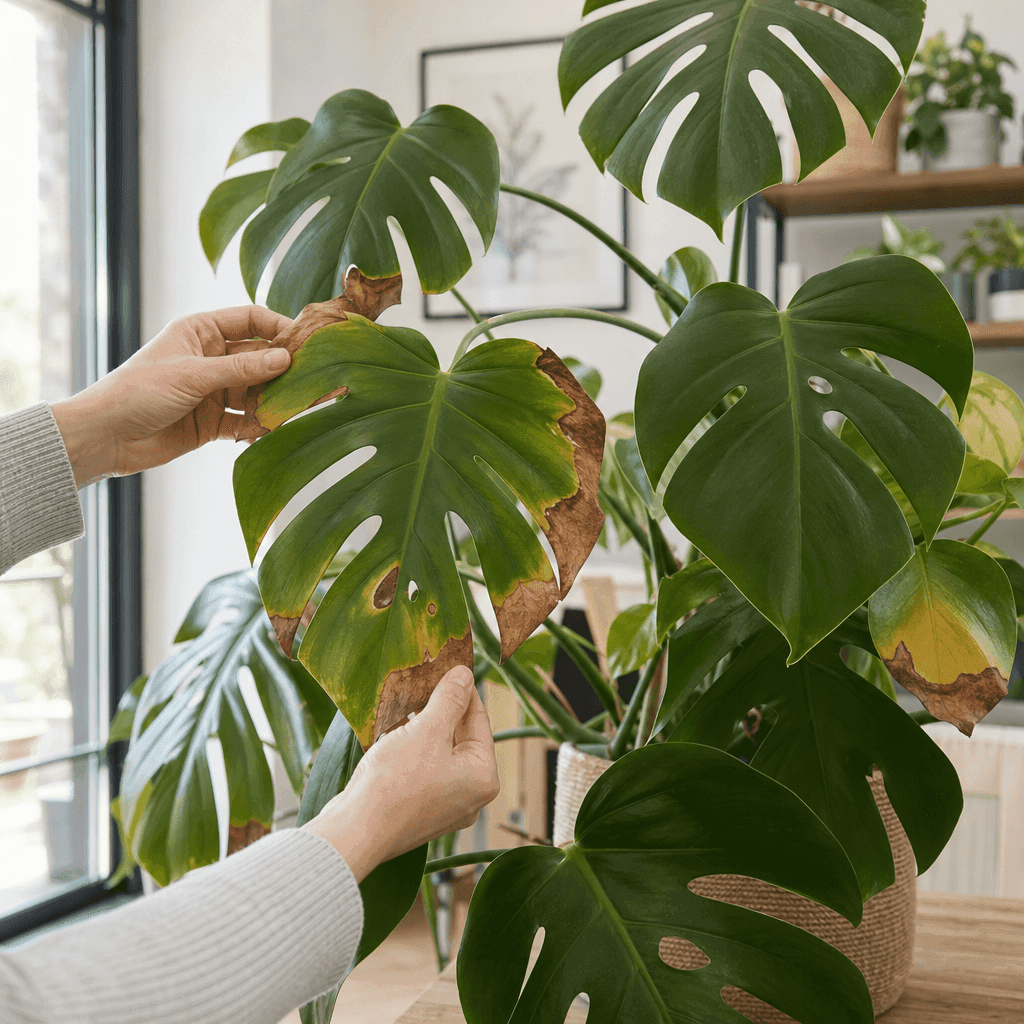
Quick diagnosis
Match the row to what you’re seeing, then jump to the fix.
| What you see | Likely cause | Confidence | How to confirm | What to do now | Urgency |
|---|---|---|---|---|---|
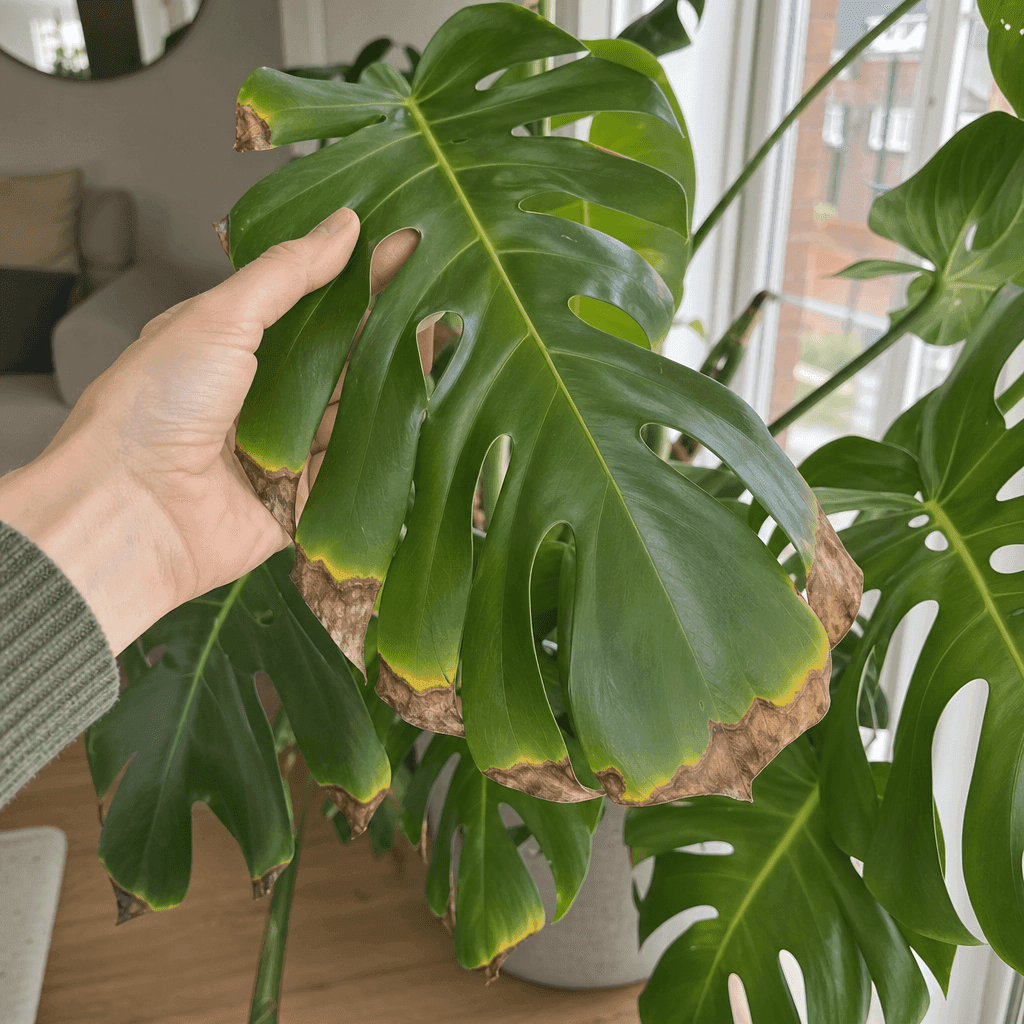
| Yellowing leaf with dry, crispy brown margins; pot feels light | Underwatering or irregular watering | High | Top half of the compost is dry; water runs quickly down the sides; leaves may curl slightly. | Soak the rootball thoroughly, let it drain, then water when the top 5cm feels dry. | Medium |
| Brown crispy edges on several leaves, especially near a radiator or in a dry room | Low humidity plus warm air | High | Compost is not bone dry, but the room is warm, dry or draughty; new edges crisp gradually. | Move away from the radiator, group plants, use a pebble tray or humidifier. | Low–medium |
| Brown tips/edges, dull growth, white crust on compost or pot rim | Fertiliser salt build-up or softened-water salts | Medium | You feed often, the compost surface has white deposits, or water drains with residue. | Flush with room-temperature water, stop feeding for 4–6 weeks, avoid softened water. | Medium |
| Yellowing spreads, brown patches feel soft or dark, stems droop; compost stays wet | Overwatering or root rot | High | Pot is heavy; no drainage or blocked holes; roots are brown, mushy or smell bad. | Stop watering, inspect roots, trim rotten roots and repot into airy fresh mix if needed. | High |
| Brown papery patches or scorched edges on the window-facing side | Direct sun scorch | Medium | Damage is on sun-exposed leaves; patches are tan, dry and do not spread after moving. | Move to bright indirect light and avoid hot midday sun through glass. | Low–medium |
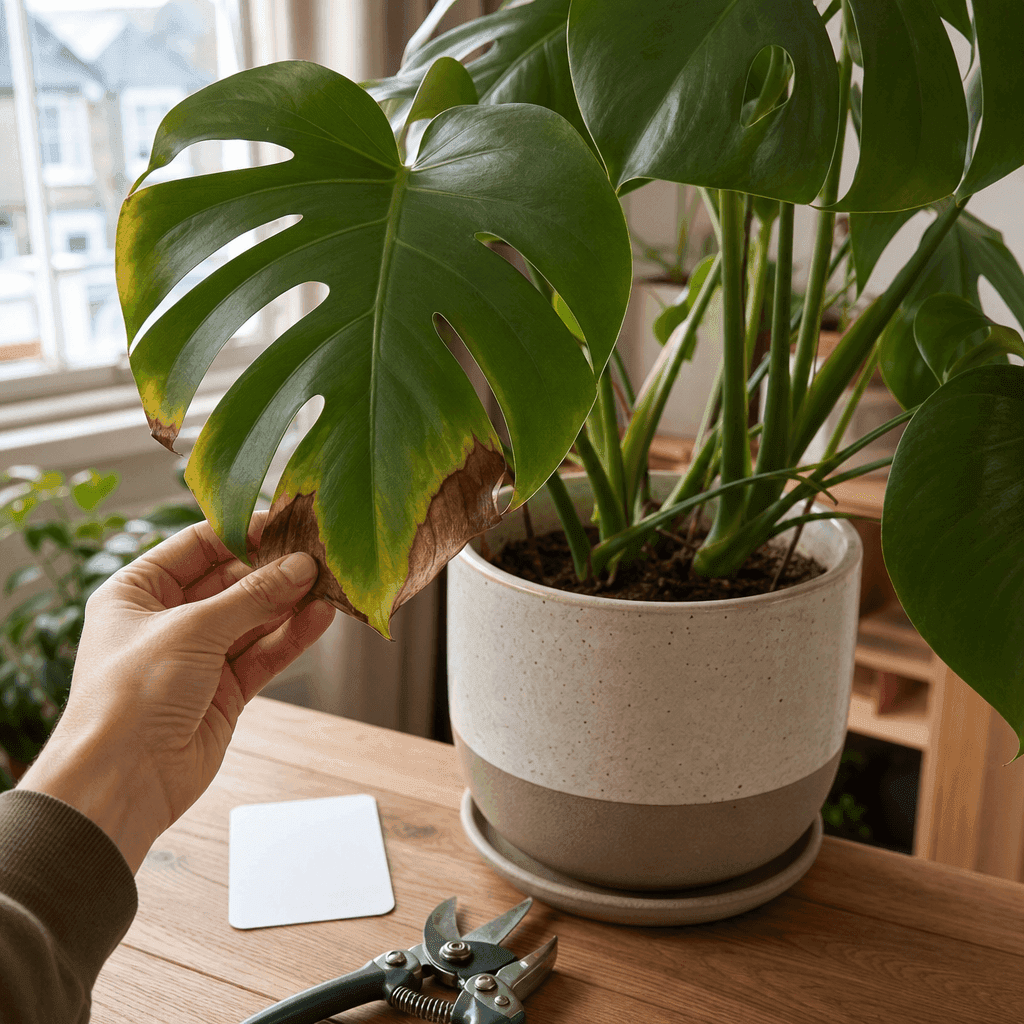
| One old lower leaf turns yellow, then brown, while new growth is healthy | Natural leaf ageing | Medium | Only the oldest lower leaf is affected and the plant is otherwise growing. | Wait until it is mostly yellow/brown, then remove cleanly. | Low |
The causes, in detail
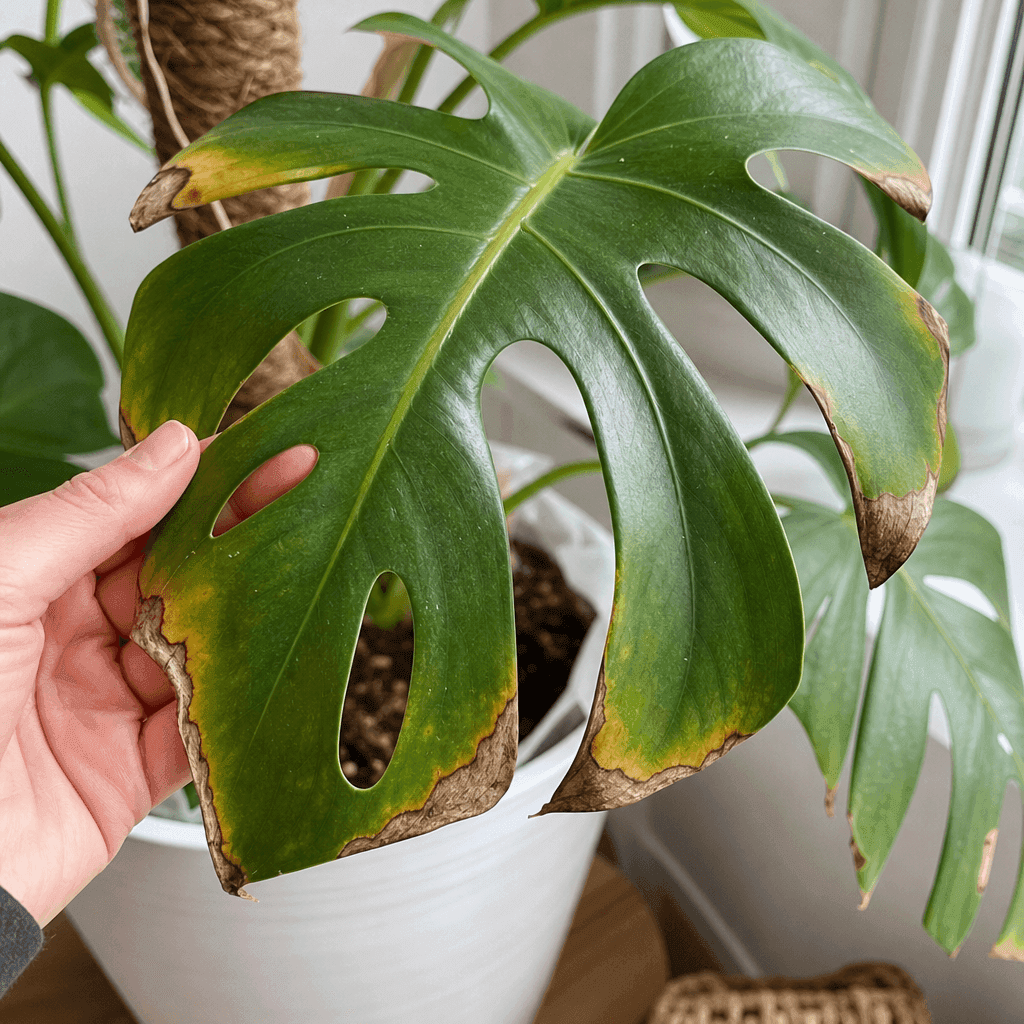
Underwatering or inconsistent watering
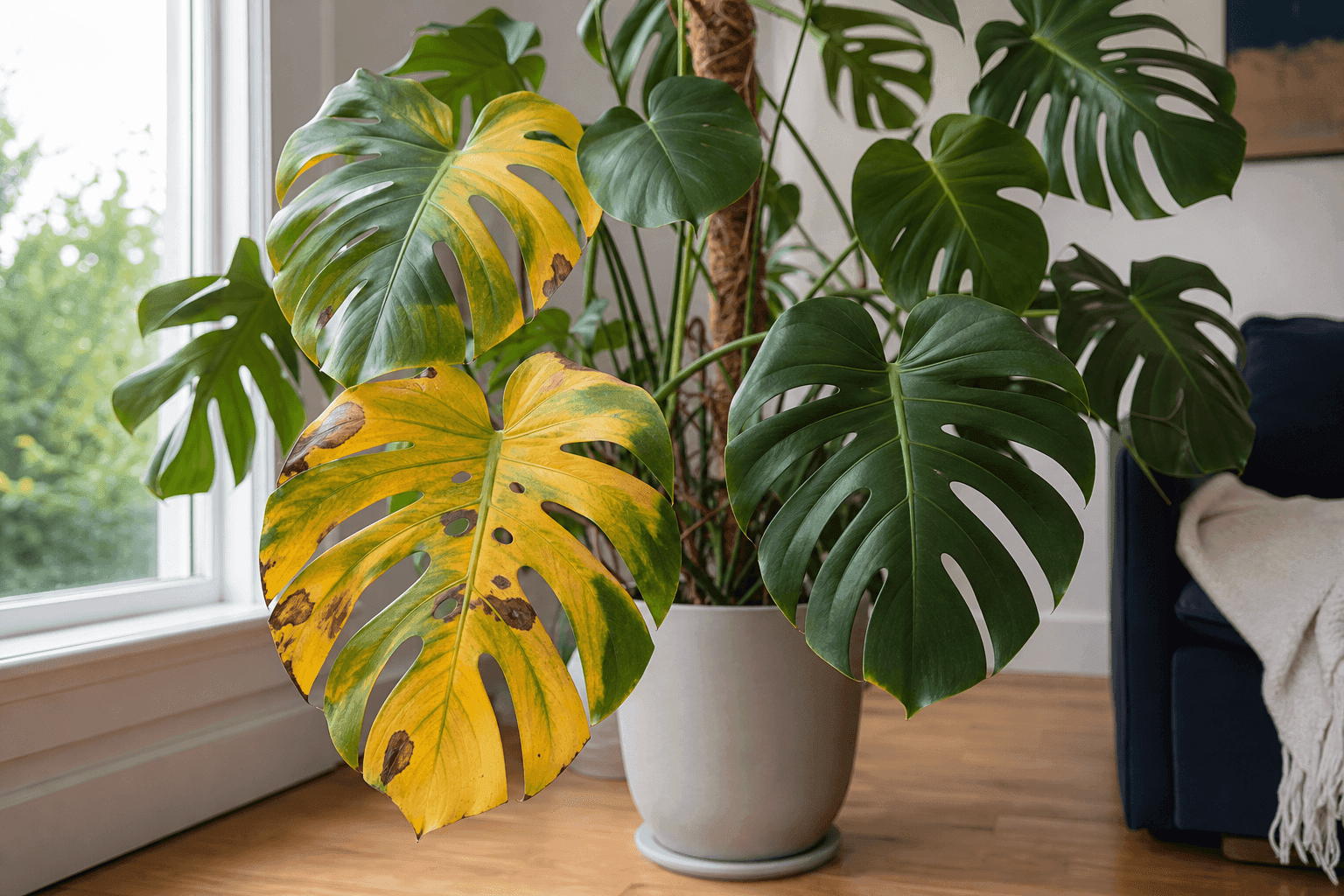
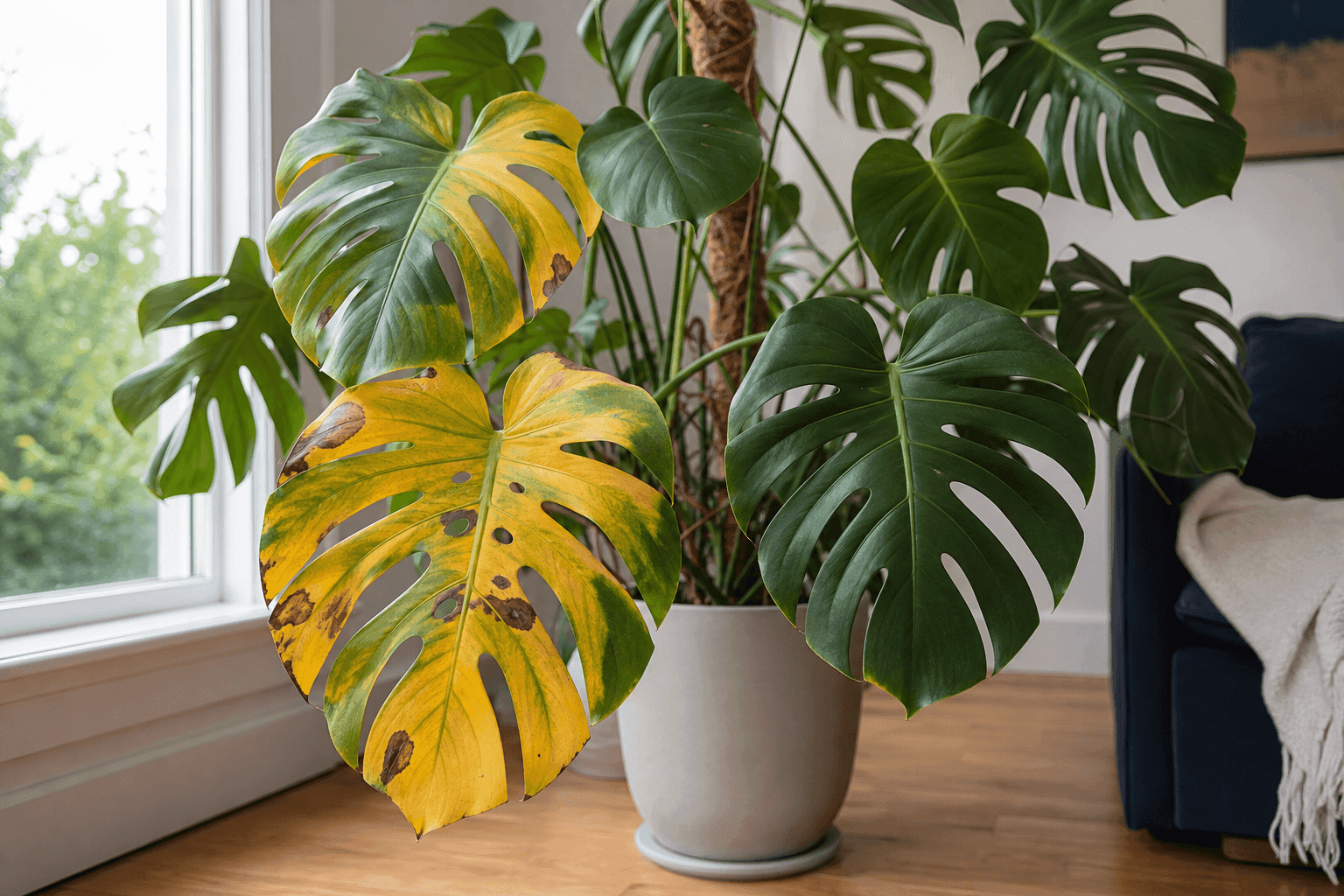
Most likelyUnderwatered Monstera leaves often develop dry brown tips or margins before the whole leaf yellows. The brown edge is usually crisp, papery and easy to crumble, and leaves may droop or curl slightly. It is common when a large Monstera is in a small pot, a very free-draining mix, or a warm bright room where the compost dries faster than expected.
- Lift the pot — it feels much lighter than usual.
- A finger or chopstick pushed 5–8cm in comes out dry.
- Water races down the sides and straight out of the drainage holes (the rootball has shrunk away).
- Leaves are crisp at the edge rather than soft.
- Water thoroughly with room-temperature water until it runs from the drainage holes, then empty the saucer or cachepot.
- If the rootball is very dry and water bypasses it, stand the inner pot in a basin of water for 20–30 minutes, then drain well.
- Afterwards, water when the top 5cm of compost is dry and the pot feels lighter — not by calendar.
- Adjust for season, pot size and room temperature.
Stop it coming back:Drooping can improve within 24–72 hours if the roots are healthy. Yellowed tissue and brown edges will not turn green again — judge recovery by firm new growth and no new crispy margins over 2–4 weeks.
give tiny daily splashes that only wet the surface, leave the pot standing in water after soaking, or feed immediately to 'green it up'.
Low humidity and dry indoor air
Most likelyLow humidity usually causes brown, crisp edges or tips first, with yellowing following around the damaged edge, especially on older leaves. The compost may not be extremely dry. In UK homes this often appears in winter with central heating on, or when a Monstera sits near a radiator, stove, sunny glass or a draughty doorway. RHS guidance notes low humidity increases water loss from leaves.
- The plant is within a metre of a radiator or heat source.
- Several leaves crisp at the edges while the compost is only moderately dry.
- Other tropical houseplants nearby also show brown tips.
- The problem worsens in winter.
- Move the Monstera away from hot, dry air into bright indirect light.
- Group it with other houseplants, and use a pebble tray or humidifier if the room is very dry.
- A bathroom can work only if it has enough light.
- Keep watering based on compost moisture — low humidity is not fixed by keeping the compost wet.
Stop it coming back:Existing brown margins stay. With humidity and watering corrected, new leaves should emerge with cleaner edges and undamaged leaves should stop crisping within a few weeks.
rely on weekly misting to fix dry edges — it gives only a brief humidity rise — or compensate by overwatering.
Fertiliser salt build-up or unsuitable water
PossibleFertiliser salt injury can look like dryness: brown tips and edges, dull growth, lower leaf drop or wilting. The key clue is often a white crust on the compost, pot rim or drainage holes, especially if you feed frequently or use hard/softened water without flushing. Clemson Extension notes salt build-up damages roots and causes brown tips and leaf drop; RHS warns not to feed dry compost and that water-softener salts are highly toxic to plants.
- You feed more often than the label recommends, or fertilise in winter when growth is slow.
- There is white or pale crusting on the compost or pot.
- Brown tips persist despite reasonable watering.
- You water with softened water from a domestic water softener.
- Flush the compost with plenty of room-temperature water, letting it drain fully; repeat once if crusting is heavy.
- Empty the saucer afterwards.
- Pause feeding for 4–6 weeks, then resume at a weaker dose only during active growth.
- If the compost is old, compacted or crusted throughout, repot into fresh free-draining peat-free mix with bark or perlite.
- Use rainwater or stood tap water; avoid softened water.
Stop it coming back:Salt stress improves slowly because root tips need time to recover — expect stabilisation over 3–6 weeks. Damaged margins will not repair.
add more fertiliser because the leaf is yellow, fertilise dry compost, or just scrape off the top crust and ignore the salts inside the rootball.
Overwatering and root rot
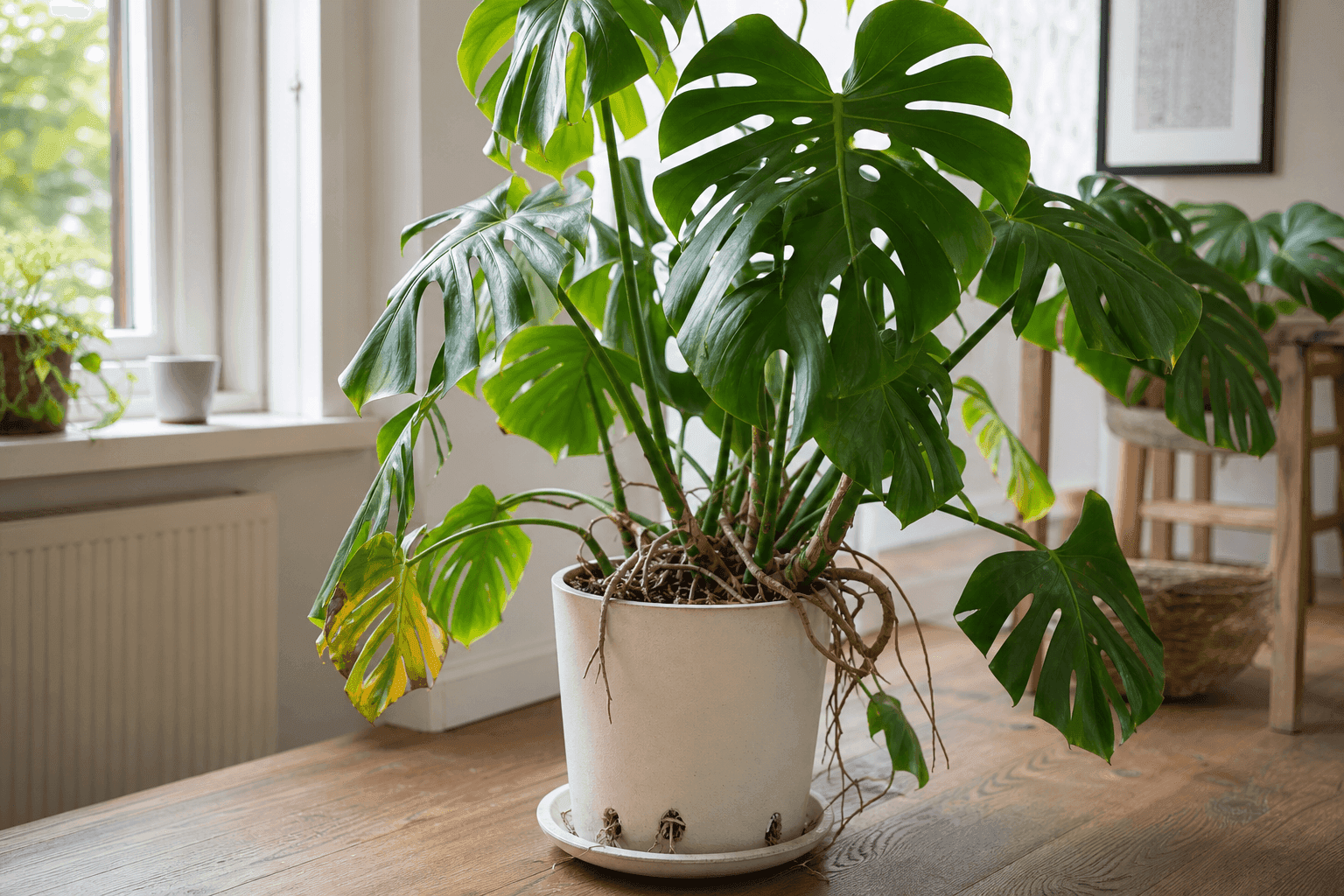
Most likelyMonstera root rot can cause yellow leaves with brown edges because damaged roots cannot supply water, even when the compost is wet. The plant may droop, yellow from the lower leaves up, develop dark or soft brown patches, or sit in wet compost for many days. Clemson notes root rot usually results from a slow-draining mix or overly frequent watering; RHS notes roots need air and can drown when compost stays saturated.
- The pot feels heavy several days after watering, or the cachepot holds standing water.
- Drainage holes are absent or blocked, and the compost smells sour or swampy.
- Fungus gnats are present and the compost stays wet.
- Roots are brown, black, hollow, mushy or pull away easily (healthy roots are firm and pale to tan).
- Stop watering until you have checked the rootball.
- Slide the plant out and inspect the roots; cut away mushy, hollow or foul-smelling roots with clean secateurs.
- Repot into a pot with drainage holes using a chunky, airy mix.
- Water once to settle, drain well, then let the top 5cm dry before watering again.
- If most roots have rotted but some stems are firm, take healthy stem cuttings with nodes as a backup.
Stop it coming back:A lightly affected plant may stabilise in 2–4 weeks. A badly affected Monstera may take 2–3 months to make strong growth because it must rebuild roots first.
keep watering because the leaves look thirsty, leave the nursery pot in a water-filled cachepot, move straight into a much larger pot, or use fungicide instead of fixing drainage.
Direct sun scorch through glass
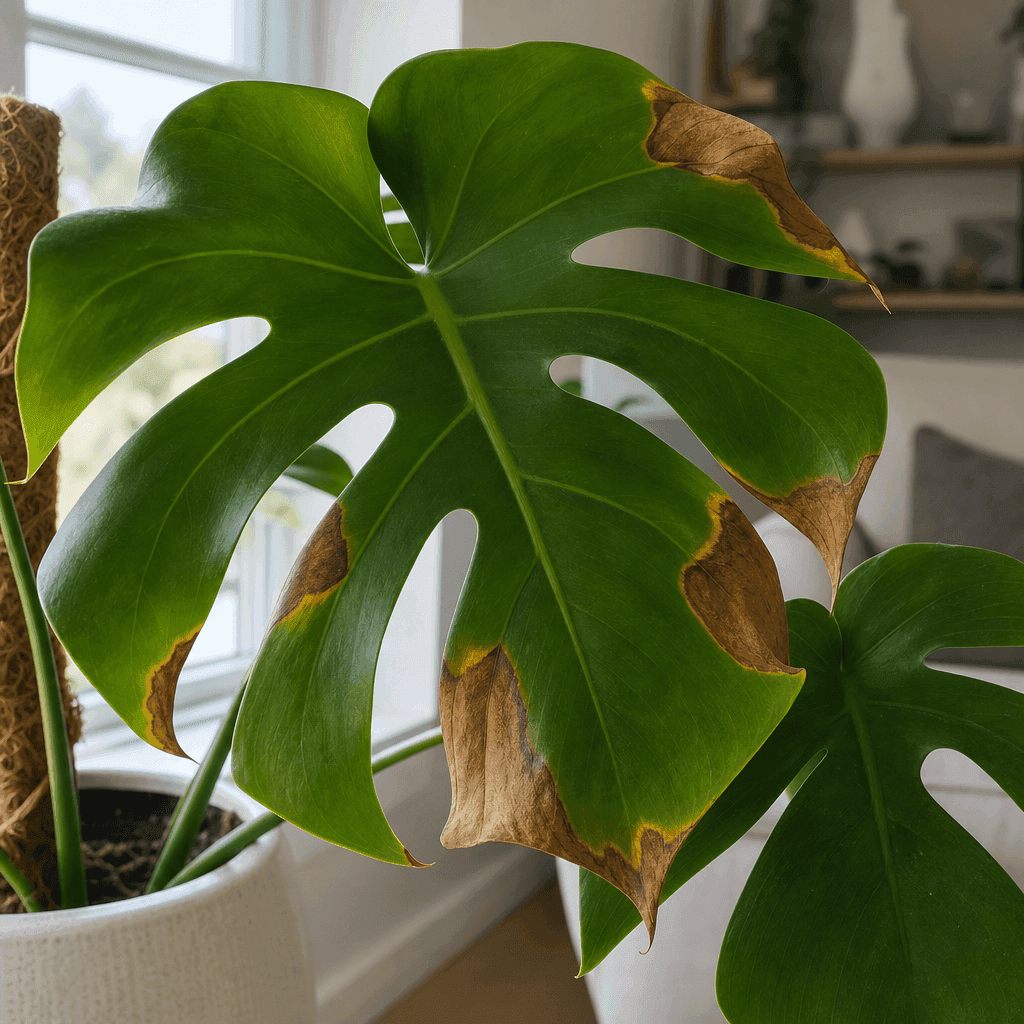
PossibleSun scorch usually appears as tan, brown or bleached papery patches on the side of the leaf facing the window, sometimes edged with yellow. Monsteras need good light but do best in bright indirect light indoors. RHS notes strong summer sun through glass can scorch susceptible houseplants; Clemson notes excessive direct light can bleach or scald leaves.
- The worst damage is on window-facing leaves or where a leaf touched hot glass.
- Patches are tan, dry and papery rather than spreading.
- Damage appeared after moving the plant closer to a south- or west-facing window, or during a bright spell.
- Turning the pot shows one side far more affected than the other.
- Move the plant back from the window, or filter the light with a sheer curtain.
- An east window, or a position set back from a bright south/west window, is often better than direct midday sun.
- Make light changes gradually if the plant has been in a darker spot.
- Rotate the pot occasionally for even growth.
Stop it coming back:Scorched tissue is permanent. The plant stabilises immediately after being moved, but cosmetic recovery depends on new leaves, which take weeks to months.
put a stressed indoor Monstera outdoors in direct sun, or confuse fixed scorch patches with spreading disease — scorch does not keep spreading once the light stress is removed.
Natural leaf ageing
PossibleIt can simply be an old leaf if it is one old lower leaf and the rest of the Monstera is growing well. Older leaves naturally senesce — the plant withdraws resources before the leaf dies. House Plant Journal notes lower old leaves are often the first to yellow.
- Only one old lower leaf is affected.
- New growth is healthy and the plant is otherwise firm.
- There is no sour smell or wet compost.
- Browning is not appearing on new leaves.
- Wait until the leaf is mostly yellow or brown, then remove it cleanly near the petiole base.
- Keep care steady — bright indirect light and water when the top 5cm dries.
Stop it coming back:This is normal maintenance, not a fault. Watch that it stays limited to the oldest leaves and does not spread to new growth.
dismiss it as ageing if several leaves yellow at once, new leaves are browning, the compost smells bad, or the plant is declining overall.
Still not sure?
Work down these branches — the first one that matches is your answer.
What not to do
- Assume every yellow-and-brown leaf just needs more water — a rotting Monstera looks thirsty too.
- Mist a few times a week and expect it to fix dry edges.
- Add fertiliser to a plant that already has brown tips and salt crust.
- Leave the nursery pot standing in a water-filled cachepot.
- Remove every marked leaf at once from a weak plant.
Common questions
Why are my Monstera leaves turning yellow with brown edges?
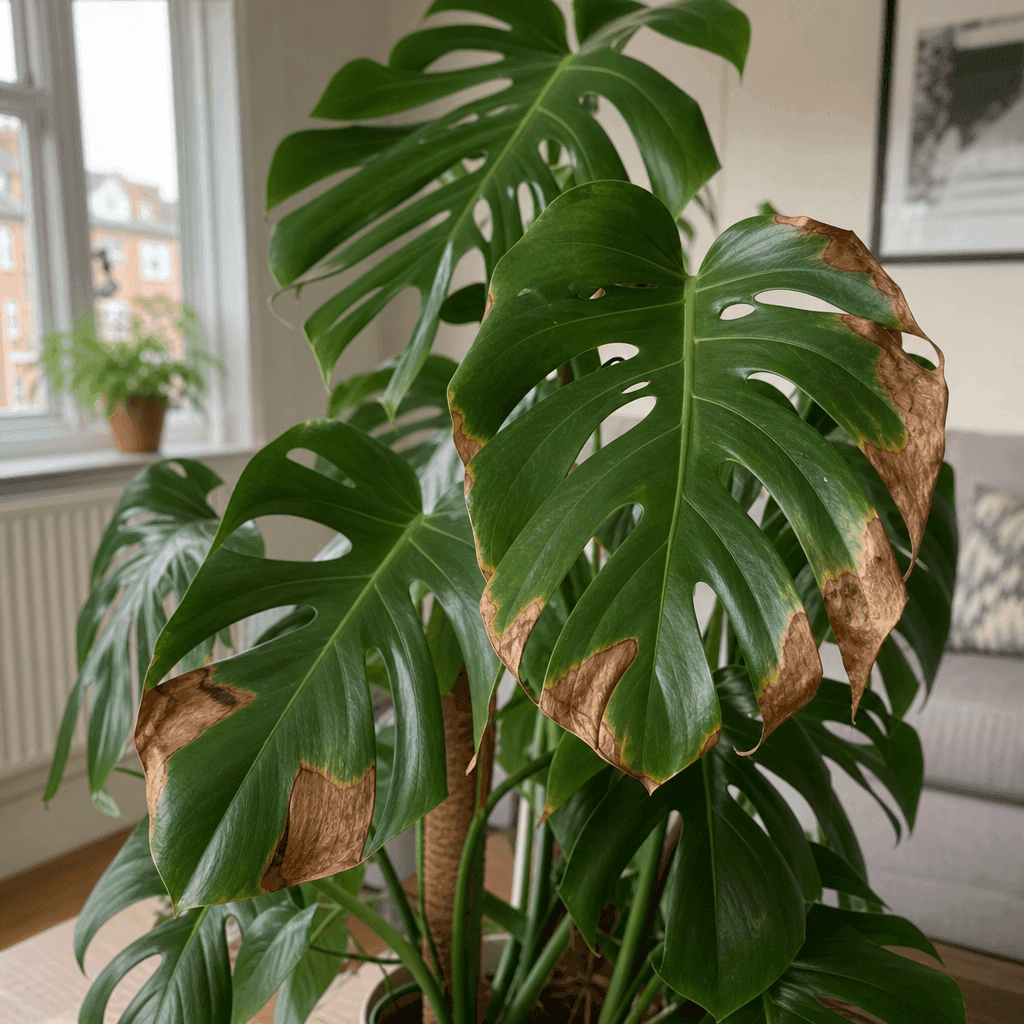
The most likely causes are underwatering, low humidity, fertiliser salt build-up, root rot from wet compost, or direct sun scorch. Check compost moisture and drainage first, because dry stress and root rot can look similar above ground.
What are the signs of an overwatered Monstera?
An overwatered Monstera often has yellowing leaves, drooping stems, compost that stays wet for days, fungus gnats, and sometimes dark soft brown patches. If roots are mushy, hollow or foul-smelling, root rot is likely.
How do I fix brown tips on Monstera leaves?
Fix the cause rather than the tip. Water deeply if the plant is dry, raise humidity if the room is hot and dry, flush excess fertiliser salts if there is crusting, and move the plant out of direct sun if tips are scorching.
Will yellow Monstera leaves turn green again?
Usually no. Once a Monstera leaf has turned yellow, that tissue rarely returns to green. A successful fix shows up as healthy new leaves and no new yellowing or browning.
Should I mist a Monstera with brown edges?
Misting is not harmful if leaves dry quickly, but it is usually too brief to solve brown edges. For dry air, move the plant away from heat, group houseplants, use a pebble tray, or use a humidifier.
Can tap water cause brown edges on Monstera?
It can contribute if salts build up, especially with heavy feeding or poor flushing. Avoid water from domestic softeners, because softener salts are unsuitable for houseplants. Flush the compost if you see white crusting.
Is a yellow leaf with brown edges a disease?
Usually it is a care or root problem, not an infectious disease. Disease is more likely if spots are spreading, wet-looking, circular, or accompanied by mould. Improve airflow and avoid leaving foliage wet overnight.
How often should I water a Monstera in the UK?
There is no fixed schedule. In many UK homes, Monsteras need less water in winter and more in warm bright months. Water when the top 5cm of compost is dry and the pot feels lighter, then drain fully.