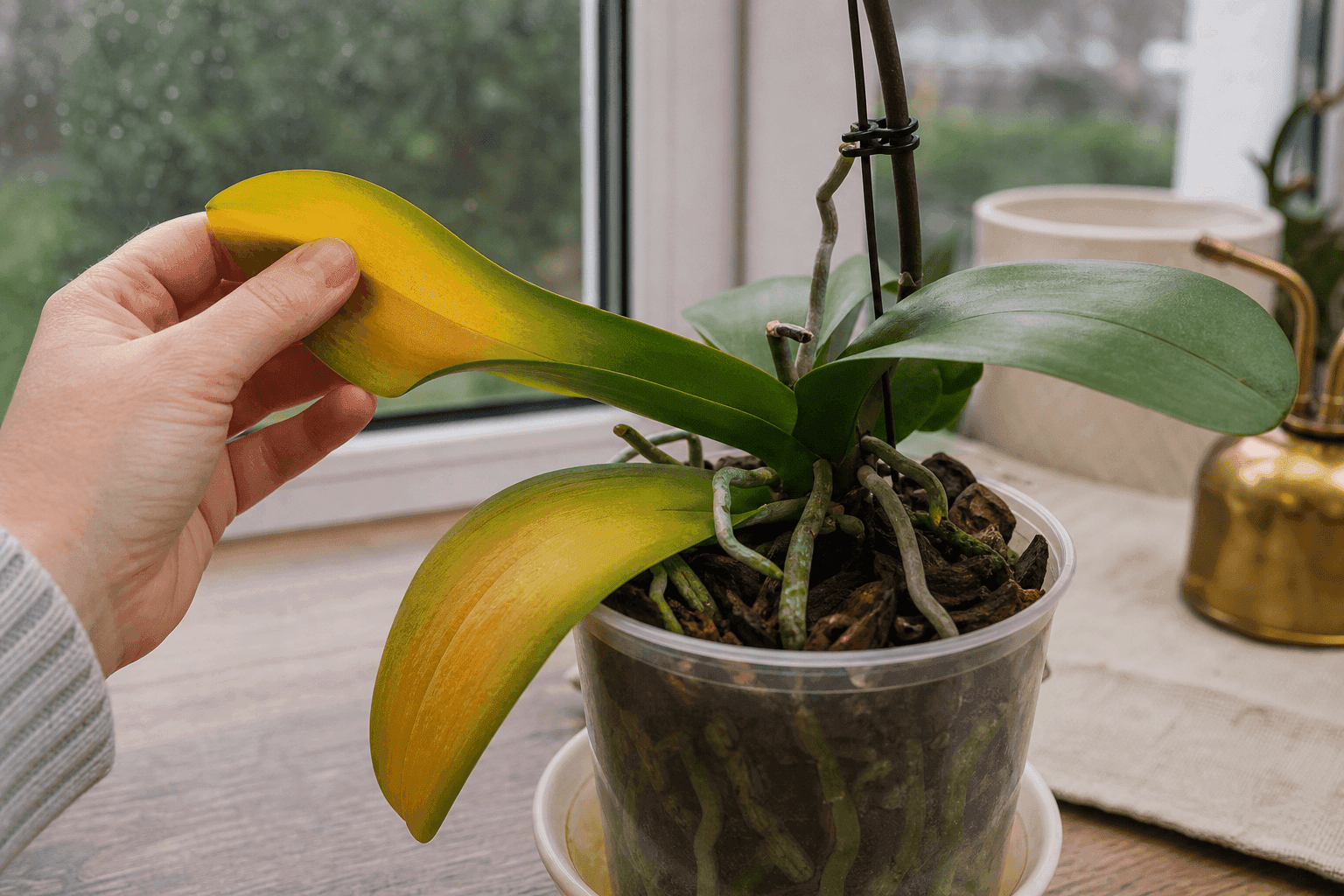
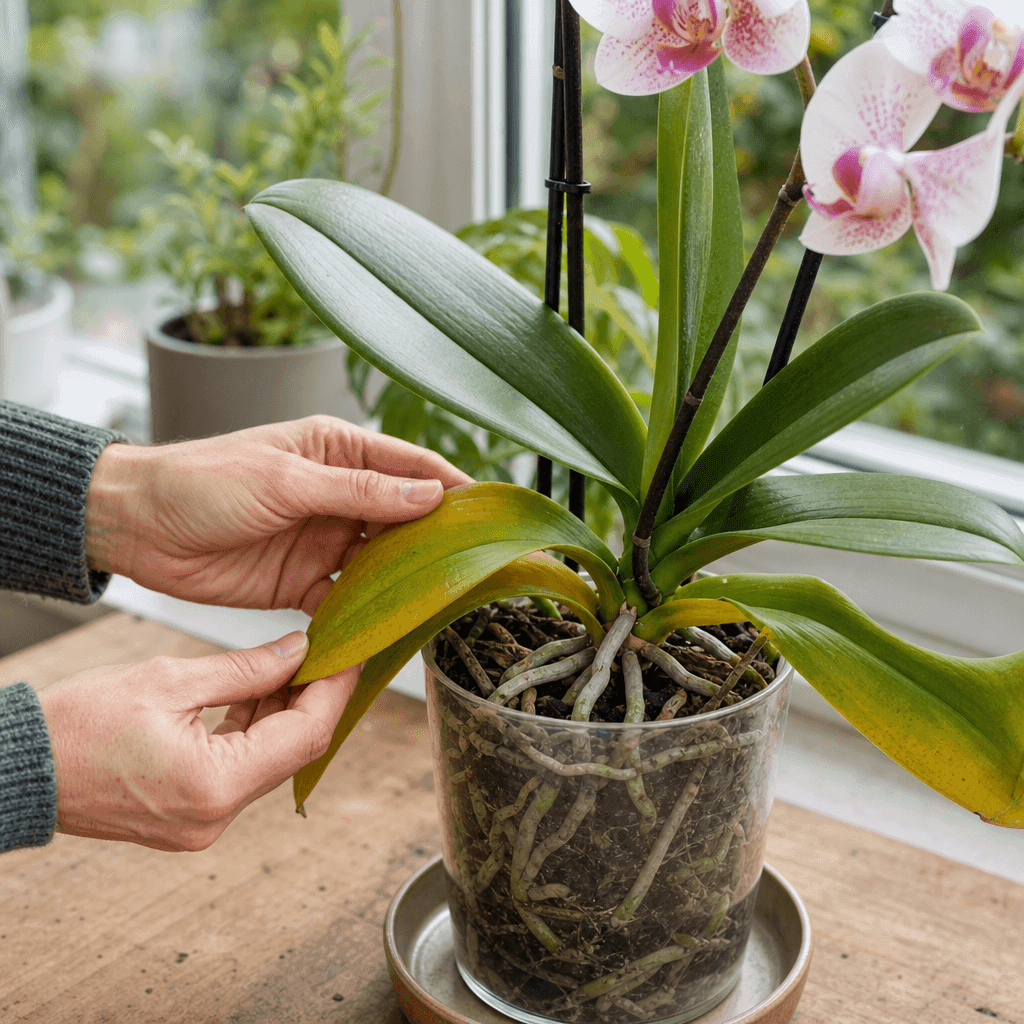
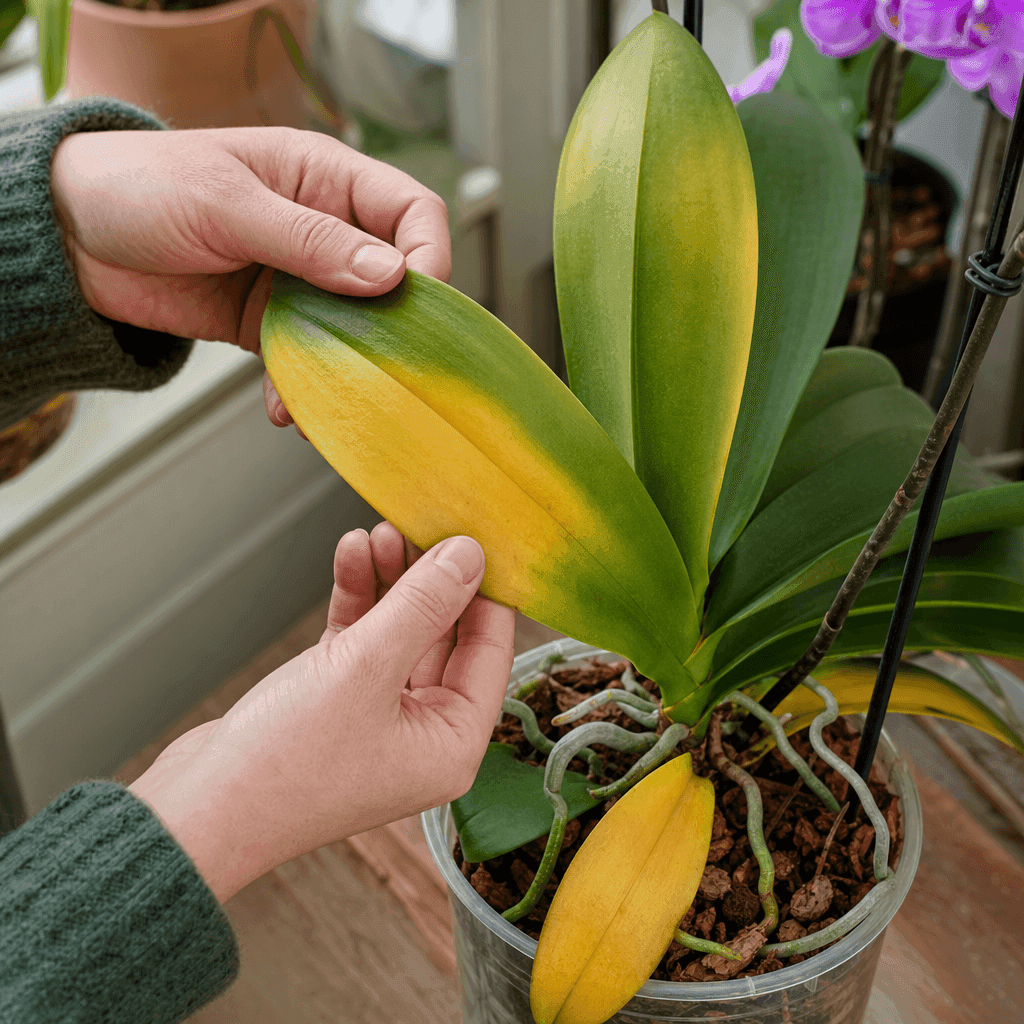
Quick diagnosis
Match the row to what you’re seeing, then jump to the fix.
| What you see | Likely cause | Confidence | How to confirm | What to do now | Urgency |
|---|---|---|---|---|---|
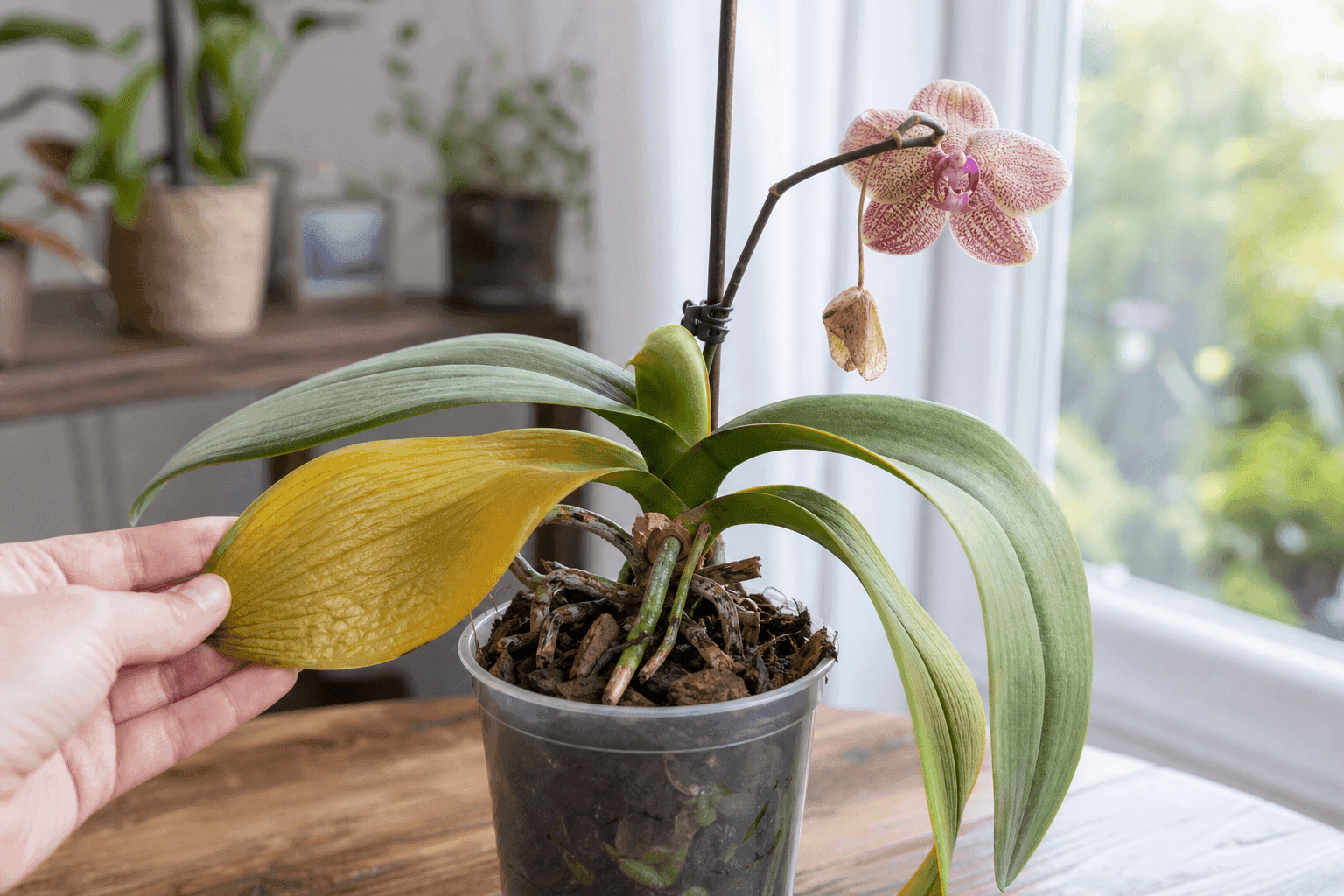
| One or two bottom leaves yellowing gradually; rest of plant healthy | Natural leaf ageing and shedding | High | Only the lowest, oldest leaf is yellowing; roots look healthy (green or silvery-grey but not brown and mushy); new growth is normal | No action needed — remove the yellow leaf once it detaches easily | Low |
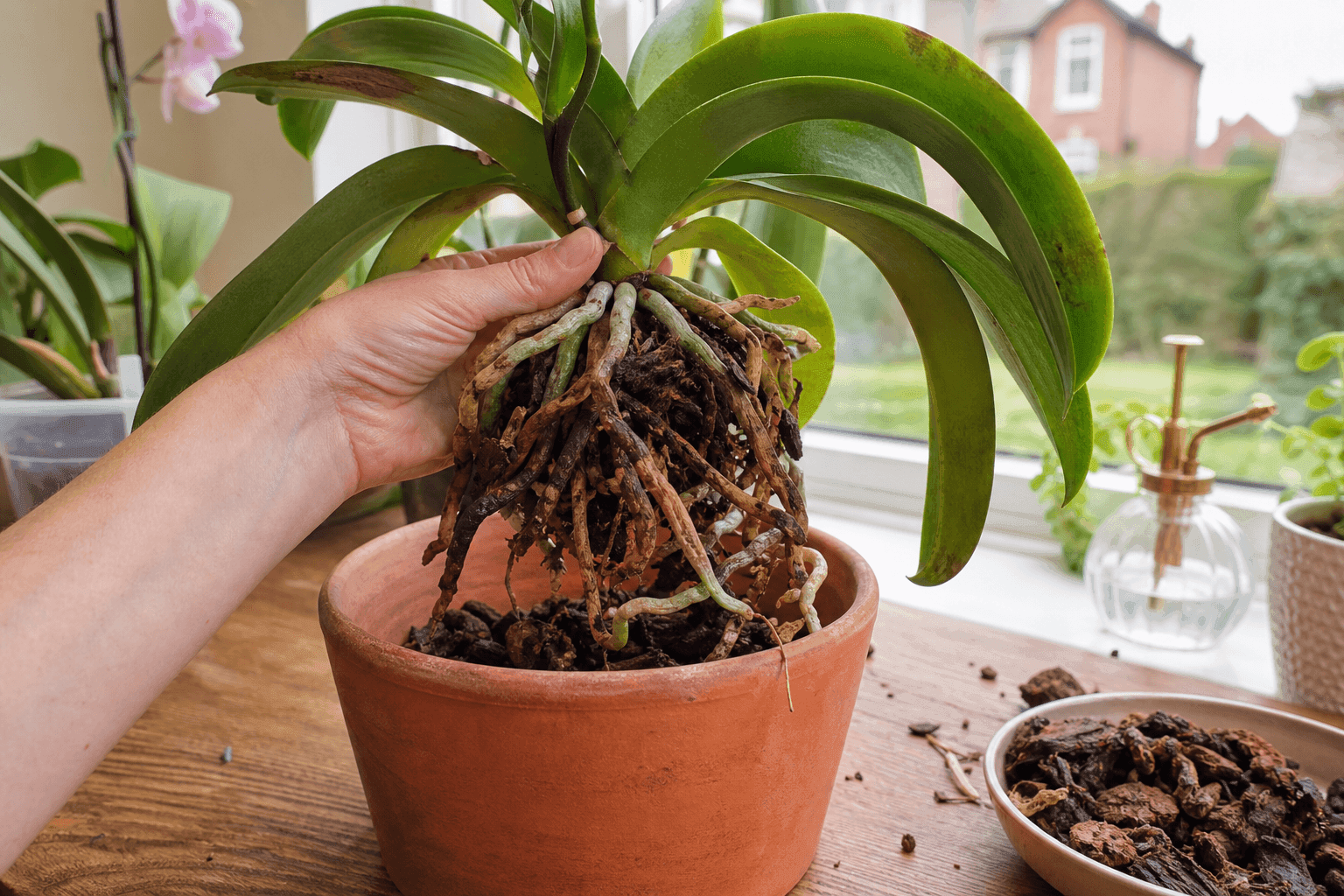
| Multiple leaves yellowing; leaves feel soft and limp; brown or mushy roots | Overwatering and root rot | High | Look through the clear pot — roots are brown or grey-black and soft, not plump and green; compost is always wet | Remove from pot, trim dead roots, repot in fresh orchid bark, reduce watering frequency | High |
| Yellow, bleached or papery patches on firm, plump leaves — often on the side facing the window | Direct sunlight / sunburn | High | The plant is close to a south- or west-facing window; damage is worst on the sun-facing side; leaves feel leathery or papery not soft | Move away from direct sun to bright indirect light; damaged patches will not recover but new leaves should be healthy | Medium |
| Limp, wrinkled or shrivelled leaves; silvery-grey roots; compost bone dry | Underwatering / drought stress | Medium | Roots are silvery-grey throughout; the pot feels very light; compost is completely dry | Soak the pot in room-temperature water for 15 minutes, then drain fully; repeat weekly in summer | Medium |
| Yellowing or translucent patches on leaves; possible blackening; occurred after a cold night or near a draughty window | Cold damage or temperature shock | Medium | Plant is near a single-glazed window, draughty door or has been left in a cold room; temperatures below 10°C cause damage | Move to a consistent 18–24°C position away from draughts; remove badly damaged leaves | Medium |
| General yellowing of younger leaves; slow growth; no flowering for a long time | Nutrient deficiency | Low | Plant has not been repotted for two or more years and has not been fed; old compost has broken down to a dark, sodden mass | Feed with a balanced orchid fertiliser at half the recommended dose every third or fourth watering during active growth | Low |
The causes, in detail
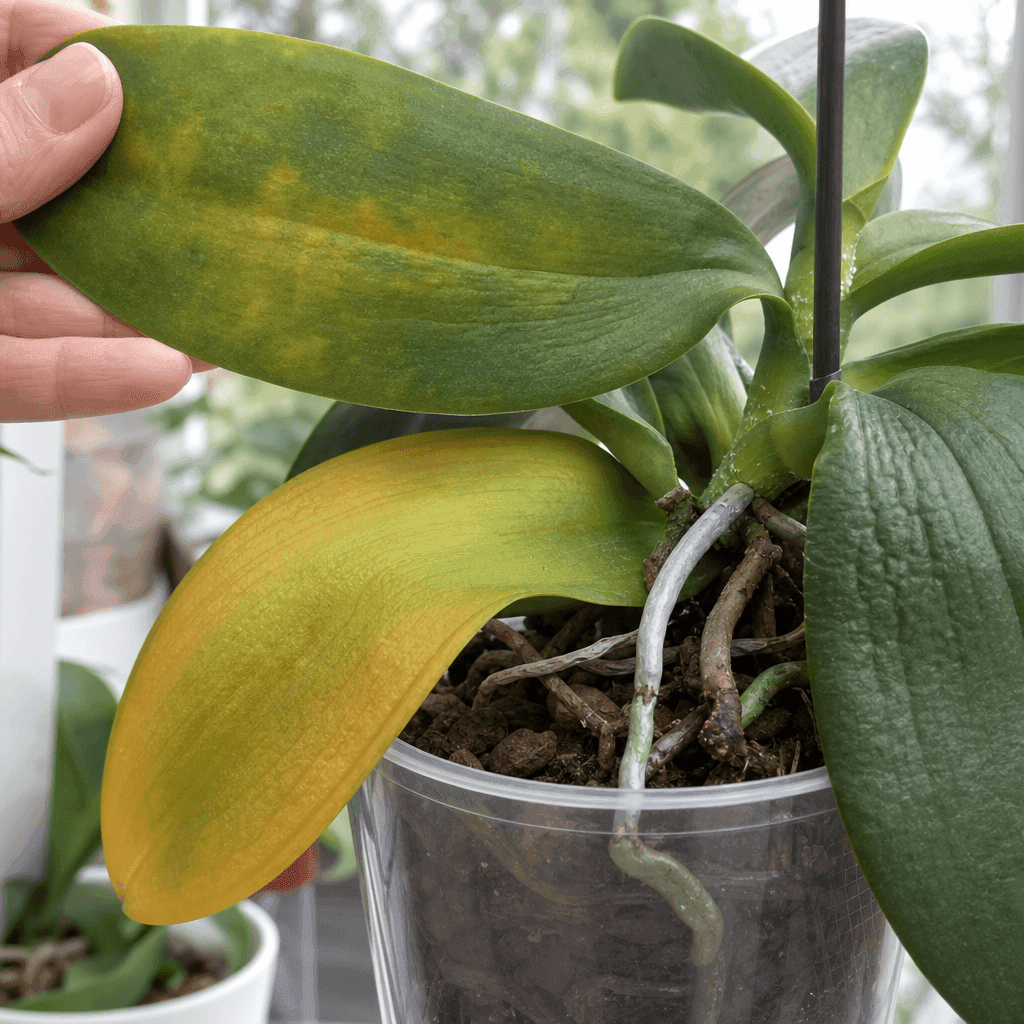
Natural leaf ageing and shedding
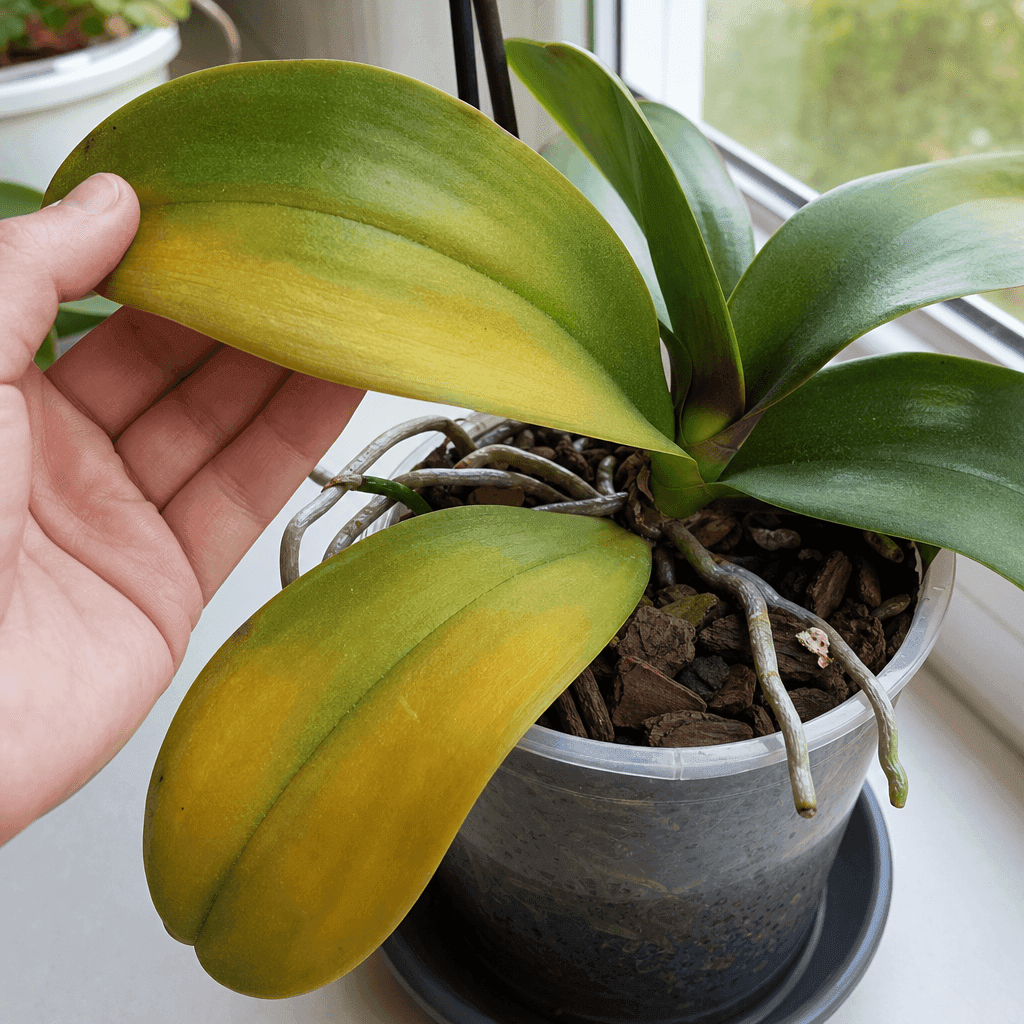
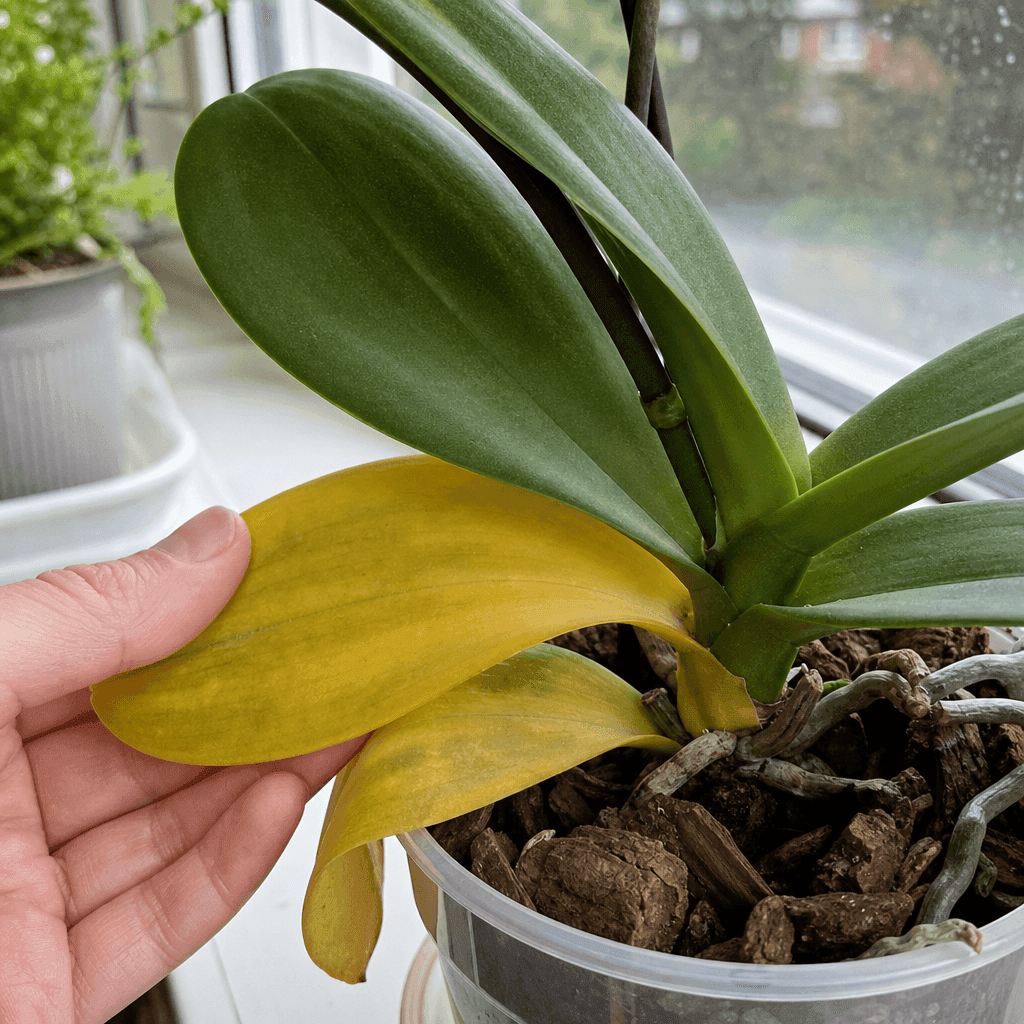
Most likelyPhalaenopsis orchids are sympodial plants that grow from a single stem, producing one or two new leaves per growing season from the top while the oldest lowest leaves gradually age and yellow. The American Orchid Society notes this is completely normal — a Phalaenopsis losing its bottom leaf every six to twelve months is not in decline. The leaf will gradually yellow over several weeks, soften, and eventually detach. If only one leaf is affected and the rest of the plant is firm, green and growing, no intervention is needed.
- Only the lowest, oldest leaf is yellowing — the one closest to the compost.
- Yellowing is gradual, uniform and the leaf eventually goes fully yellow.
- All other leaves are firm, green and healthy.
- New growth is emerging from the centre of the plant.
- Roots look healthy — green when recently watered, silvery when dry.
- No action is needed — this is healthy behaviour.
- Once the leaf is fully yellow and detaches easily with a gentle tug, remove it to keep the plant tidy.
- Do not pull a leaf that is still partially green or firmly attached — you can damage the stem.
- Continue normal care.
panic and water more frequently when you see one bottom leaf yellowing — extra water is more likely to cause root rot than to solve anything.
Overwatering and root rot
Most likelyOverwatering is the most common cause of multiple yellowing leaves and plant death in UK Phalaenopsis orchids. Orchid bark compost should dry out significantly between waterings — in a warm UK home, once every seven to fourteen days in summer, less in winter. When orchids are watered too frequently, or if they sit in a cachepot with standing water, the roots are deprived of oxygen, begin to rot, and can no longer absorb water or nutrients. Love Orchids (UK specialist) describes the signs as brown, slimy roots and leaves that feel soft and limp even though the compost is wet. If the roots have already started to rot, follow our step-by-step guide to orchid root rot recovery to salvage the plant.
- Look through the clear inner plastic pot — brown, grey-black or slimy roots indicate rot.
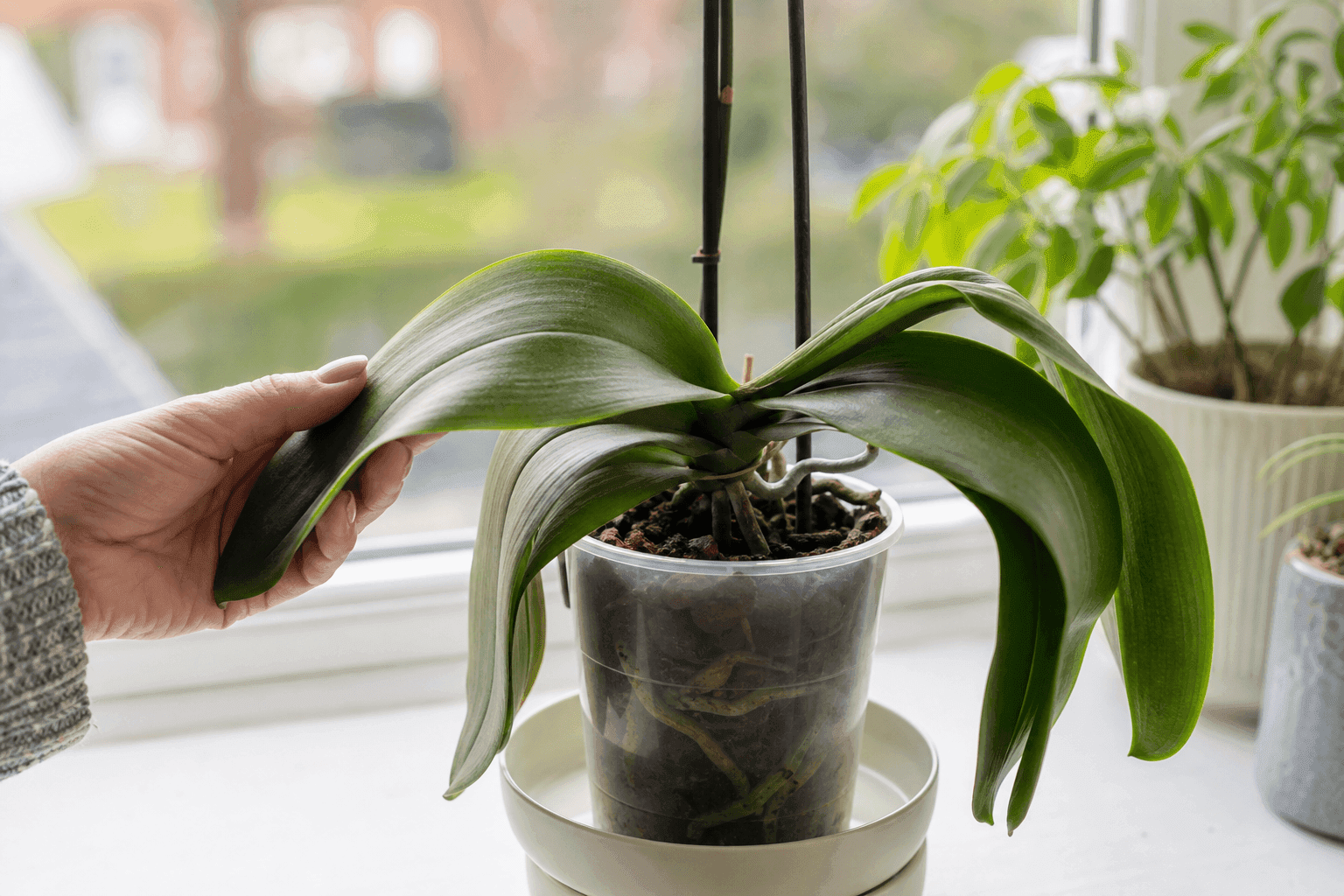
- Leaves feel soft and limp rather than firm and plump.
- The compost has been wet for more than two weeks without drying out.
- The plant is sitting in standing water in a decorative cachepot.
- Multiple leaves are yellowing simultaneously or in rapid succession.
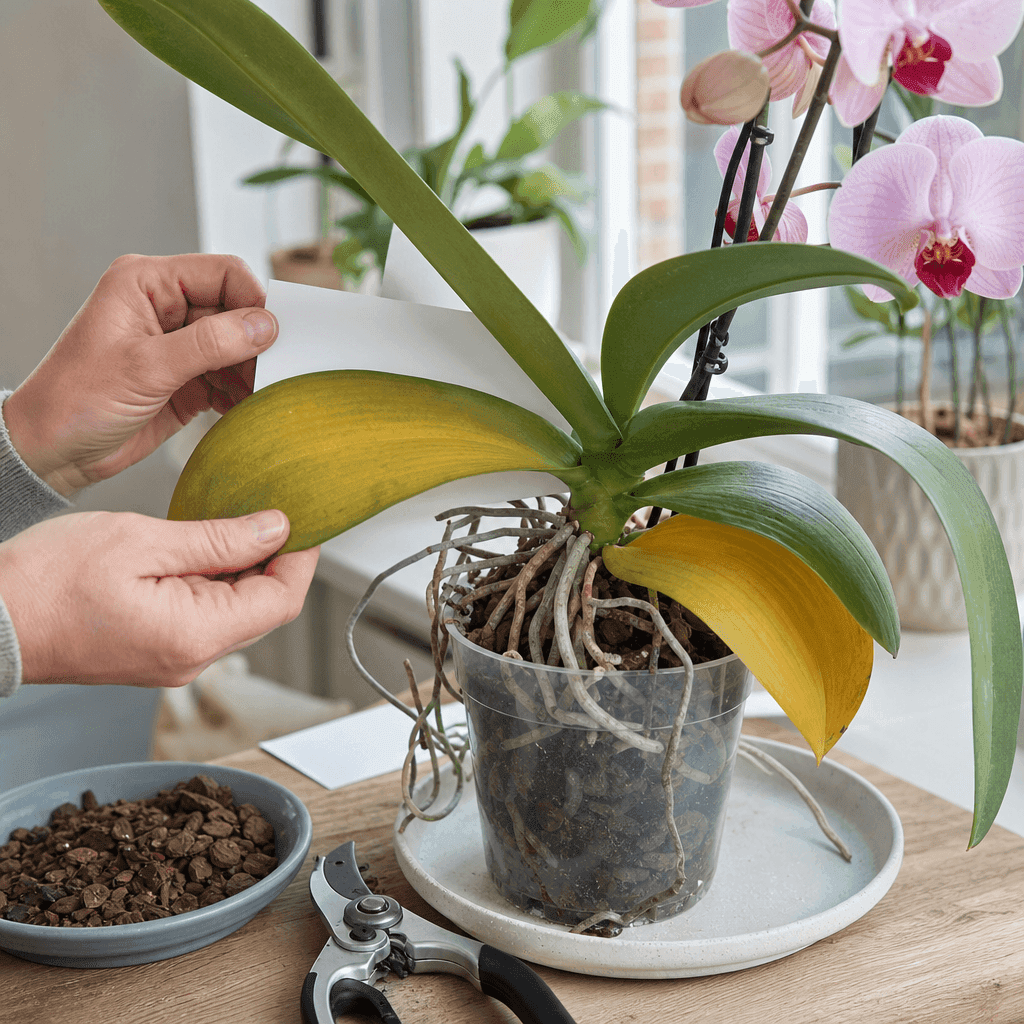
- Remove the orchid from its decorative pot and clear inner pot.
- Gently shake out the old bark compost and examine the roots.
- Trim all brown, mushy roots with clean, sharp scissors — cut back to white, firm tissue.
- Dust cut ends with powdered cinnamon (a natural antifungal) or leave to air-dry for 30 minutes.
- Repot in fresh orchid bark compost in a clear plastic pot with drainage holes.
- Do not water for 3–5 days after repotting.
- In future, water only when roots turn silvery-grey throughout, and always allow the pot to drain fully.
Stop it coming back:Never let an orchid sit in standing water in a saucer or cachepot. Check the root colour through the clear pot before watering — if any roots are still green, wait.
continue watering on a fixed schedule regardless of root colour — the correct watering frequency varies with season, pot size and room temperature.
Too much direct sun / sunburn
Most likelyPhalaenopsis orchids evolved in the dappled shade of rainforest canopies and are intolerant of direct midday or afternoon sun. In UK homes, a south- or west-facing windowsill between April and October can expose orchids to light levels that bleach and damage the chlorophyll in their leaves. The Just Add Ice Orchid blog notes that sunburned leaves have an unevenly faded, splotchy or papery appearance — they remain firm and plump (unlike the soft, limp leaves of overwatered plants) but the damaged tissue is permanent.
- Bleached, papery or yellow-white patches on firm, plump leaves.
- Damage is worst on the side or surface facing the window.
- The plant is on or near a south- or west-facing windowsill.
- Damage appeared or worsened in spring or summer when the sun angle is higher.
- Move the orchid to bright, indirect light — a north- or east-facing windowsill, or 1–2 metres back from a bright south or west window.
- A net curtain or sheer blind on a south or west window is enough to filter direct sun.
- Damaged patches will not recover — they remain bleached — but new leaves will grow healthy if light conditions are corrected.
- Do not increase watering in response to sun stress — the issue is light, not drought.
put a struggling orchid in a dark corner to 'protect' it from sun damage — insufficient light causes poor growth and failure to flower.
Underwatering and drought stress
PossibleWhile overwatering is far more common, underwatered Phalaenopsis orchids also develop yellow leaves — but the pattern is distinct. Drought-stressed orchids have shrivelled, wrinkled or limp leaves combined with entirely silvery-grey roots, a very light pot and bone-dry compost. The same dehydration often shows up as orchid leaves drooping before they yellow. In the UK, this is most common in centrally heated homes in winter when the air is dry, or when an orchid is forgotten for several weeks.
- Roots are silvery-grey throughout — not green or brown-mushy.
- Leaves are limp or wrinkled, not soft and slimy.
- The pot feels very light when lifted.
- The bark compost is completely dry and pulls away from the pot sides.
- Submerge the pot in room-temperature water for 15–20 minutes to allow the bark to fully rehydrate.
- Lift out, allow to drain thoroughly and return to its position.
- Check again in 7–10 days — roots should look green after watering.
- In very dry, centrally heated rooms, stand the orchid on a pebble tray with a little water (below the pot base) to raise local humidity.
water so frequently after a drought episode that you swing into overwatering — wait until the roots go silvery again before the next watering.
Cold damage and temperature shock
PossiblePhalaenopsis orchids are tropical plants and require temperatures between 18°C and 30°C. In the UK, they are commonly placed on windowsills that become very cold at night in winter, or near draughty doors. Temperatures below 10°C cause cell damage, leading to yellowing, translucent or water-soaked patches on the leaves. The damage can look similar to bacterial or fungal infection but is caused purely by cold.
- Yellowing or translucent, water-soaked patches appeared after a cold night or cold spell.
- The plant is near a single-glazed window, draughty door or external wall.
- The plant has been moved from a warm to a cold environment recently.
- Thermometer readings near the plant drop below 10°C at night.
- Move the orchid to a stable position, ideally 18–24°C and away from draughts.
- Avoid placing orchids directly against glass in single-glazed windows in winter.
- Remove badly damaged leaves cleanly at the base with sterilised scissors.
- Do not move the plant suddenly from a very cold to a very hot room — gradual acclimatisation is better.
Stop it coming back:In winter, pull orchids back from the glass at night, or move them to a warmer spot. A consistent temperature is more important than a slightly higher average — orchids tolerate cool stable conditions better than frequent temperature swings.
place an orchid over a radiator to warm it up — the dry heat and temperature fluctuation causes more stress than cold.
Nutrient deficiency in old or broken-down compost
Less likelyOrchid bark compost breaks down over two to three years into a fine, sodden mass that retains water, loses aeration and provides no nutrients. General yellowing of younger leaves in an orchid that has not been repotted for several years often indicates nutrient deficiency — but this is only likely once watering, light and temperature are already correct. The American Orchid Society recommends feeding with a balanced fertiliser ('weekly, weakly') at quarter to half the suggested dose.
- The orchid has not been repotted for two or more years.
- The compost has broken down — it looks dark, dense and soil-like rather than chunky bark.
- Younger leaves (not just the oldest bottom leaf) are yellowing.
- Growth is very slow and the plant has not flowered for over a year despite adequate light.
- Repot into fresh orchid bark compost — this is the most effective nutrient 'reset'.
- Use a pot only slightly larger than the root ball — orchids flower best when slightly pot-bound.
- Once settled (after two to four weeks), begin feeding with a balanced orchid fertiliser at half strength every three to four waterings during active growth.
- Reduce or stop feeding entirely in winter when growth slows.
feed an orchid with root rot or in poor health — nutrients cannot be absorbed if the roots are damaged and feeding adds stress.
Still not sure?
Work down these branches — the first one that matches is your answer.
What not to do
- Water on a fixed weekly schedule regardless of root colour — check the roots first.
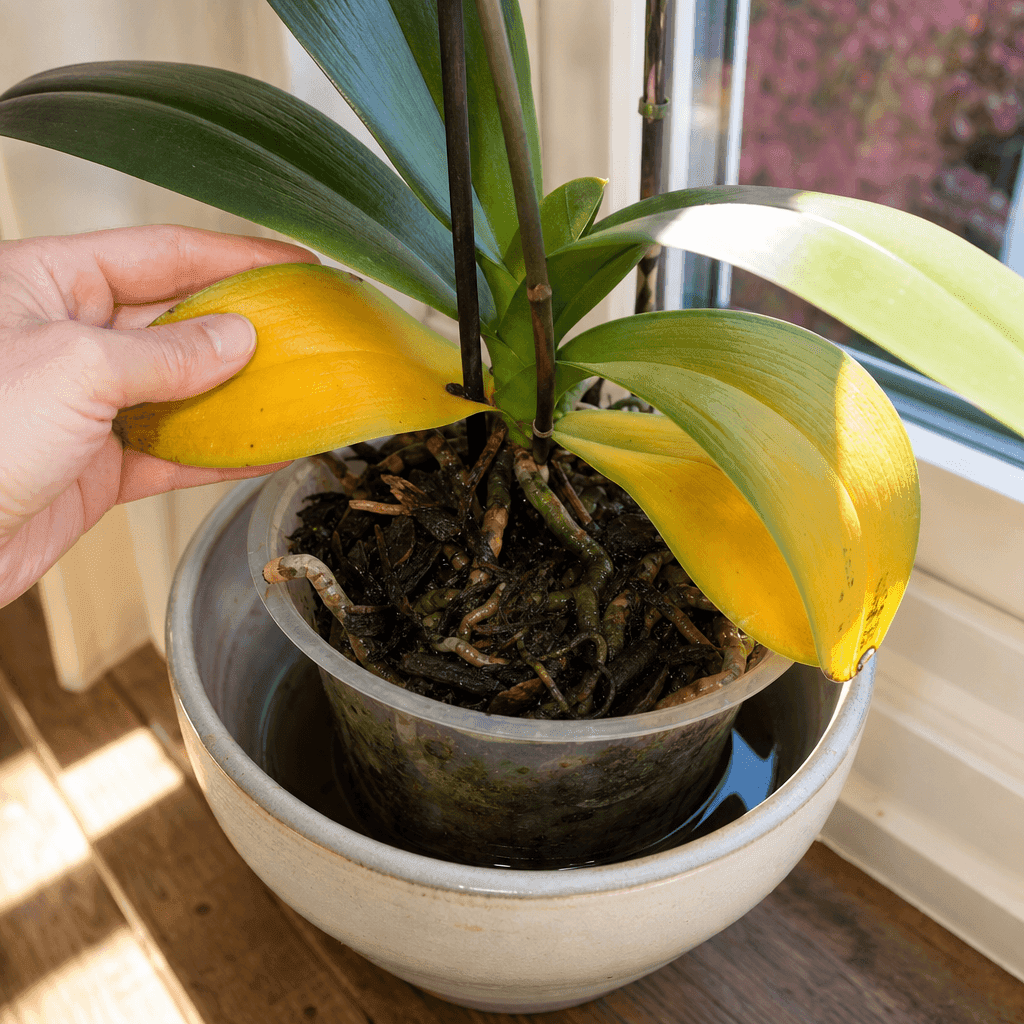
- Leave the orchid sitting in standing water in a decorative cachepot.
- Place the orchid on a sunny south-facing windowsill in summer.
- Pull off a partly-green leaf that is still firmly attached to the stem.
- Feed an orchid with damaged or rotten roots — it cannot absorb nutrients.
Common questions
Is it normal for orchid leaves to turn yellow?
Yes, if only the oldest bottom leaf is yellowing — Phalaenopsis orchids naturally shed their lowest leaf every six to twelve months. This is not a problem. If multiple leaves are yellowing or leaves higher up the plant are affected, investigate overwatering, sunburn or cold damage — the same checks apply to yellow leaves on indoor plants generally.
How do I know if my orchid has root rot?
Look through the clear inner plastic pot. Healthy roots are plump and bright green after watering, turning silvery-grey as they dry. Rotten roots are brown, grey-black, soft or slimy and do not turn green after watering. If you see these, repot immediately and trim all dead roots.
How often should I water an orchid in the UK?
There is no fixed schedule. Water when the roots turn silvery-grey throughout — typically once every 7–14 days in summer and every 14–21 days in winter. Always allow the pot to drain completely after watering and never leave it standing in water.
What is the best position for a Phalaenopsis orchid in a UK home?
A north- or east-facing windowsill is ideal. South- or west-facing windows work if the plant is kept at least a metre back from the glass or shielded by a net curtain. Avoid draughty spots near doors or single-glazed windows in winter. See our full orchid care and problem-solving guides for more on light, watering and feeding.
Can yellow orchid leaves turn green again?
No. Once leaf tissue has yellowed, it cannot recover its green colour. The goal is to correct the underlying cause so that new leaves grow healthy. Burnt patches from sunlight and cold damage also remain permanently discoloured.
Should I cut off yellow orchid leaves?
Only if the leaf is entirely yellow and detaches easily with a gentle tug — at that point it is no longer contributing to the plant. Do not remove leaves that are still partly green or firmly attached. Always use sterilised scissors to avoid introducing disease.
Why is my orchid not flowering?
The most common reasons are insufficient light, too-warm nights (orchids need a temperature drop to 15–17°C at night to trigger flowering), or the plant is still recovering from root damage. Correct light first — an orchid in a dark corner will rarely flower.
When should I repot my orchid?
Repot every two to three years, or when the bark compost has broken down to a dark, dense mass, or when roots are growing heavily out of the drainage holes. The best time is after flowering. Move up only one pot size — orchids flower best when slightly pot-bound.