Quick diagnosis
Match the row to what you’re seeing, then jump to the fix.
| What you see | Likely cause | Confidence | How to confirm | What to do now | Urgency |
|---|---|---|---|---|---|
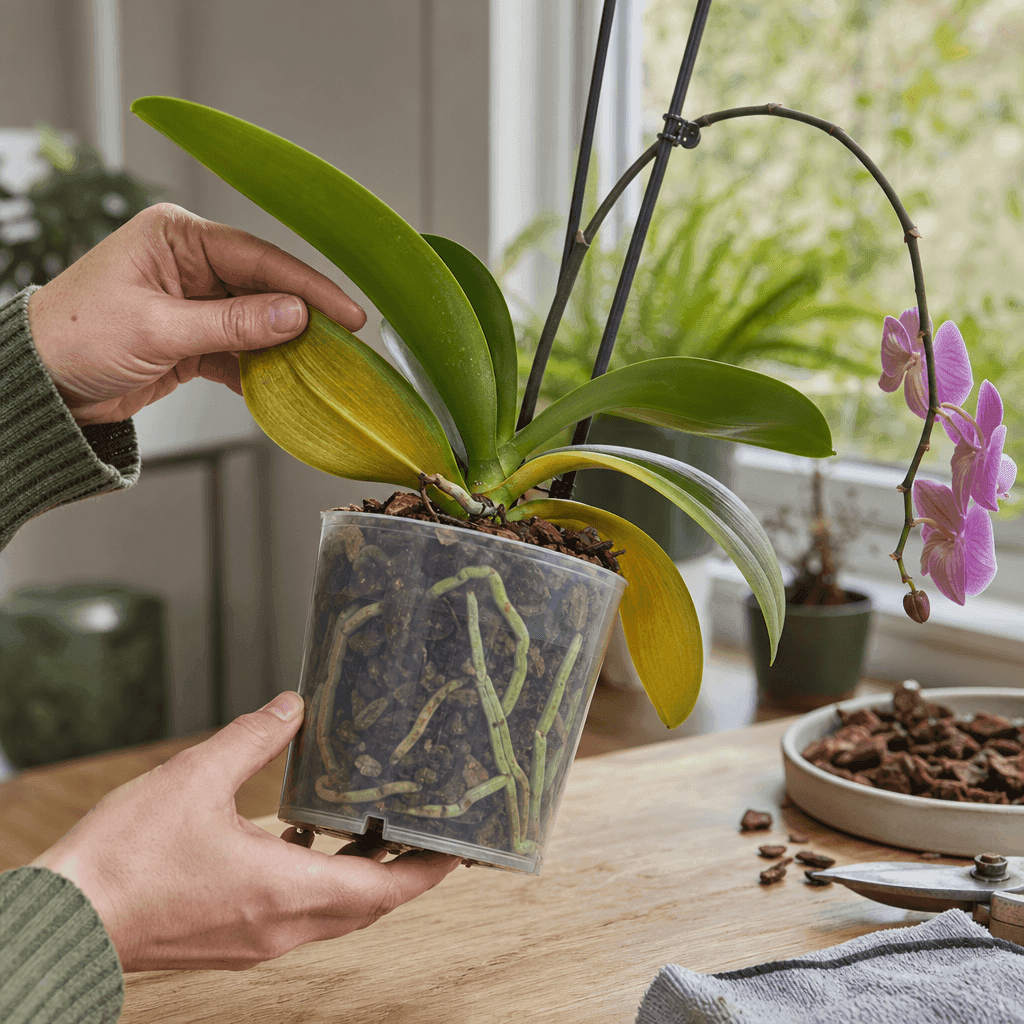
| Leaves floppy and yellowing; roots brown, soft or hollow in the pot | Overwatering / root rot | High | Remove inner pot and inspect roots — healthy roots are firm and silvery-green, rotted roots are brown and mushy. | Trim dead roots, repot into fresh bark, reduce watering frequency. | High |
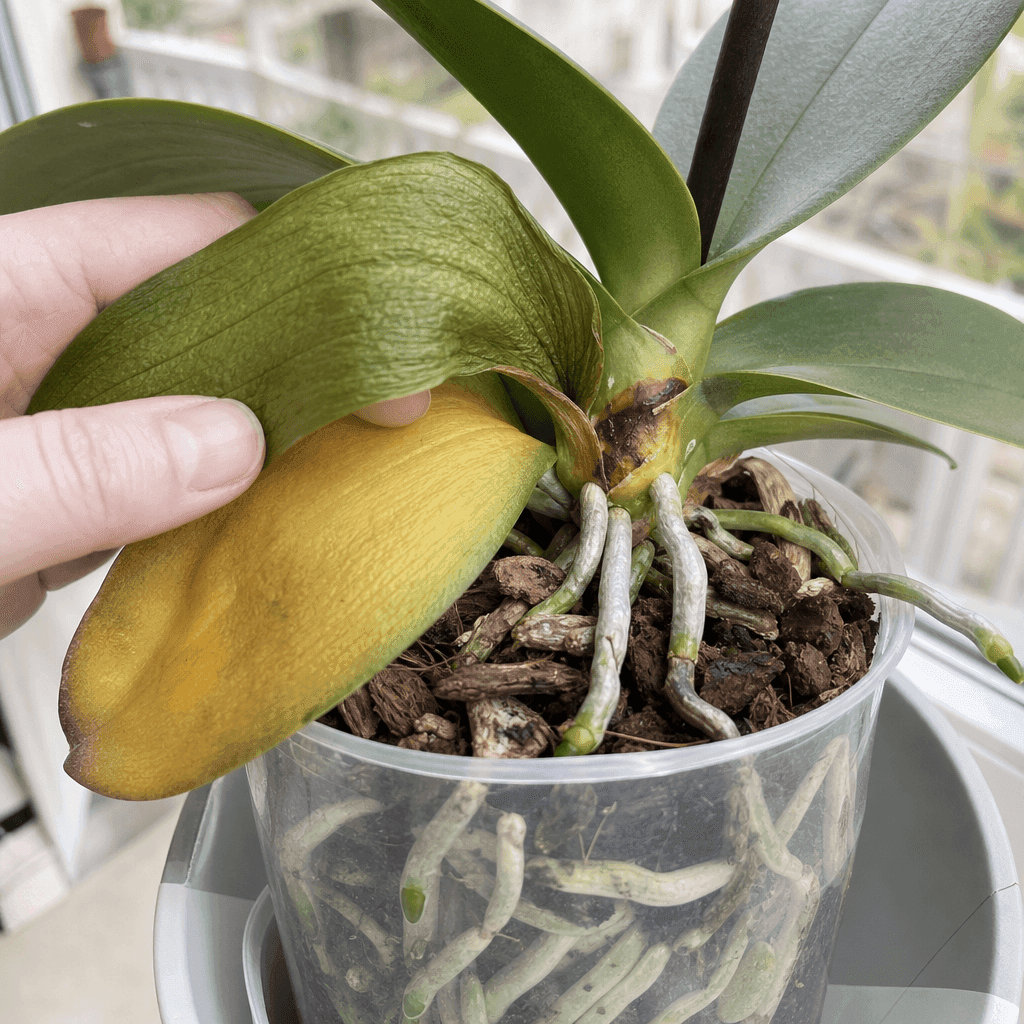
| Leaves turning yellow from the top down; dark, mushy patch in the crown | Crown rot | High | Dark, soft, wet area at the very centre of the plant where the leaves emerge. | Blot out standing water; remove rotted tissue; treat crown with cinnamon or hydrogen peroxide; keep crown dry. | High |
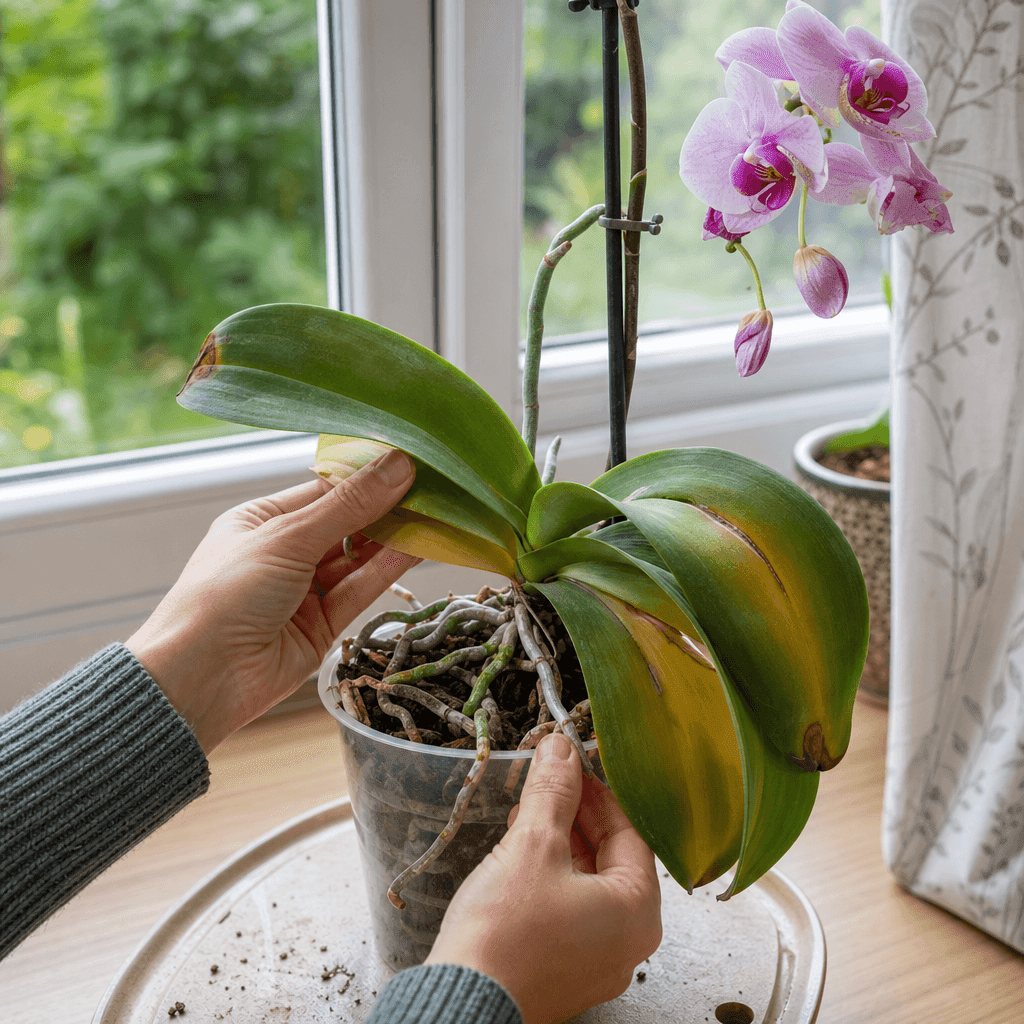
| Leaves leathery, wrinkled or accordion-pleated; roots are silvery throughout | Underwatering / dehydration | Medium | All roots look pale and dried; leaves feel thin and wrinkled; bark has been bone dry for weeks. | Soak the pot in room-temperature water for 15–20 minutes; resume watering when roots turn silvery. | Medium |
| Leaf tips brown; leaves wrinkling; flower buds dropping before opening | Low humidity or cold draughts | High | Plant is near a radiator, in a cold or draughty window, or in a room with very dry air. | Move away from radiators and draughts; increase humidity with a pebble tray or room humidifier. | Medium |
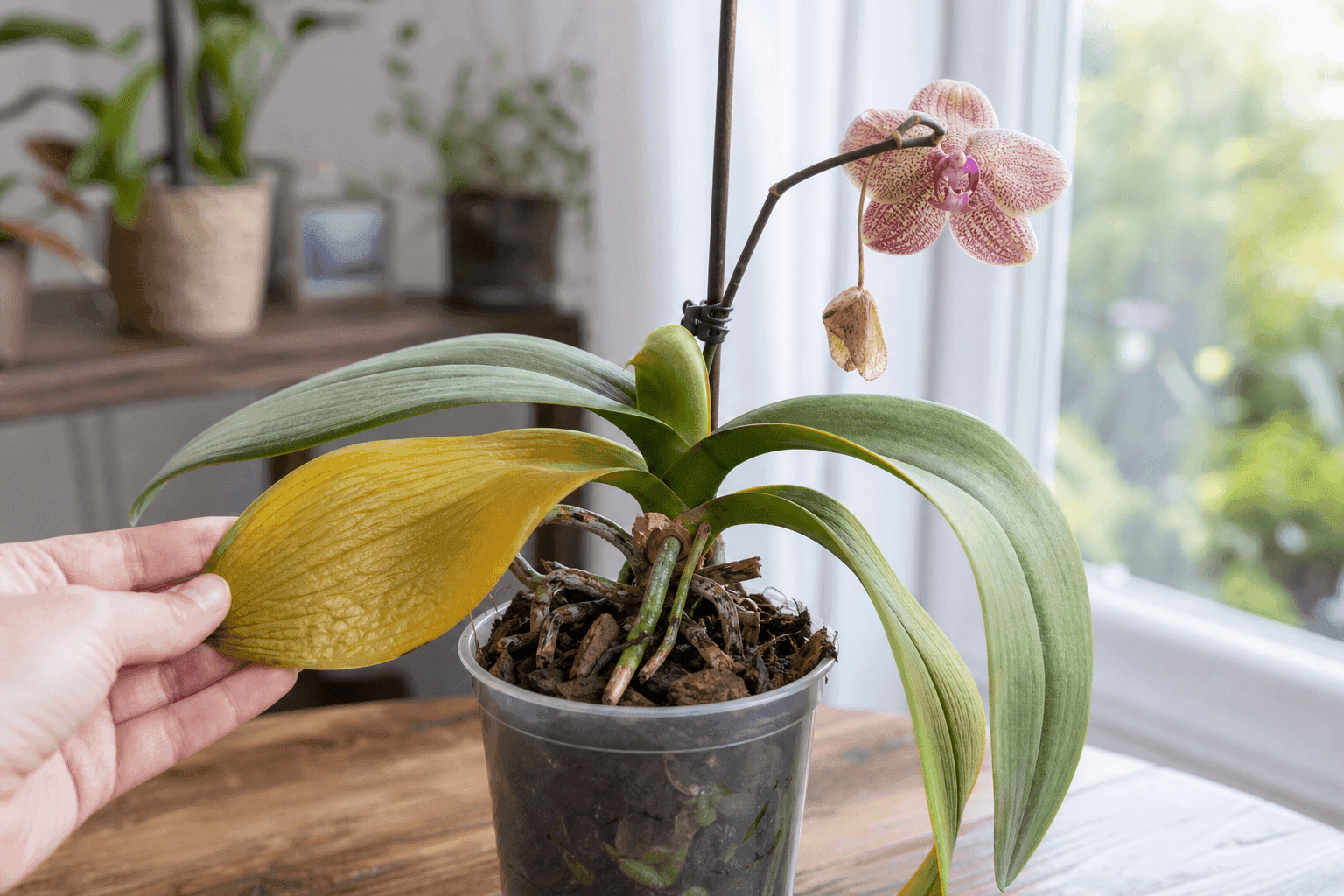
| One or two bottom leaves turn yellow then drop while new leaves grow at the top | Natural leaf turnover | High | Only the oldest, lowest leaf is affected; the rest of the plant is firm and upright. | Remove the yellowed leaf cleanly; continue normal care. | Low |
| All flowers dropped, no new spike, leaves look healthy | Post-flowering rest period | High | Plant is otherwise healthy; the flower spike has finished; leaves are firm and green. | Cut spent spike to a node; move to brighter indirect light; cool nights 15–18°C will encourage reblooming. | Low |
| Leaves yellowing slowly; no new spike after many months; growth very slow | Insufficient light | Medium | Plant is more than 1–2 m from a window; winter light levels in the UK are very low. | Move to a bright east- or west-facing windowsill; avoid direct midday sun in summer. | Low–medium |
The causes, in detail
Overwatering and root rot
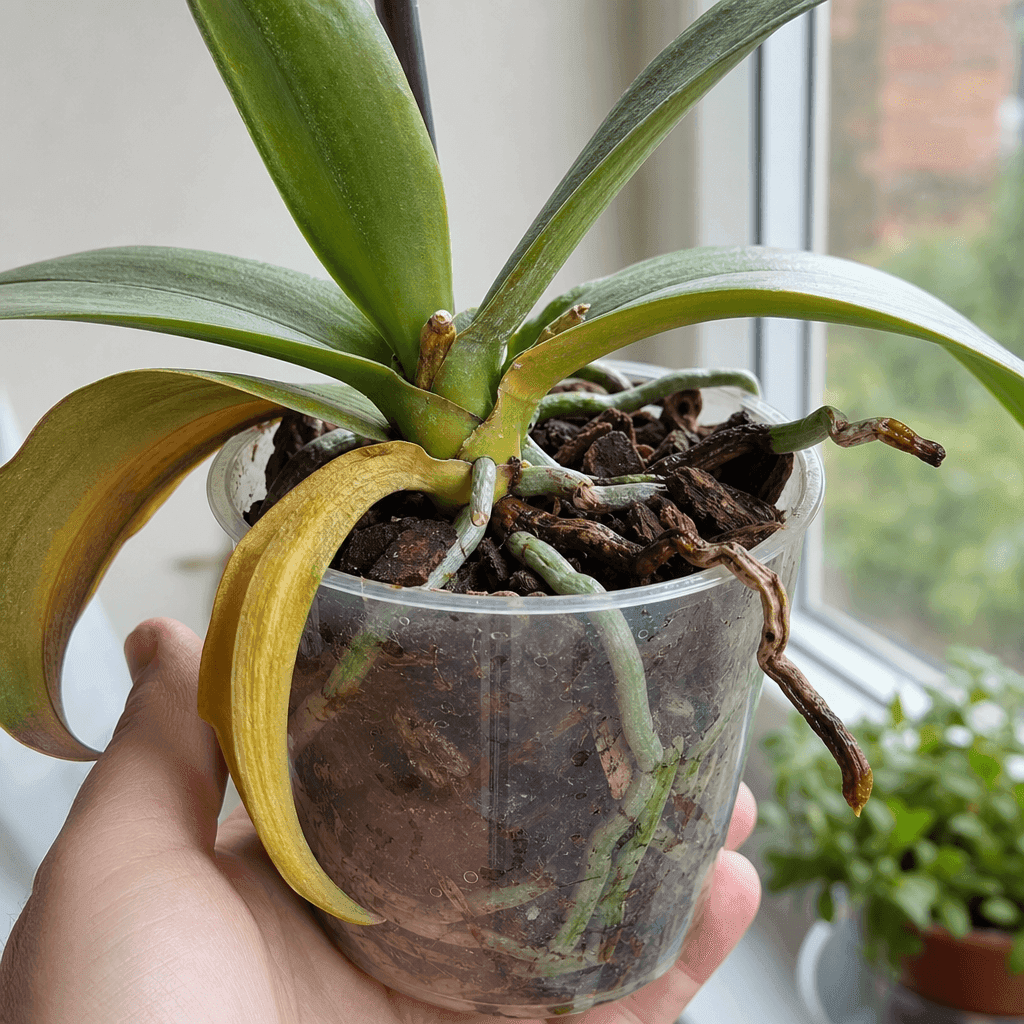
Most likelyRoot rot in orchids is the single most common reason a Phalaenopsis orchid dies in a UK home. In nature, Phalaenopsis orchids are epiphytes — they grow on tree bark with their roots exposed to air, drying fully between rain events. UK conditions (cool rooms, low light in autumn and winter, frequent good intentions) mean many are watered far too often. Orchid roots can only absorb water for a limited period before they begin to break down and allow fungi and bacteria to colonise them. Gardeningetc.com and specialist orchid growers consistently identify overwatering as the leading killer. Look through the clear inner pot: silver roots are dry and ready to water; green roots already have water and do not need more.
- Remove the clear inner pot and look at the roots — brown, hollow, mushy roots confirm rot.
- The bark compost smells sour or musty.
- The leaves are floppy and yellowing but the bark has been kept consistently wet.
- The pot feels heavy despite the bark appearing old and broken down.
- Remove the orchid from its pot and shake away the old bark gently.
- Cut away all dead, brown, hollow or mushy roots with sterilised scissors — healthy roots are white, firm and full. The same step-by-step root rot treatment applies to most potted plants.
- Dust cuts with powdered cinnamon (a natural antifungal) or leave to air for 30 minutes.
- Repot into fresh orchid bark — not multipurpose compost — in a clean clear pot with drainage holes.
- Water only when roots turn from green to silvery, typically every 7–14 days in winter and every 5–10 days in summer.
Stop it coming back:A plant with living root stubs can recover over several months. Do not expect new leaf growth for 6–8 weeks. The key marker of recovery is white root tips appearing on the stubs.
water on a fixed weekly schedule regardless of the root colour — always check first. Do not place the pot in a saucer of water, as standing water rots roots from below.
Crown rot
Most likelyCrown rot is the cause of Phalaenopsis death most specific to this genus. The crown is the tight funnel at the centre of the plant where the leaves emerge. If water pools there — from overhead watering, misting, or the plant sitting in a position where condensation drips into the centre — the densely packed tissue cannot dry out and begins to rot rapidly. The American Orchid Society identifies crown rot as one of the most preventable causes of Phalaenopsis death: always water in the morning so any water that enters the crown has time to evaporate, and blot it out immediately with a paper towel if watering from above.
- The newest leaf or the central growing point looks dark, soft or water-soaked.
- A foul smell may come from the crown when leaves are gently pulled apart.
- Yellowing has progressed from the top leaves downward, not from the bottom leaves upward.
- Stop misting or overhead watering immediately.
- Blot standing water from the crown with a paper towel or cotton bud.
- If rot has begun, carefully remove the affected leaf and any soft tissue with a sterilised blade.
- Dust the wound with powdered cinnamon or apply a small amount of 3% hydrogen peroxide.
- Place the plant so air can move around the crown — do not leave it in a still, enclosed space.
- The plant can sometimes recover if the rot is caught early and at least one healthy root remains.
mist the crown of a Phalaenopsis. Do not water from above in the evening when the crown has no time to dry out.
Underwatering and dehydration
PossibleUnderwatering is less common than overwatering in UK conditions but does occur, particularly in centrally-heated homes in winter where the bark dries quickly, or after a holiday when the plant has been left unattended. A dehydrated Phalaenopsis has wrinkled, accordion-pleated or leathery leaves and roots that look uniformly silvery because they have no water at all. This is distinct from a healthy dry root, which has a silvery sheen but is still firm.
- All roots look pale silver and the bark is bone dry.
- Leaves feel thin, leathery, or have an accordion-pleated appearance.
- The pot is very light when lifted.
- Place the inner pot in a bowl of room-temperature water for 15–20 minutes — this allows the roots to absorb water slowly.
- Remove the pot and let it drain fully before returning it to the decorative outer pot.
- Resume normal watering — water when roots turn from green to silver, roughly every 7–14 days.
- Do not mist the leaves — this raises humidity but does not water the roots.
leave the pot sitting in water for hours — soaking for more than 20–30 minutes can paradoxically cause root oxygen deprivation.
Low humidity and cold draughts
Most likelyPhalaenopsis orchids originate from tropical and subtropical Asia and prefer humidity of 50–70%. UK homes in winter, especially when heated by radiators, routinely drop to 30–40% relative humidity or lower. Cold draughts from poorly sealed single-glazed windows are particularly damaging — the RHS recommends placing Phalaenopsis away from both direct radiator heat and cold window draughts. Symptoms of low humidity include brown leaf tips, bud blast (buds dropping before opening), and progressively thinner, drier roots.
- The plant is near a radiator or in front of a draughty window.
- Leaf tips are brown and dry, not soft or water-soaked.
- Flower buds are dropping before they open, despite the plant appearing otherwise healthy.
- Move the plant to a bright spot at least 50 cm away from radiators and draughts.
- Place the pot on a tray of wet pebbles — as water evaporates it raises the humidity immediately around the plant.
- A small room humidifier benefits orchids and many other houseplants.
- An east- or west-facing windowsill is usually ideal in a UK home.
mist directly into the crown or onto flower buds — this can cause crown rot and bud blast. Aim misting at the roots only if you choose to mist at all.
Natural leaf turnover
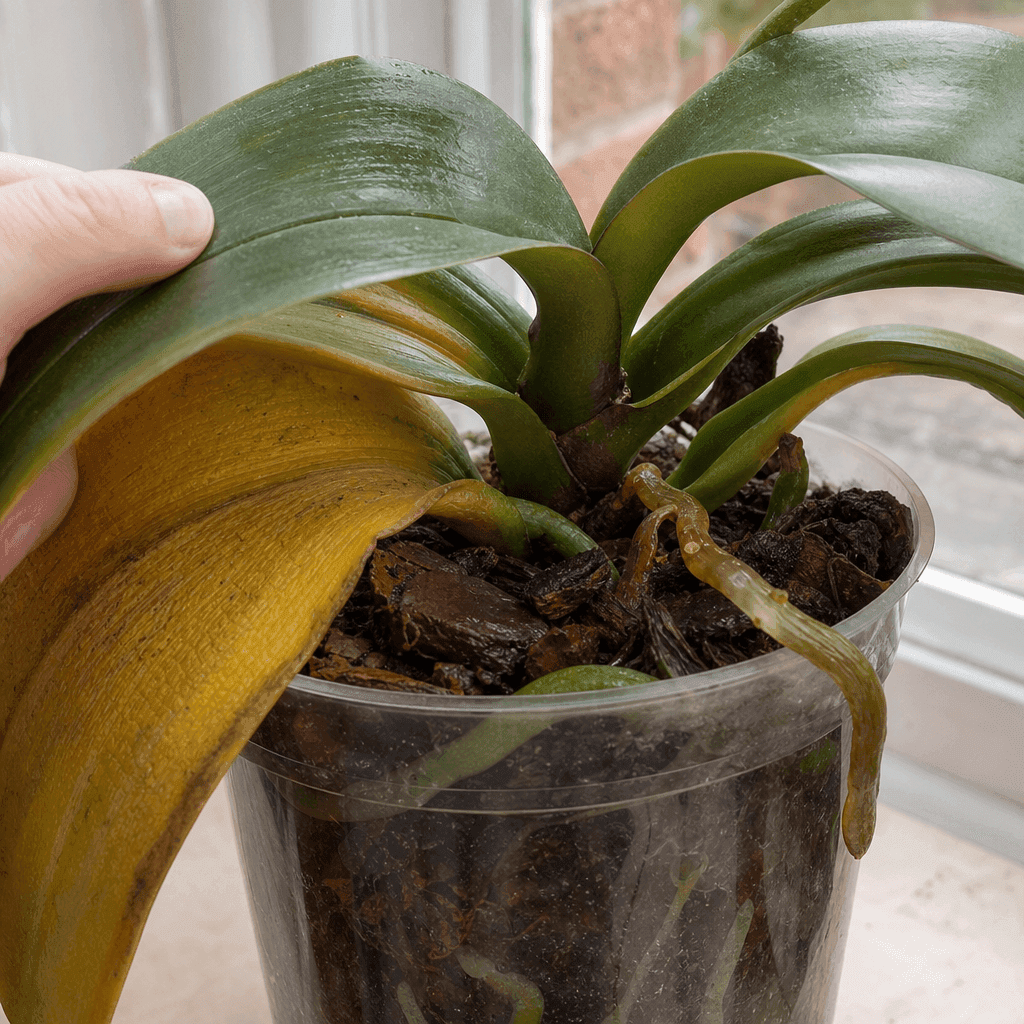
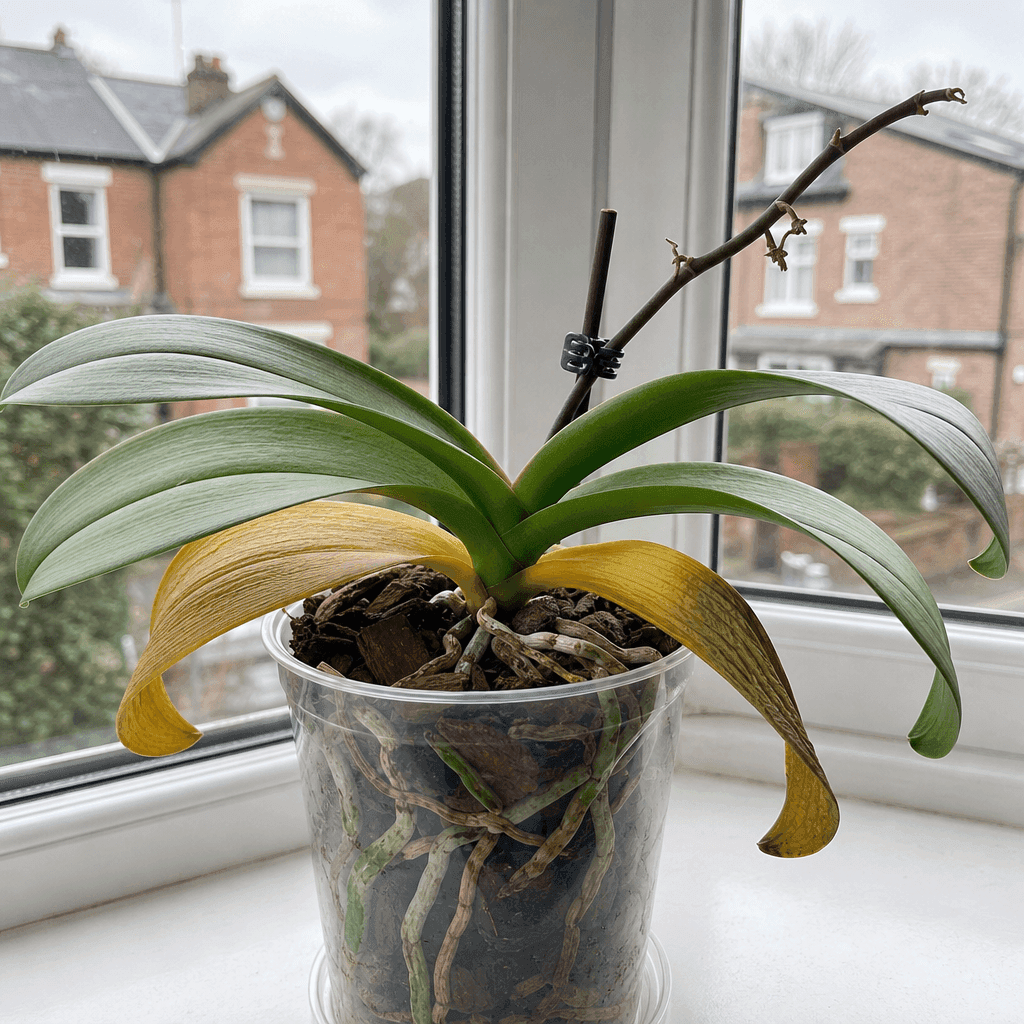
Most likelyPhalaenopsis orchids replace their oldest leaves periodically. The lowest, oldest leaf turns yellow and drops — this is normal and does not indicate disease or poor care. Problems arise when gardeners mistake this natural process for a sign of decline and begin changing watering, feeding and light all at once, which can actually cause the stress they are trying to prevent. The key clue is that only the single oldest leaf is affected and the rest of the plant is upright and firm.
- Only the single lowest, oldest leaf is yellowing.
- The yellowing is uniform and even, not patchy or spotted.
- All other leaves are firm, upright and a healthy mid-green.
- Remove the yellowed leaf cleanly by giving it a gentle tug at the base, or use sterilised scissors.
- Continue normal care without changing anything else.
- Monitor the next leaf down over the following weeks.
begin changing watering, light and fertiliser at the first sign of a single yellowing bottom leaf — this is almost always natural turnover.
Post-flowering rest and failure to rebloom
Most likelyAfter a Phalaenopsis finishes flowering — which can last many months — it enters a rest period. This is often mistaken for decline. The plant needs a period of cooler nights (around 15–18°C) to trigger a new flower spike. In UK homes this often happens naturally near a window in autumn and early winter. The RHS notes that Phalaenopsis will generally reflower if given bright indirect light and a period of cooler temperatures.
- The flower spike has finished and dropped its blooms.
- All leaves are firm, upright and healthy.
- No new spike has appeared after several months.
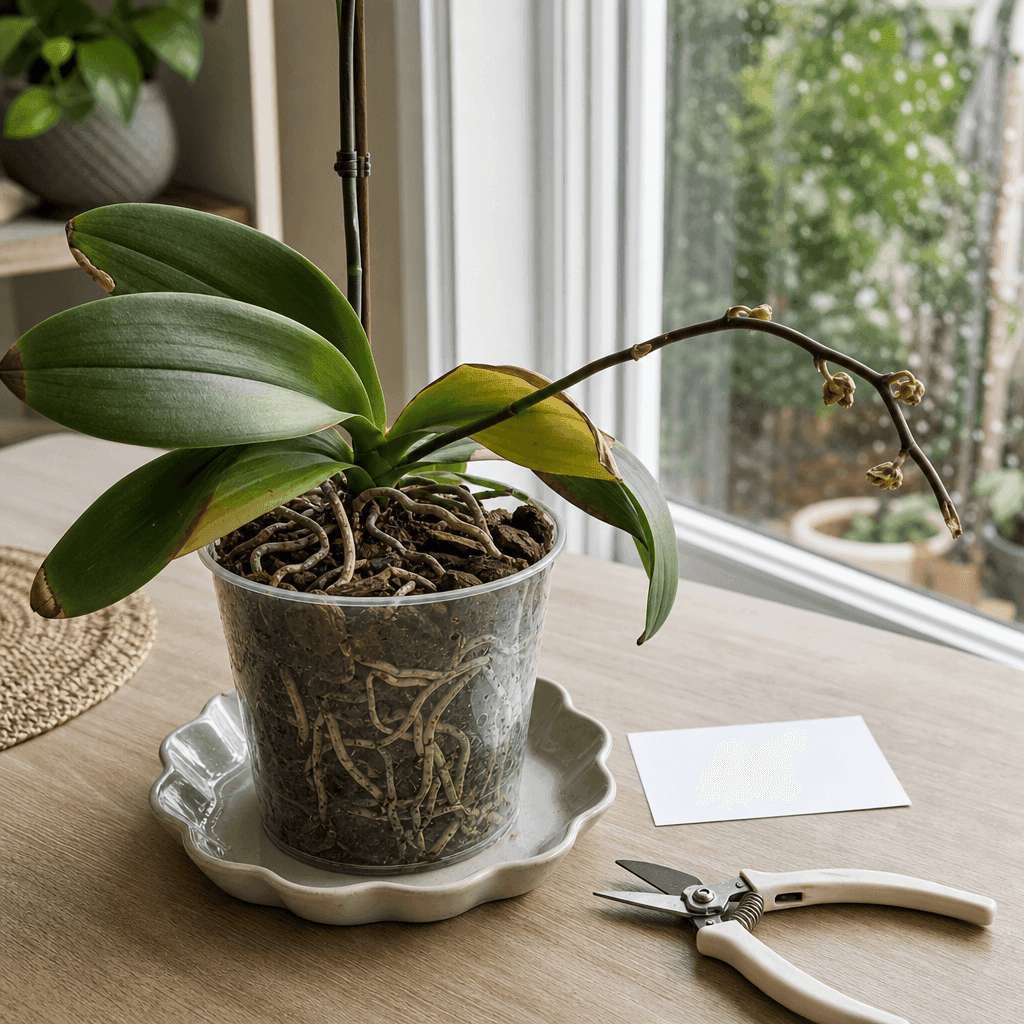
- Cut the spent spike back to just above a node — the plant may produce a branching spike from that node.
- Move to a bright east- or west-facing windowsill.
- Allow night temperatures to drop slightly — near a window in autumn naturally achieves this.
- Feed with a specialist orchid fertiliser at half strength once a month during this period.
cut the spike all the way to the base immediately — leave it for a few weeks first in case it branches from a node.
Insufficient light
PossiblePhalaenopsis orchids tolerate lower light than many houseplants, but they need bright indirect light to flower and stay healthy. In the UK, winter light levels — especially north of Birmingham — can drop very low, and a plant placed more than 2 metres from a window may receive almost no useful light for several months. The American Orchid Society recommends placing Phalaenopsis near an east- or south-facing window where it receives bright indirect light but not direct summer midday sun.
- The plant is positioned more than 1–2 metres from the nearest window.
- Leaves are pale, limp or yellowing slowly without an obvious watering cause.
- No new spike has appeared after more than 12 months of otherwise good care.
- Move the orchid to a bright east- or west-facing windowsill.
- In winter, a south-facing window is acceptable — the low winter sun is unlikely to scorch.
- Avoid north-facing windowsills in the UK where winter light is very poor.
- A specialist orchid grow light can supplement natural light in winter for serious growers.
place the orchid in direct summer midday sun — this scorches the leaves and stresses the plant. Bright indirect light, not direct sun, is the target.
Still not sure?
Work down these branches — the first one that matches is your answer.
What not to do
- Water on a fixed weekly schedule without checking the root colour first.
- Mist the crown or water from above in the evening.
- Leave the orchid sitting in a saucer of water.
- Feed a plant with root rot or crown rot — it adds stress.
- Place the orchid in direct summer sun or directly in front of a radiator.
Common questions
How do I know if my orchid is dead or just resting?
Check the roots. If at least some roots are firm and white or silvery-green, the orchid is alive. A plant that has finished flowering with healthy leaves and some good roots is resting, not dying. An orchid with all brown, hollow, mushy roots and collapsed leaves is very unlikely to recover.
Why are my orchid leaves turning yellow?
The most common reasons are overwatering and root rot, natural leaf turnover (one old bottom leaf), insufficient light, cold draughts, or natural ageing after a long flowering period. Our guide to orchid leaves turning yellow walks through each cause in detail. Check the roots first — if they are brown and mushy, reduce watering and repot.
How often should I water a Phalaenopsis orchid in the UK?
Water when the roots change from green to silvery — roughly every 7–14 days in winter and every 5–10 days in summer. Never water on a fixed schedule; always check the roots through the clear pot first.
Can I save an orchid with crown rot?
Possibly, if it is caught early. Remove all soft, dark tissue, blot the area dry and treat with powdered cinnamon. Stop overhead watering immediately. If one or more healthy roots remain, the plant may recover slowly over months, though it may not produce new leaves if the growing point is destroyed.
Why did my orchid's flower buds drop before opening?
Bud blast — buds dropping before opening — is usually caused by sudden temperature changes, cold draughts, low humidity, or being moved while in bud. Keep the plant in one stable position from the time buds form until the flowers open.
How do I get my orchid to flower again?
Phalaenopsis need a period of slightly cooler nights (around 15–18°C) to trigger a new flower spike. This often happens naturally near a window in autumn. Ensure bright indirect light and feed with half-strength orchid fertiliser monthly. Cut the spent spike just above a node rather than at the base.
Should I repot my orchid?
Repot every 2–3 years when the bark breaks down into fine particles, or immediately if root rot is found. Choose a clear plastic orchid pot with drainage holes and fresh orchid bark, not multipurpose compost. Go up only one pot size at a time. See our full orchid care and problem guides for more on keeping Phalaenopsis healthy.
What humidity do orchids need in a UK home?
Phalaenopsis prefer 50–70% relative humidity. UK homes with central heating often drop to 30–40%. A pebble tray with water under the pot raises local humidity effectively without waterlogging the roots.