Quick diagnosis
Match the row to what you’re seeing, then jump to the fix.
| What you see | Likely cause | Confidence | How to confirm | What to do now | Urgency |
|---|---|---|---|---|---|
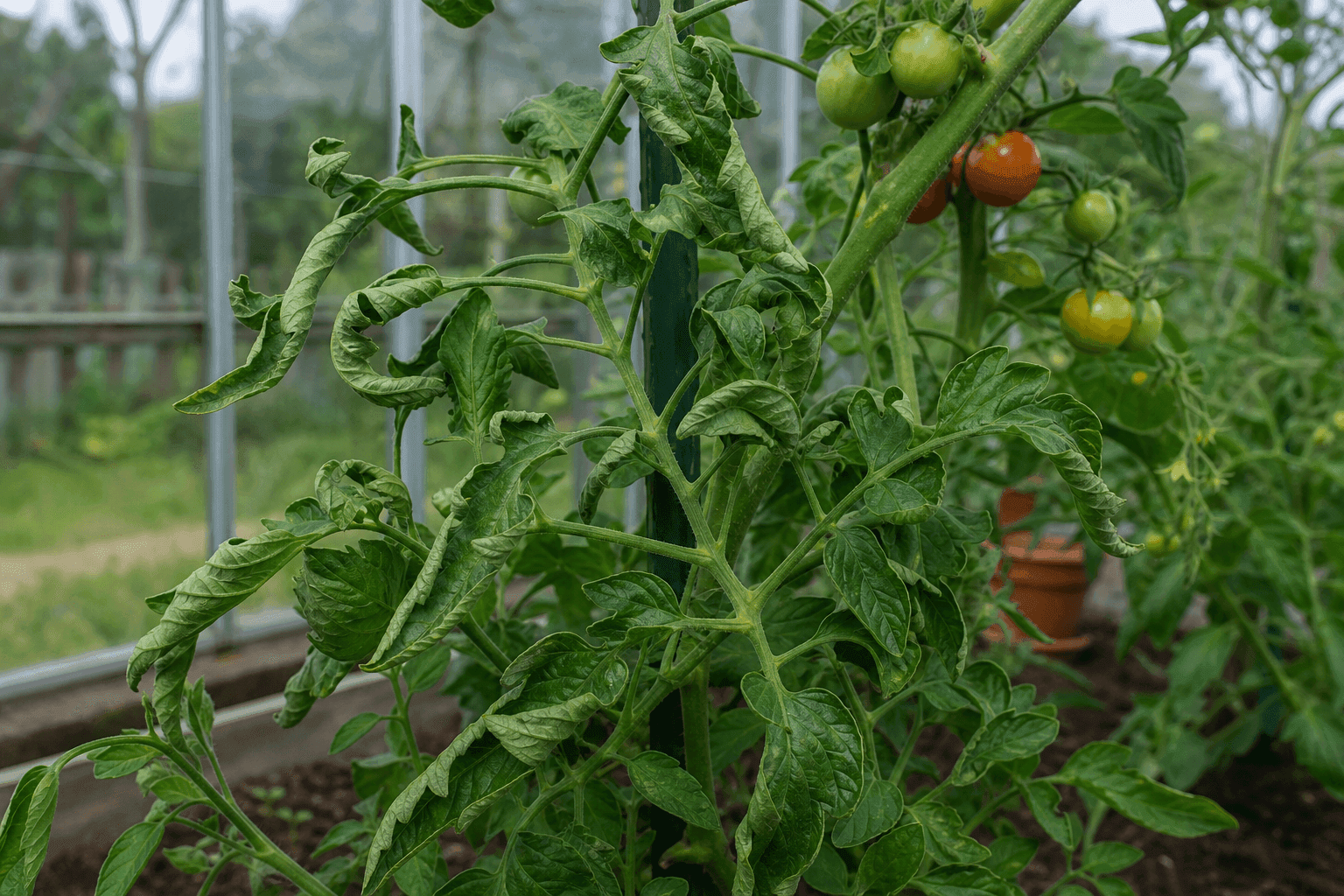
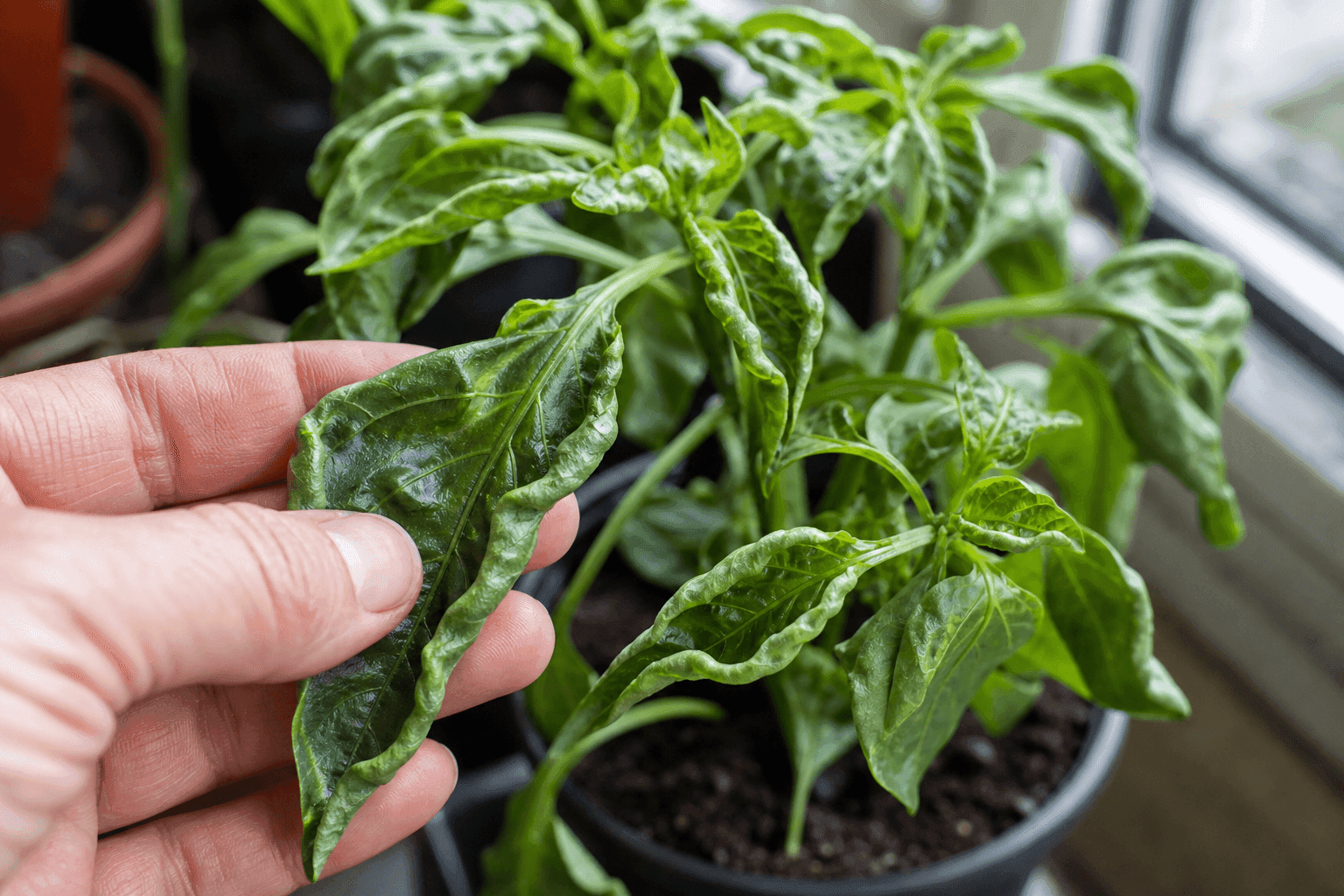
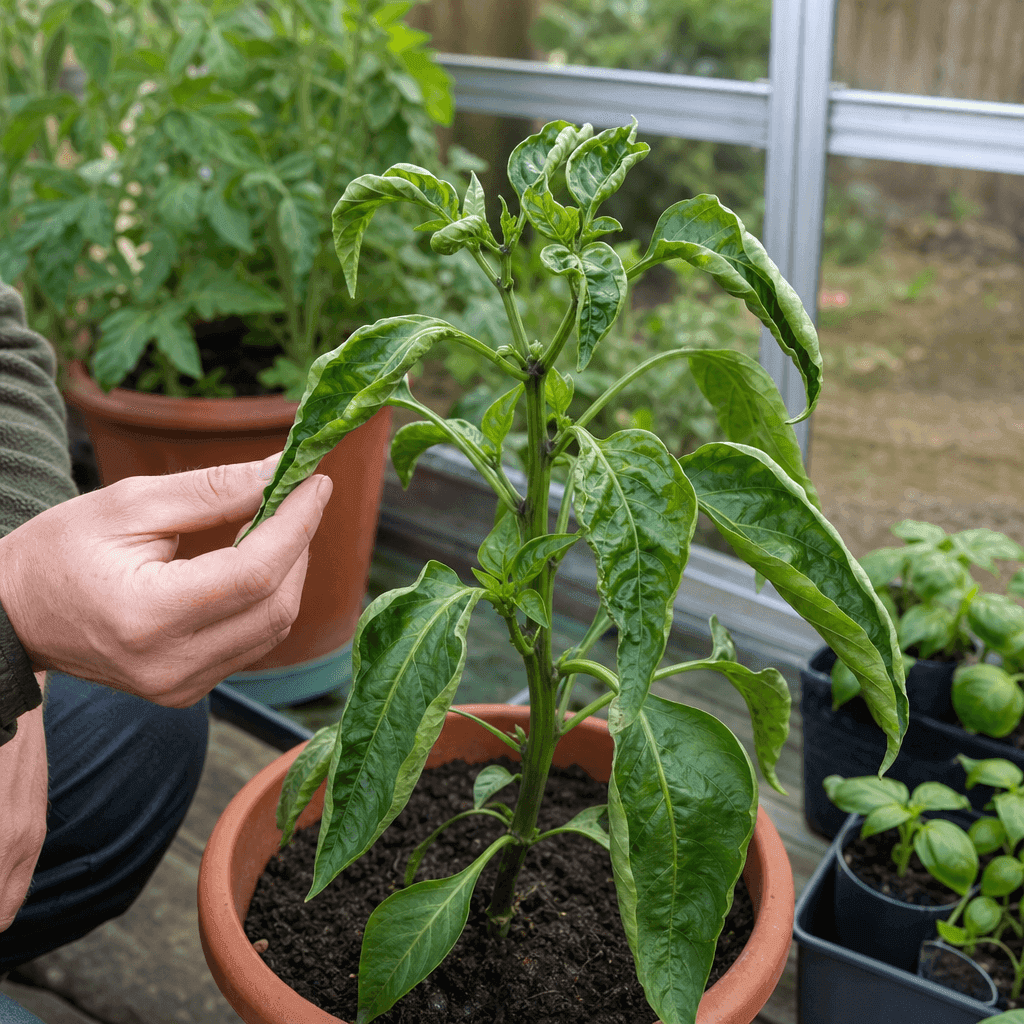
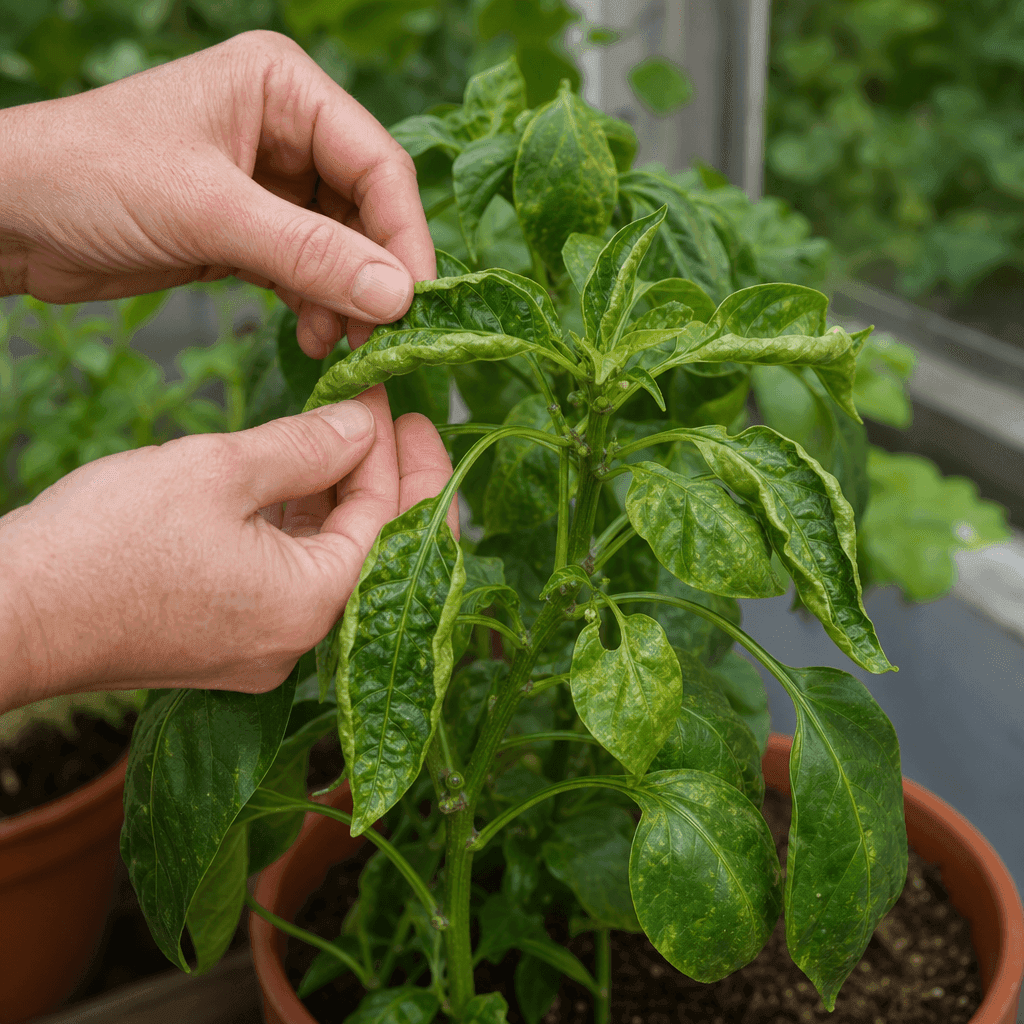
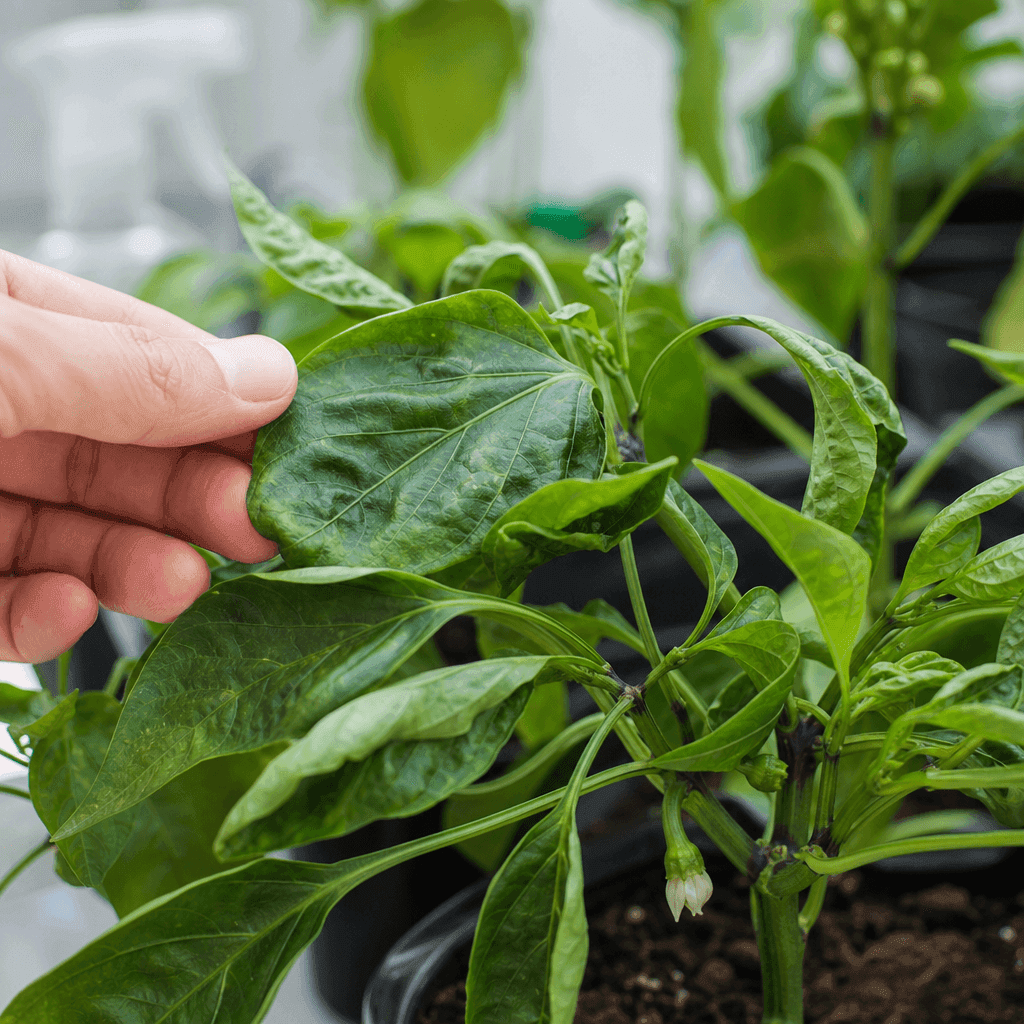
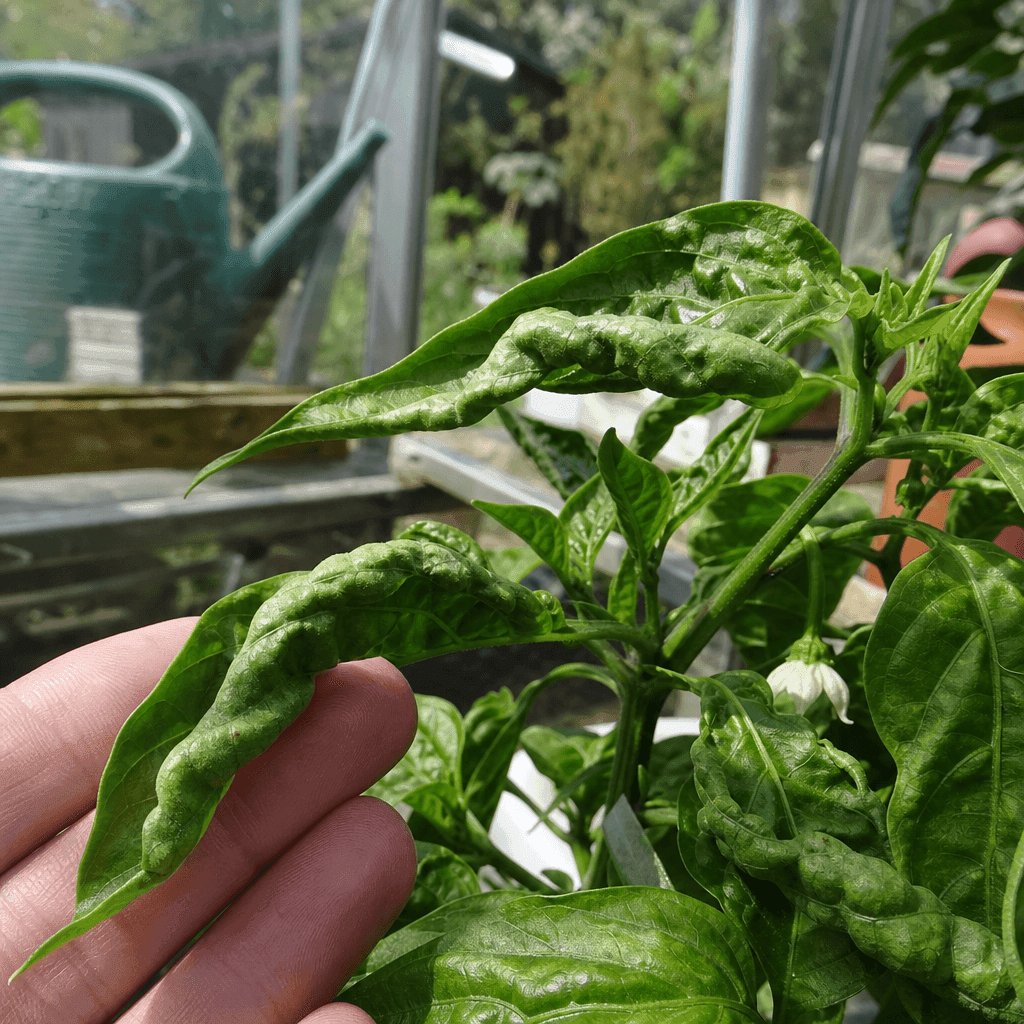
| Newest leaves emerging twisted, blistered, downward-curled or leathery; growing tip may abort | Broad mites (Polyphagotarsonemus latus) | High | Damage concentrated on newest growth only; leaves appear distorted and bronzed; mites invisible to naked eye but check with magnifier. | Remove and destroy affected growing tips; consider a sulphur-based or fatty acid spray; good air circulation helps. | High |
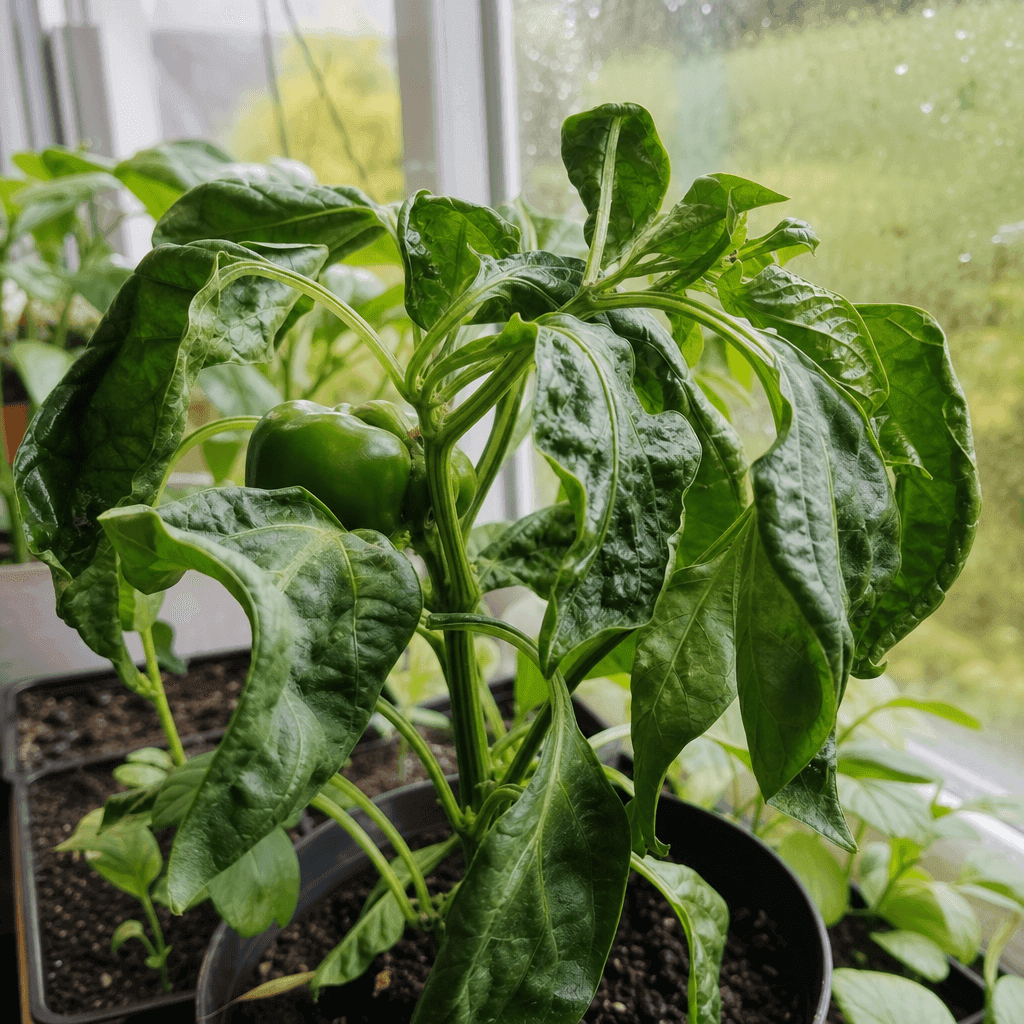
| Older leaves curling upward on hot days, recovering by morning; compost is moist | Heat stress and transpiration curl | High | Curling improves overnight; plant is in hot, sunny or draughty conditions; leaves not distorted or discoloured. | Provide temporary shade at midday; water consistently; mulch to keep roots cool. | Low |
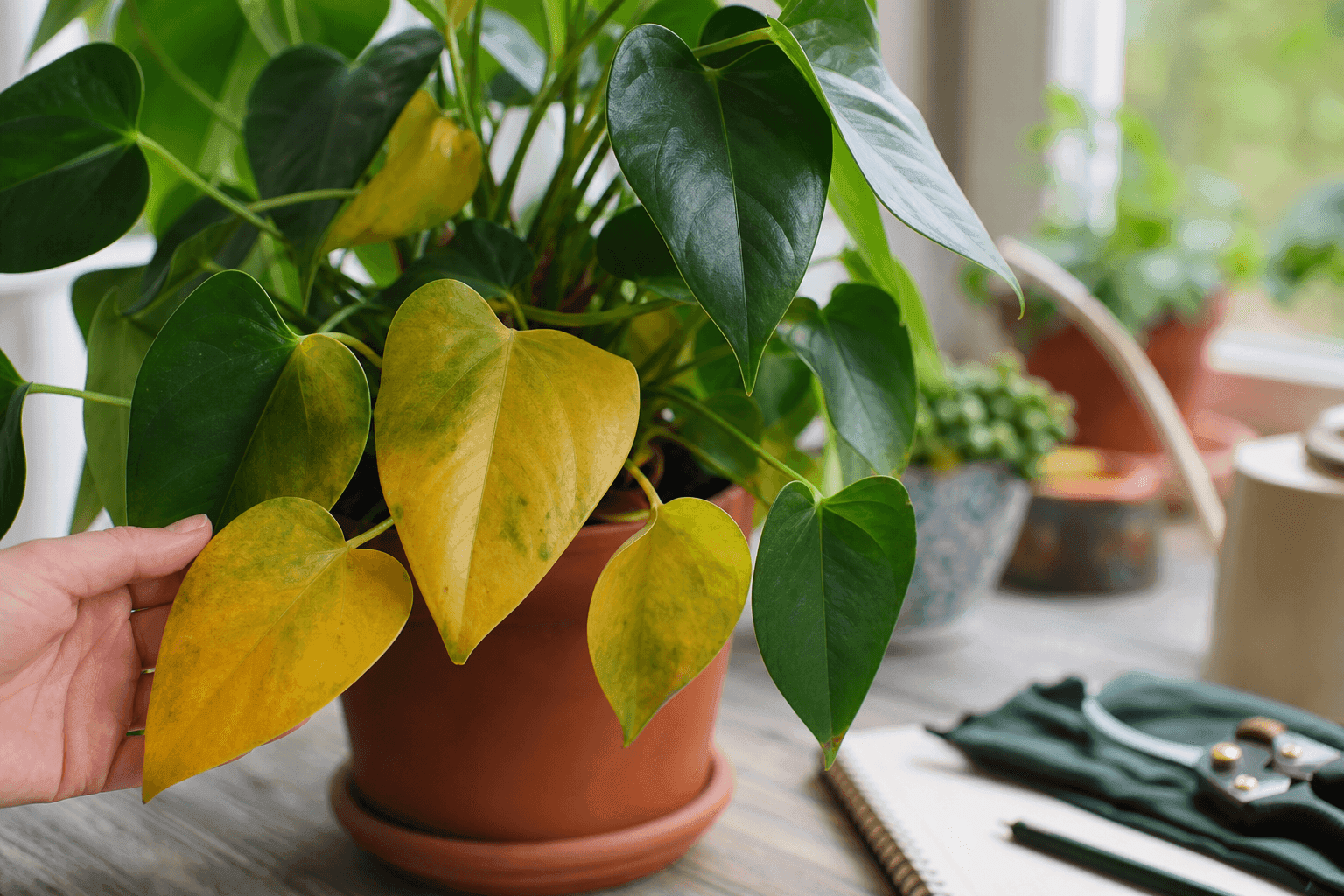
| Whole plant limp and curling; soil is wet; lower leaves yellowing | Overwatering or root damage | High | Compost is wet below the surface; roots may be brown; pot has blocked drainage. | Stop watering; check drainage; inspect roots and repot if root rot is found. | High |
| Leaves curling or wilting; compost is dry; pot feels light | Underwatering | Medium | Compost is dry 3–5cm down; plant recovers within hours of a thorough soak. | Water thoroughly until it drains from the pot base; check compost before each watering. | Medium |
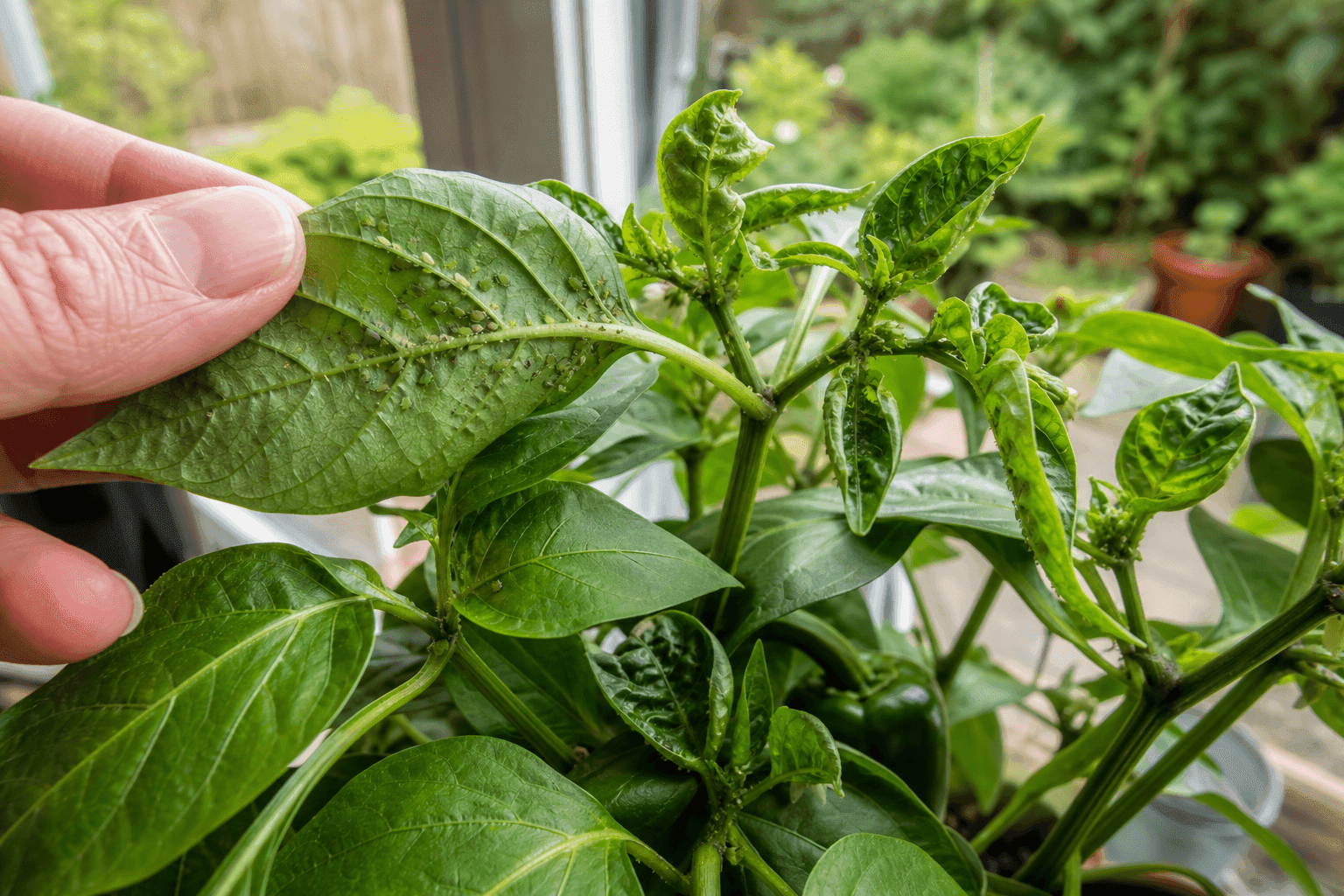
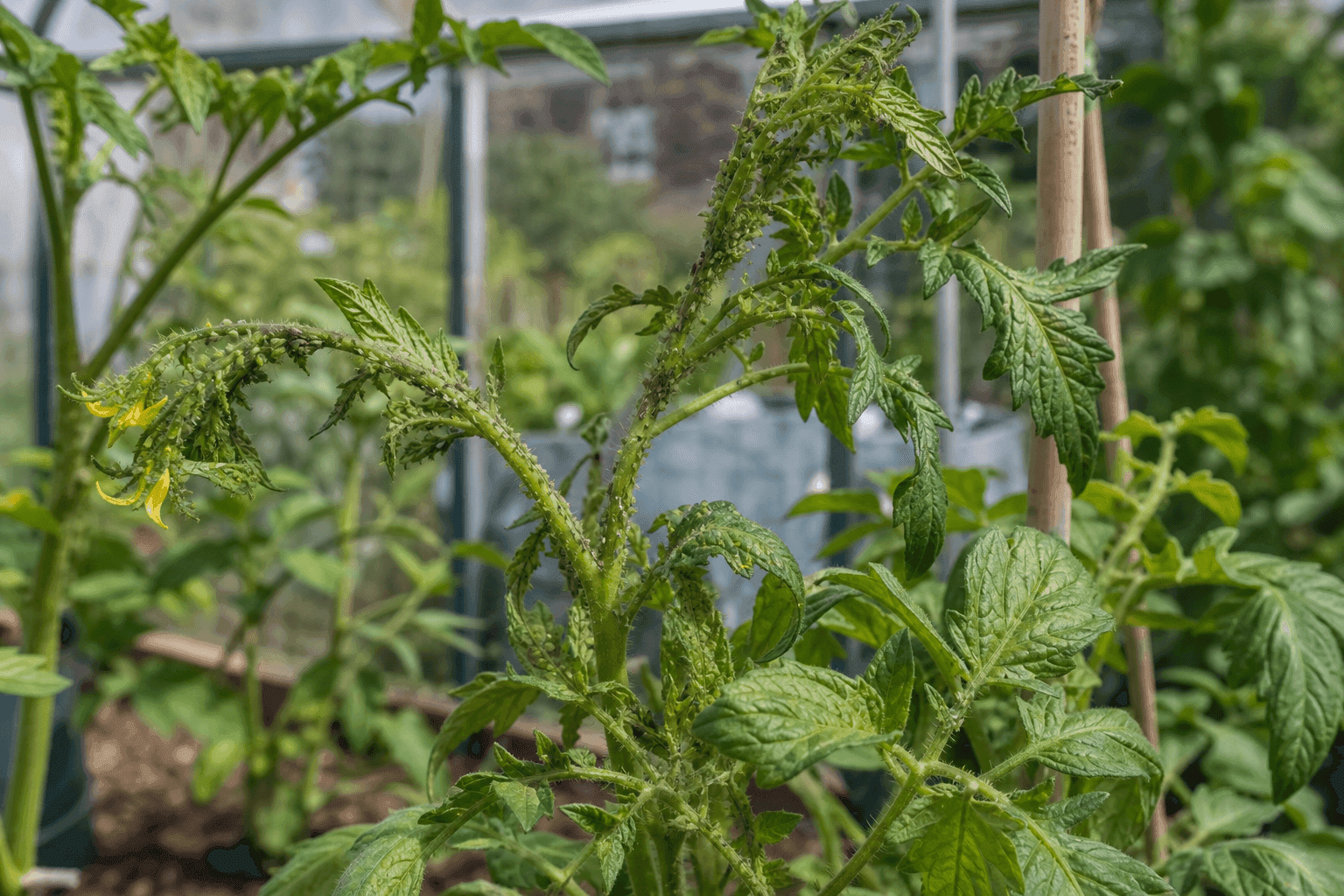
| Leaves curl and distort where insects are feeding; visible colonies on shoot tips | Aphids or thrips | Medium | Check shoot tips and leaf undersides for soft-bodied green, black or yellow aphids, or tiny thrips; sticky honeydew on leaves. | Remove by hand or water spray; introduce biological controls (parasitic wasps, predatory mites) in polytunnels. | Medium |
| Youngest leaves at the tips curl or cup inward; leaf edges may brown; blossom end rot on fruit | Calcium deficiency or blossom end rot | Medium | Curling concentrated on new growth; dark sunken patches at the fruit tip; irregular or drought-interrupted watering. | Water consistently and evenly; apply calcium-containing foliar spray if deficiency is confirmed. | Medium |
The causes, in detail
Broad mites (Polyphagotarsonemus latus)
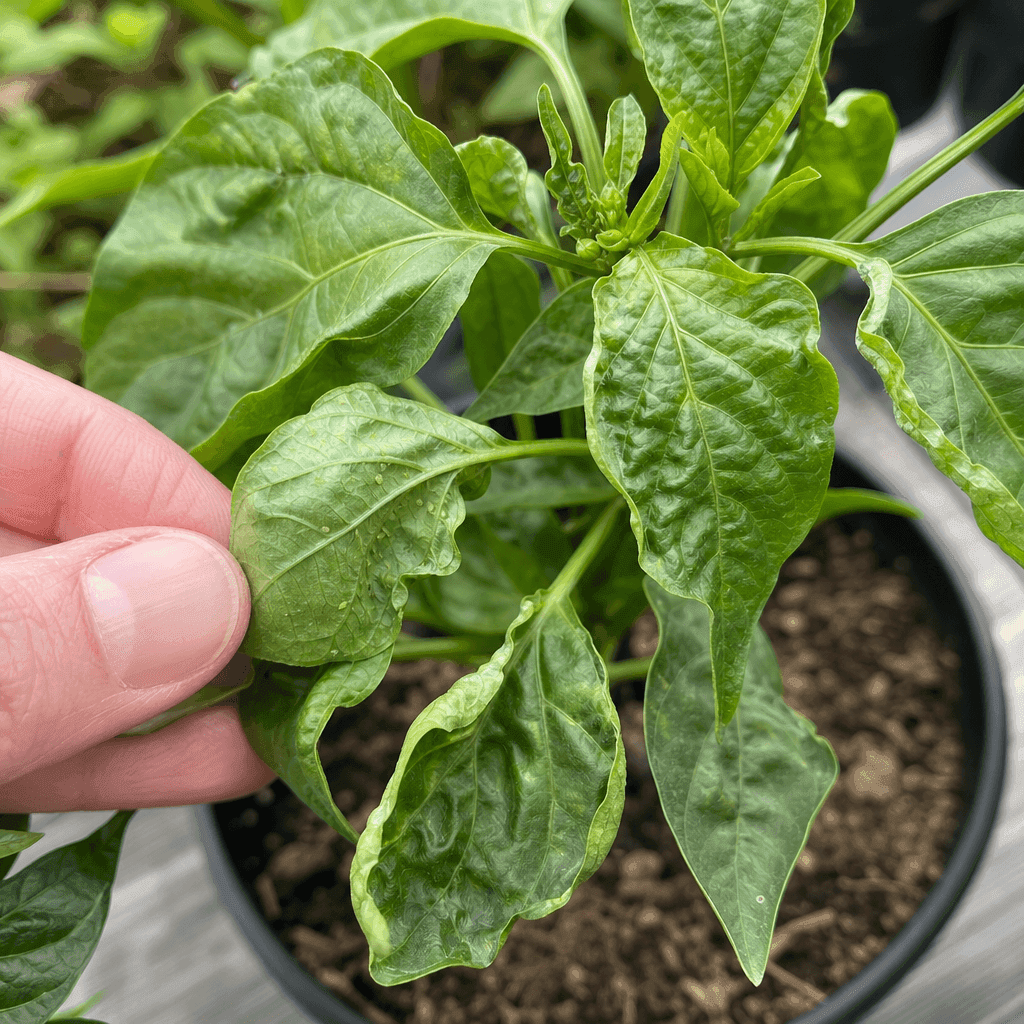
Most likelyBroad mites are one of the most damaging pests of pepper and chilli plants in UK polytunnels and greenhouses, and are increasingly reported in UK growing communities. At around 0.2mm long, they are invisible to the naked eye but their damage is distinctive — one of the most easily misdiagnosed garden pests on protected crops. Red Dragon Seeds (a UK chilli specialist) describes the symptoms clearly: infested leaves exhibit curling, puckering and twisting, and new growth emerges twisted, blistered, downward-curled and leathery. The growing tip may abort entirely in severe infestations. The damage looks like herbicide injury or a virus. Broad mites prefer hot, dry conditions and spread rapidly between plants on hands, tools and clothing. They primarily attack the newest, softest tissues first.
- Damage is concentrated on the newest, actively growing leaves and shoot tips.
- Affected leaves look twisted, blistered, cupped downward, or have a bronzed or lacquered appearance.
- Damage is not simply a curl that reverses overnight — it is permanent distortion.
- The growing tip may be stunted, aborted or deformed.
- Use a hand lens (10x or higher) to check the underside of young leaves — mites appear as tiny pale oval specks, often near the midrib.
- Remove and destroy all distorted growing tips and affected leaves immediately — do not compost.
- Isolate affected plants from others to prevent spread.
- Apply a sulphur-based fungicide/miticide spray (approved for edibles in the UK) to all plant surfaces, particularly growing tips; repeat at 5–7 day intervals for three applications.
- In polytunnels, introduce predatory mites (Neoseiulus cucumeris) as a biological control — these are effective against broad mites and are available from UK biological control suppliers.
- Lower temperatures and increase humidity slightly — broad mites prefer hot, dry conditions.
- Clean tools and wash hands thoroughly between plants.
Stop it coming back:Introduce predatory mites preventatively in polytunnels. Avoid moving plants from unknown sources without a quarantine period. Inspect new stock carefully under a magnifying glass before placing alongside established plants.
confuse broad mite damage with virus symptoms — broad mite damage is concentrated on new growth and the pattern often improves after treatment; virus damage is usually more uniform and does not improve.
Heat stress and transpiration curl
Most likelyPeppers and chillies curl their leaves upward as a physiological response to heat and high transpiration — the plant is reducing its leaf surface area to conserve moisture. This is a normal adaptive response and does not indicate disease. In UK polytunnels and south-facing greenhouses in summer, midday temperatures can routinely exceed 35°C, well above the optimal range for peppers (21–28°C). The diagnostic clue is recovery: leaves that curl during the hottest part of the day and return to normal by the following morning are experiencing heat stress, not disease or pests.
- Curling occurs at midday in hot or sunny conditions and reverses by the following morning.
- The compost is adequately moist despite the curling.
- All leaves are affected, not just the newest growth.
- Conditions have been unusually hot, or the plant is in a very sunny or poorly ventilated spot.
- Provide temporary shade during peak midday heat using shade cloth, fleece or a nearby taller plant.
- Water consistently to keep the root zone moist — pepper roots should never be allowed to dry out in hot weather.
- Open vents or doors in polytunnels to reduce temperature and improve air movement.
- Mulch the soil surface around outdoor or bed-grown plants to keep roots cooler.
- Avoid watering over leaves in hot sunny conditions as wet leaves in strong sun can scorch.
remove curled leaves on the assumption they are diseased — a curled leaf that recovers overnight is perfectly functional and should be left in place.
Overwatering and root damage
Most likelyPeppers are sensitive to waterlogged conditions. In UK springs, when pepper plants are raised in small pots indoors or on windowsills with lower light than they need, they use very little water but are sometimes watered on a fixed schedule. Root rot follows quickly and the plant wilts and curls even though the compost is wet, because damaged roots cannot deliver water to the leaves. The Know The Pepper guide notes that overwatered pepper plants often look similar to drought-stressed ones — the difference is whether the compost is dry or wet.
- The compost is wet or damp several centimetres below the surface.
- Lower leaves are yellowing and dropping.
- Drainage holes may be blocked or the pot may be sitting in a saucer of water.
- A sour smell comes from the compost.
- Roots are brown or mushy when inspected.
- Stop watering immediately and remove the plant from any standing water.
- If the compost is just wet but roots look healthy, allow to dry before watering again.
- If roots are brown and rotten, remove the plant from its pot, trim all rotten roots with clean scissors, and repot into fresh well-draining compost.
- Allow the repotted plant to stabilise for a week before watering lightly.
- In future, water peppers only when the top centimetre of compost is dry — they prefer slightly moist but never waterlogged conditions.
water more when the plant looks wilted without first checking whether the compost is already wet — wilting on wet compost points to root damage, not thirst.
Underwatering
PossiblePeppers have a relatively high water requirement during the growing season, particularly once flowering and fruiting begin. Insufficient watering — or sporadic watering that allows the compost to dry out completely between waterings — stresses the plant and causes leaves to curl, wilt and ultimately drop. Unlike broad mite damage, the curling from underwatering is uniform across the plant, does not distort the leaf shape permanently, and reverses quickly after a thorough watering.
- Compost is dry 3–5cm below the surface.
- The pot feels very light.
- Leaves droop and curl but are otherwise healthy-looking, without distortion or bronzing.
- The plant recovers visibly within a few hours of thorough watering.
- Water thoroughly until water drains freely from the base.
- If the compost is very dry, it may be hydrophobic — sit the pot in a tray of water for 20–30 minutes to allow slow rehydration.
- In hot, sunny periods outdoors or in a polytunnel, peppers may need watering once or twice daily.
- Consider a drip irrigation system for polytunnel plants if erratic watering is a recurring problem.
overcompensate with a heavy daily watering schedule once the plant has been drought-stressed — this quickly leads to overwatering and root rot.
Aphids and thrips
PossibleAphids and thrips are common pepper pests in UK gardens and polytunnels. Aphids on pepper plants (most commonly green peach aphid Myzus persicae) congregate on shoot tips and leaf undersides, causing curling and distortion as they remove sap. Thrips rasp leaf surfaces and inject toxic saliva, causing silvery streaking, stippling and leaf curl. Both pests multiply rapidly in warm conditions. Unlike broad mites, aphids and thrips are usually visible to the naked eye: aphids form clusters and produce sticky honeydew; thrips are fast-moving slender insects about 1–2mm long.
- Visible insects on shoot tips and leaf undersides — soft-bodied clusters (aphids) or tiny fast-moving slivers (thrips).
- Sticky honeydew on leaves and sooty mould developing on it.
- Curling and distortion mainly around feeding colonies rather than uniformly throughout the plant.
- Silver streaks or bronzing on leaves from thrips feeding.
- For light infestations, remove by hand or blast with a water spray to dislodge aphids.
- For moderate infestations, apply insecticidal soap (fatty acid spray) approved for edibles in the UK.
- In polytunnels, introduce biological controls: Aphidius colemani parasitic wasps for aphids; Amblyseius cucumeris predatory mites or Orius minute pirate bugs for thrips.
- Encourage natural predators (ladybirds, lacewings, hoverflies) in outdoor gardens by avoiding broad-spectrum insecticides.
- Remove and bin heavily infested shoot tips.
use broad-spectrum insecticides in polytunnels — this destroys the natural predator population and often leads to worse pest outbreaks afterwards.
Calcium deficiency and blossom end rot
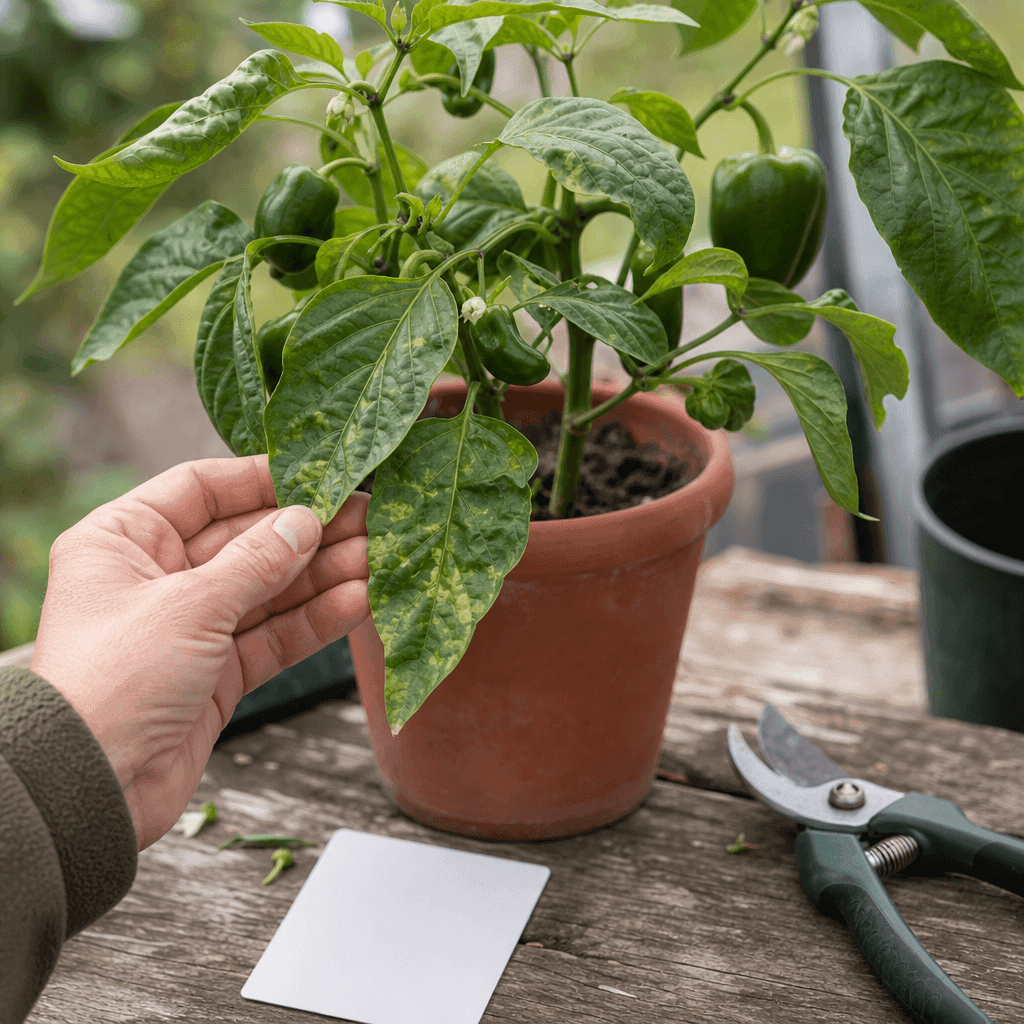
PossibleCalcium deficiency in pepper plants causes the newest leaves (those at the growing tip) to curl inward or cup, with leaf edges that may eventually brown. In fruiting plants, calcium deficiency causes blossom end rot — a dark, sunken, leathery patch at the blossom end of the fruit, which is very common in UK-grown peppers and chillies. Calcium deficiency is rarely caused by a lack of calcium in the compost; it is almost always a result of inconsistent watering or drought stress, which prevents the plant from moving calcium upward through the plant via the transpiration stream.
- Newest leaves at the growing tip curl or cup inward.
- Dark, sunken, dry patches appear at the blossom end (bottom tip) of developing fruits.
- Watering has been inconsistent — the plant has been allowed to dry out and then soaked repeatedly.
- Compost is a proprietary growing bag or potting mix that may have become exhausted.
- Establish a consistent watering routine — calcium moves into the plant via water uptake; erratic watering stops this process.
- Water little and often in hot conditions rather than allowing large wet-dry swings.
- Apply a calcium-containing foliar spray (calcium nitrate at low concentration) directly to leaves and developing fruits if deficiency is confirmed.
- Avoid excess nitrogen or potassium feed, as these compete with calcium uptake.
- Mulch around outdoor plants to moderate soil moisture fluctuation.
expect calcium-deficient fruits to recover — affected tissue is permanent; the fix prevents new fruits from developing the same problem.
Still not sure?
Work down these branches — the first one that matches is your answer.
What not to do
- Remove curled leaves that are simply showing a heat stress response — they will recover overnight.
- Water heavily on a fixed schedule without checking the compost first — peppers are vulnerable to both drought and overwatering.
- Use broad-spectrum insecticides in polytunnels where biological controls are active.
- Confuse broad mite damage with virus infection — broad mite damage is localised to new growth and responds to treatment.
- Ignore new growth distortion, hoping it will self-resolve — broad mite populations expand rapidly and early action is far more effective.
Common questions
Why are my chilli plant leaves curling inward?
Inward curling on new growth is a classic sign of broad mite infestation — check the newest leaves with a 10x magnifying glass. Inward curling on older leaves during hot days often indicates heat stress and usually reverses overnight. Calcium deficiency can also cause new tip leaves to cup inward.
What are broad mites and how do I know if I have them?
Broad mites are microscopic spider mite relatives (about 0.2mm long) that feed on the newest, softest plant tissue. Their damage is distinctive: new leaves emerge twisted, blistered, downward-curled or leathery, and the growing tip may abort. They are invisible without magnification but the damage pattern is recognisable. UK chilli specialist Red Dragon Seeds has a detailed guide on identification.
Do pepper plants recover from broad mite damage?
The distorted leaves will not straighten — remove them. But if you treat effectively (sulphur spray or predatory mites) the new growth that follows should emerge undamaged. Recovery depends on catching the infestation early. If the main growing tip has been destroyed, the plant may branch and recover, but will be set back significantly.
Why are my pepper leaves curling and turning yellow?
Curling combined with yellowing usually indicates overwatering, root damage, or a heavy pest infestation. Check the compost first — if it is wet, stop watering and inspect the roots. If the compost is dry, water thoroughly. Then check shoot tips for pest damage.
Can I use neem oil on pepper plants in the UK?
Neem oil is not approved as a pesticide for home garden use in the UK as of 2026 — it was not re-registered under UK REACH regulations. Use fatty acid insecticidal soaps (which are UK-approved for edibles), sulphur-based sprays, or biological controls instead.
How do I prevent blossom end rot on chillies?
Blossom end rot is caused by calcium deficiency, which is almost always triggered by inconsistent watering rather than a lack of calcium in the growing medium. Water your peppers consistently and evenly — never allow them to wilt then soak them heavily. Calcium foliar sprays can help if the problem persists.
Why are my pepper plants drooping in the morning?
Drooping in the morning (rather than midday) that does not recover quickly is more serious than midday heat wilt and usually points to a root problem — either overwatering and root rot, or a severely compacted or dry root ball. Check the compost moisture immediately and inspect the roots.