Quick diagnosis
Match the row to what you’re seeing, then jump to the fix.
| What you see | Likely cause | Confidence | How to confirm | What to do now | Urgency |
|---|---|---|---|---|---|
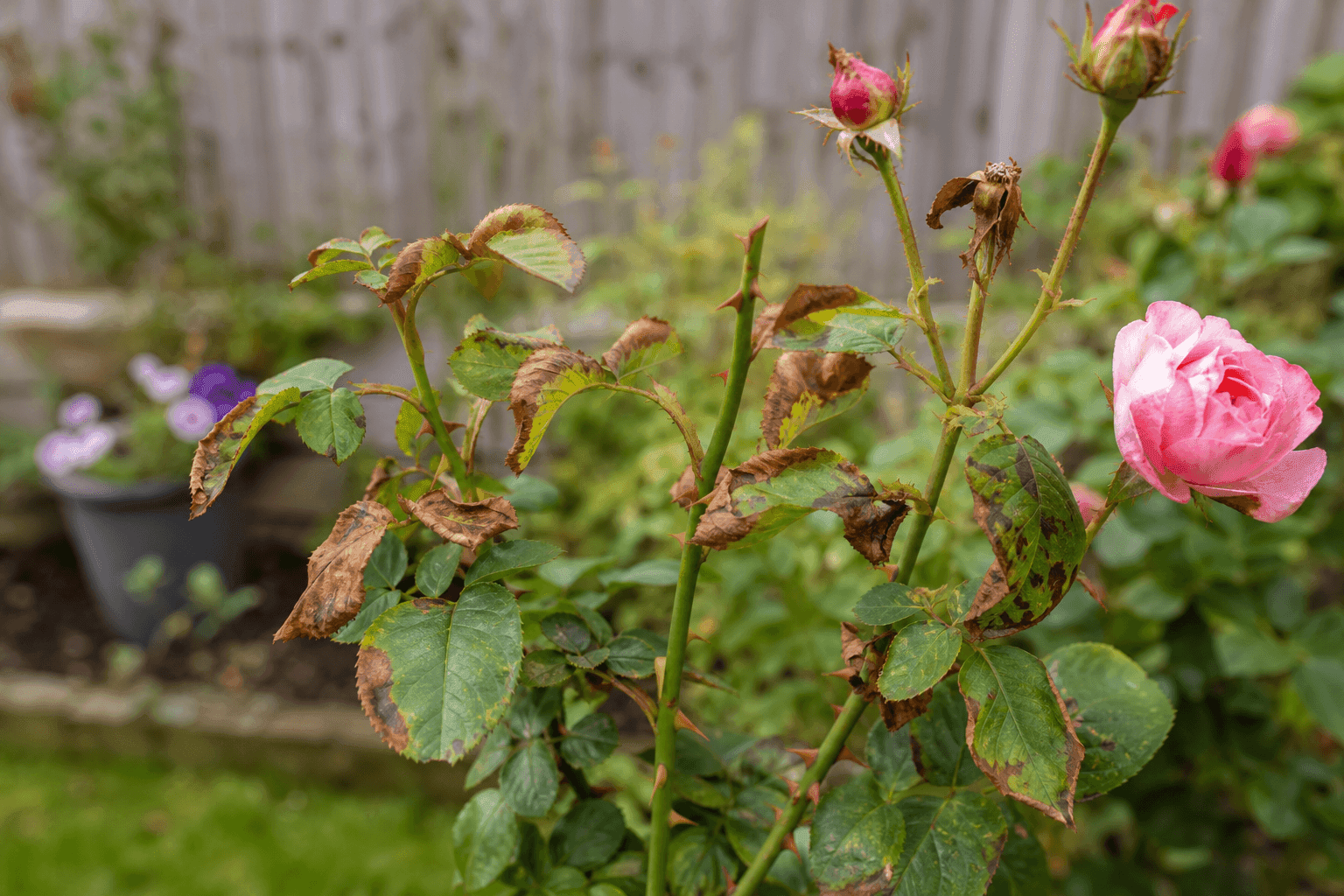
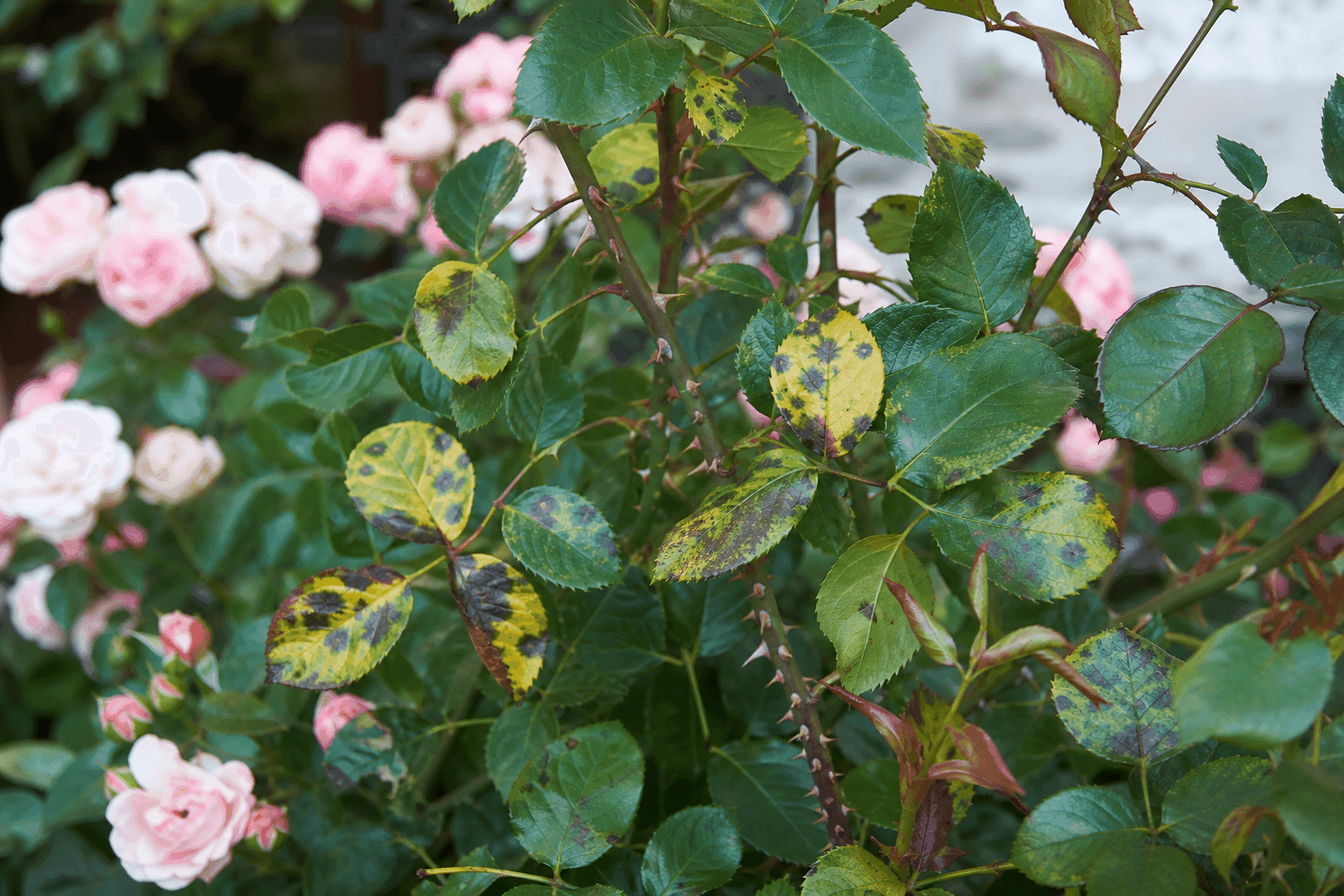
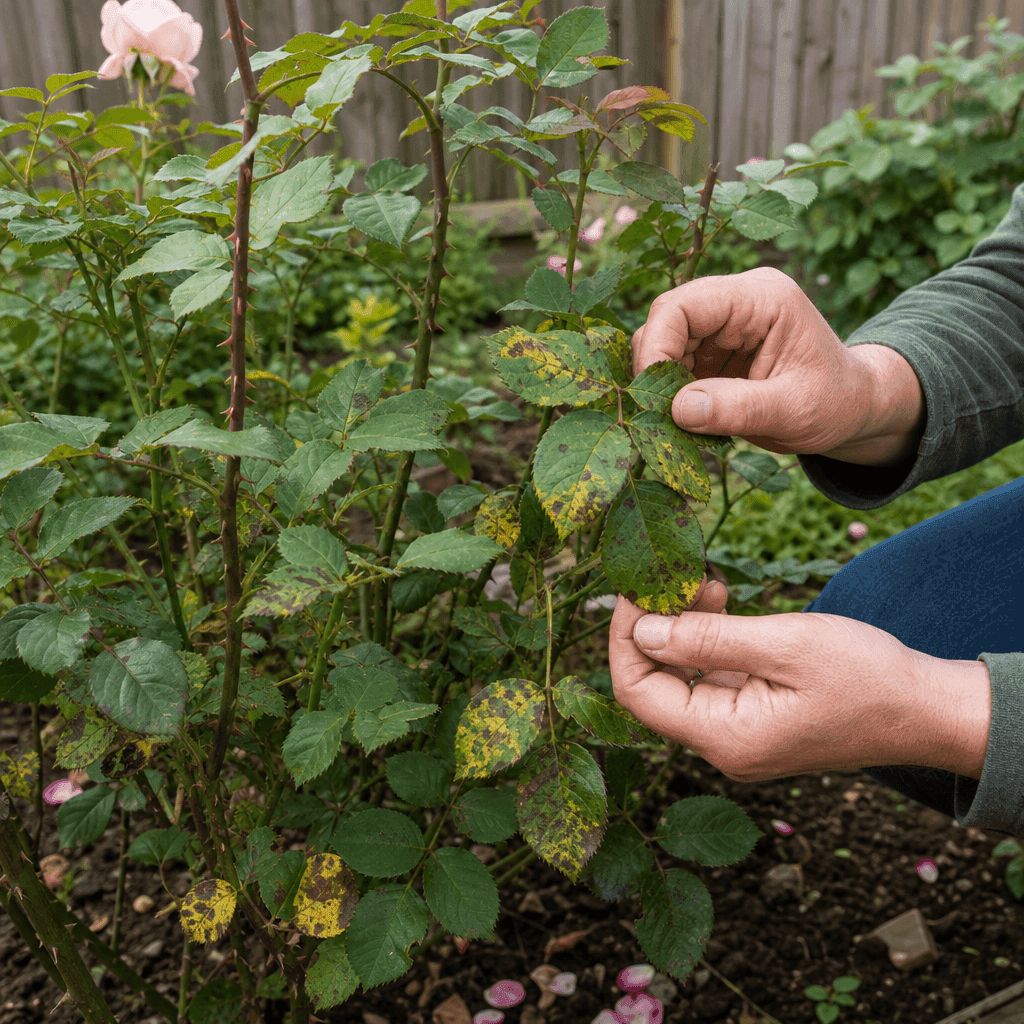
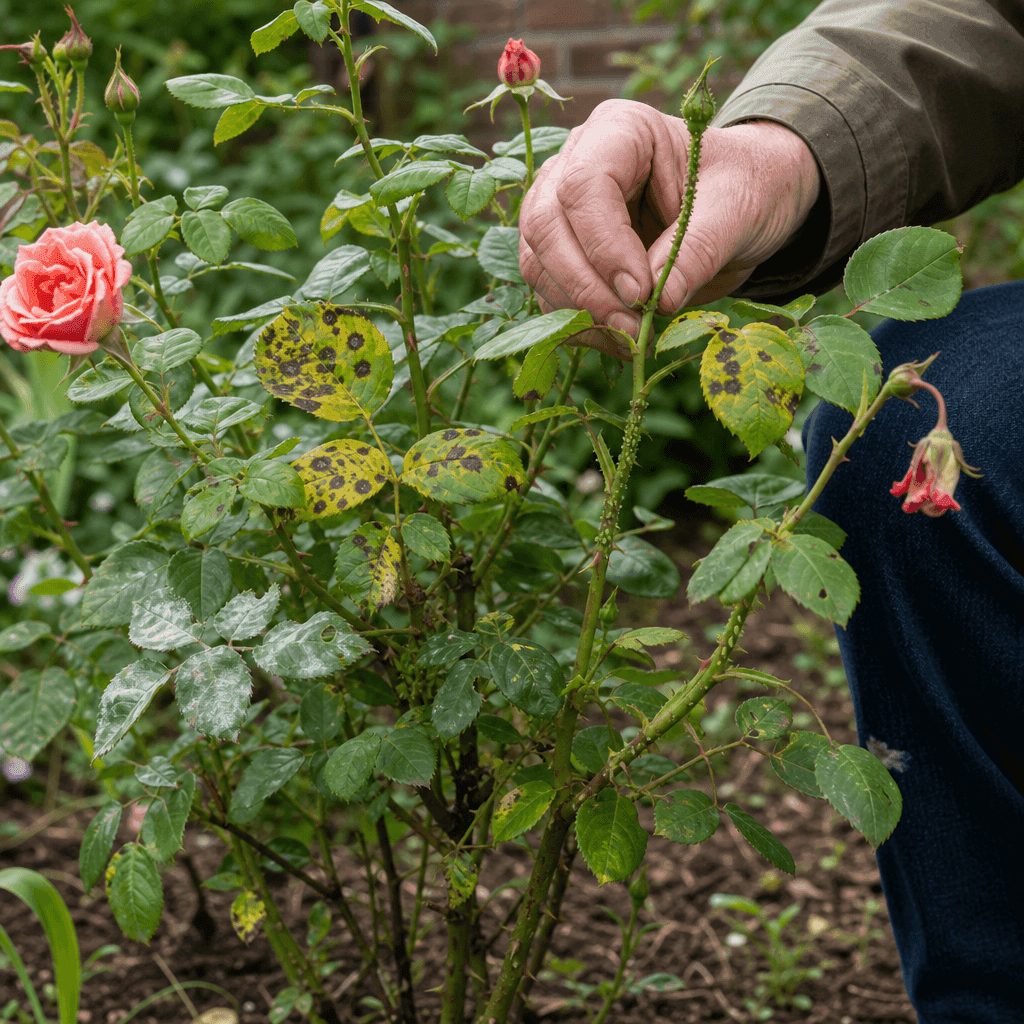
| Purple-black spots with yellow halos on leaves; leaves falling early | Rose black spot (Diplocarpon rosae) | High | Spots are circular, 5–15mm, with fringed margins; mostly on upper leaf surface; worst in warm wet weather | Remove and bin affected leaves; improve airflow; mulch; choose resistant varieties in future | Medium |
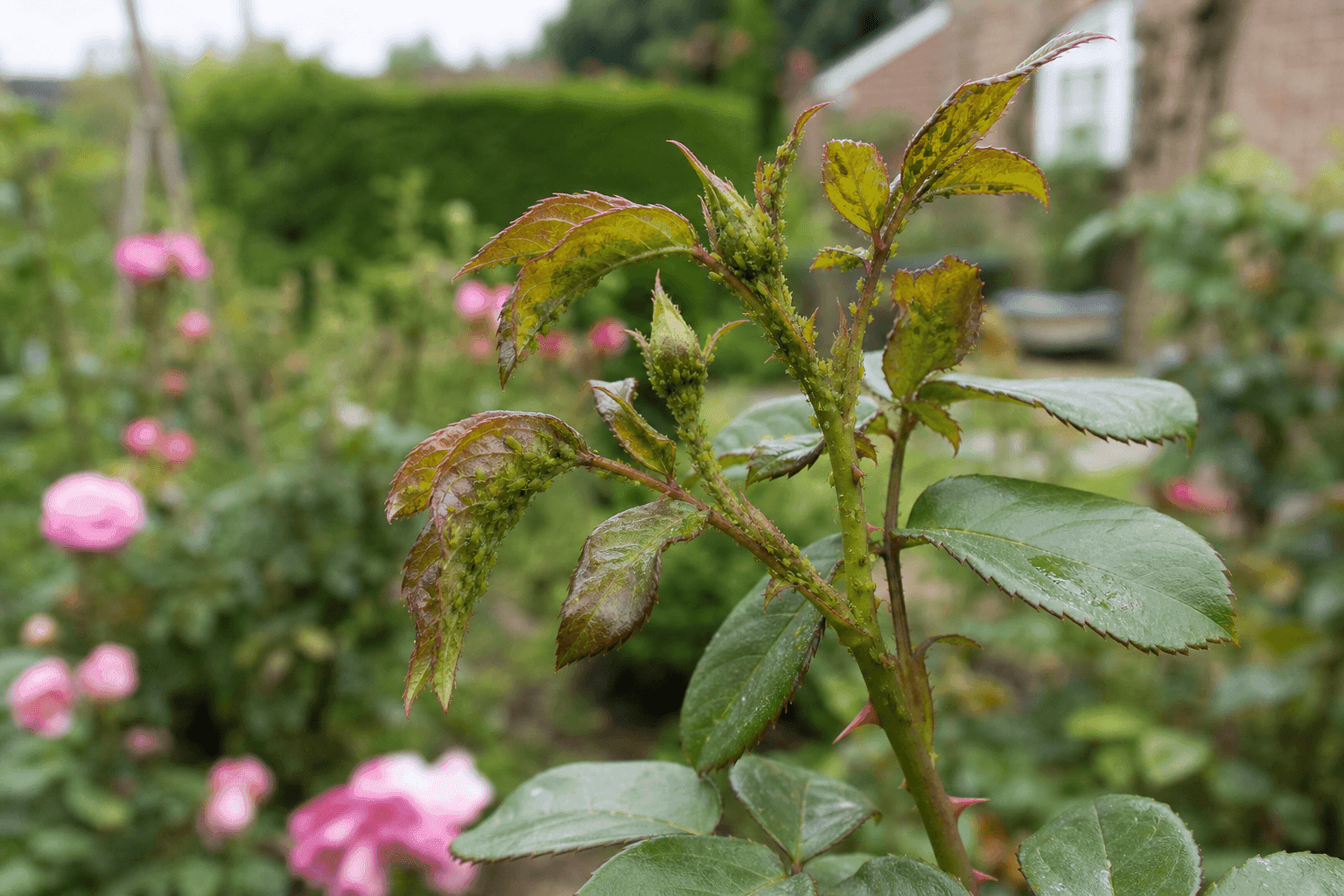
| Dense clusters of green or pink insects on shoot tips and buds | Rose aphids (Macrosiphum rosae) | High | Small, soft insects up to 3.5mm on growing tips; sticky honeydew on leaves below; possible sooty mould | Rub off by hand; encourage ladybirds and lacewings; use a soap-based spray only if infestation is severe | Low–medium |
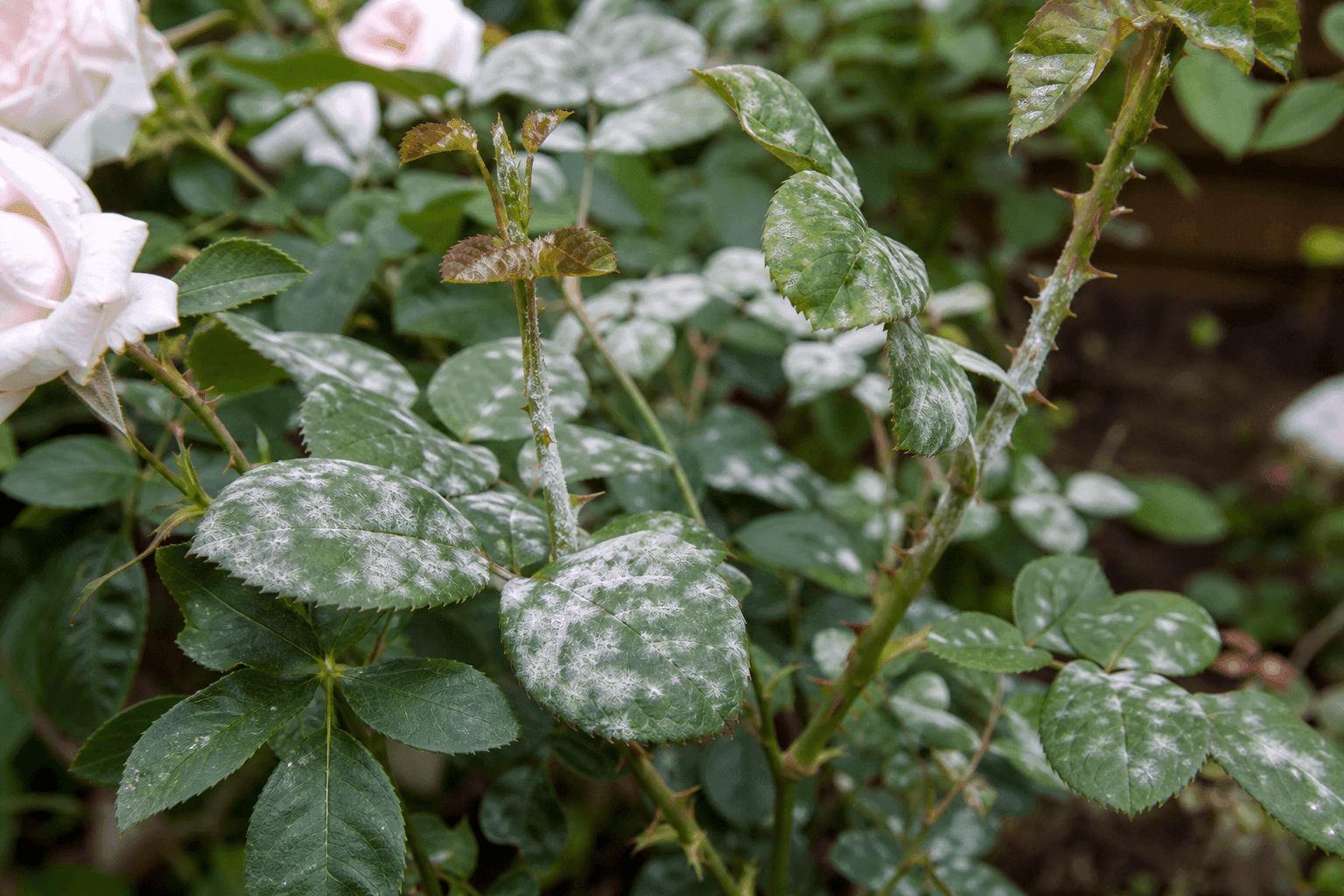
| White, powdery coating on young leaves, buds and shoots | Rose powdery mildew | High | White powder mainly on upper surfaces of young growth; worst in warm, dry spells with cool nights | Remove worst affected growth; improve watering; prune to open the canopy; avoid high-nitrogen feeding | Low–medium |
| Bright orange pustules on leaf undersides; orange-yellow patches above | Rose rust (Phragmidium mucronatum) | Medium | Orange powder on leaf undersides; early in season pustules are yellow, turning orange-brown then black in autumn | Remove affected leaves and dispose of them; do not compost; improve airflow | Medium |
| Stems dying back from the tip; brown or black discolouration extending down the stem | Rose dieback and canker | Medium | Dying stem often shows dark discolouration or sunken canker at the point of entry; may follow a pruning cut or physical damage | Prune back to healthy, white-centred wood; sterilise tools; improve plant vigour | High |
| New rose planted where an old rose was; very poor growth and establishment despite good care | Rose replant disease (rose sickness) | Medium | A rose was previously growing in the same spot; new plant is stunted and barely growing despite adequate feeding and watering | Remove and replace 60cm of soil in the planting hole; use a mycorrhizal treatment at planting | Medium |
| Yellow leaves with green veins (interveinal chlorosis), pale overall growth | Nutrient deficiency (often manganese or magnesium) | Low | Interveinal yellowing on younger leaves suggests manganese deficiency on alkaline soil; older-leaf yellowing with green veins suggests magnesium shortage | Apply a balanced rose fertiliser or Epsom salts for magnesium; check soil pH | Low |
The causes, in detail
Rose black spot (Diplocarpon rosae)
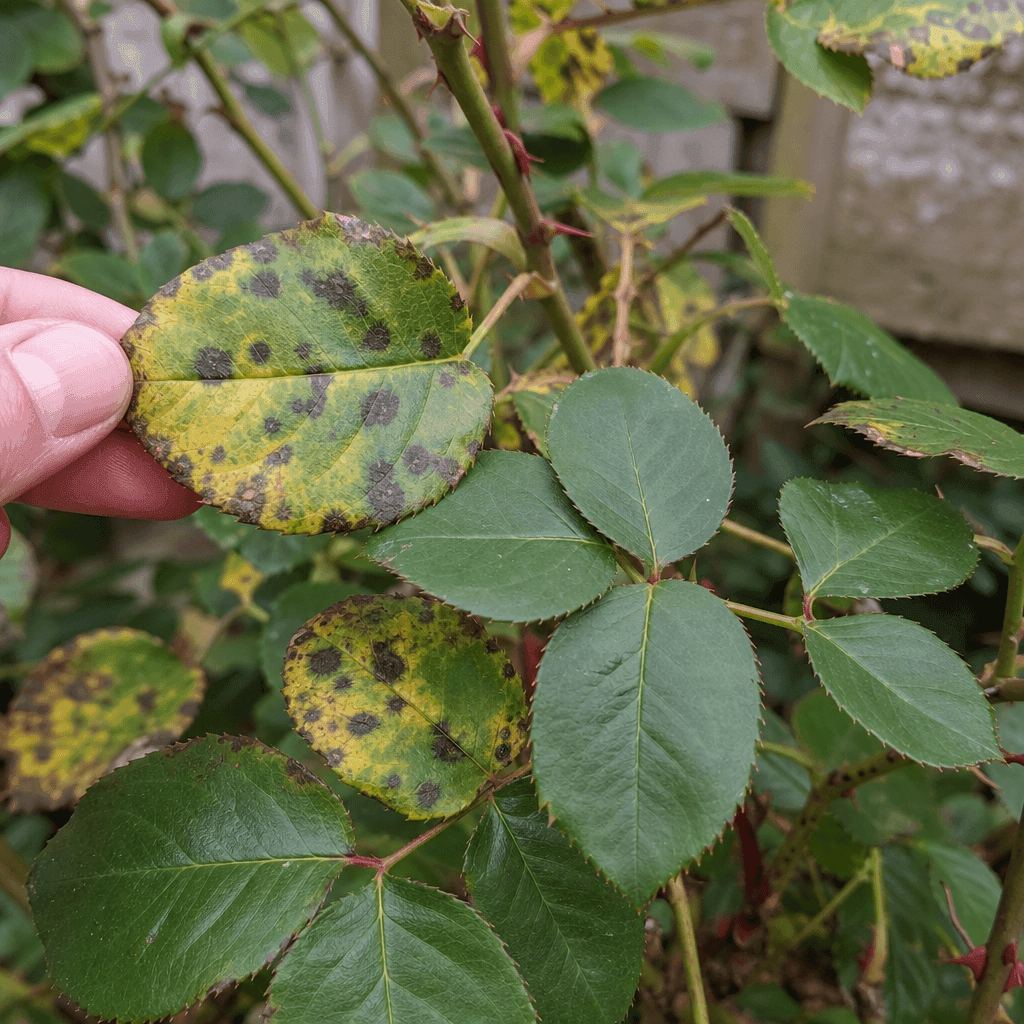
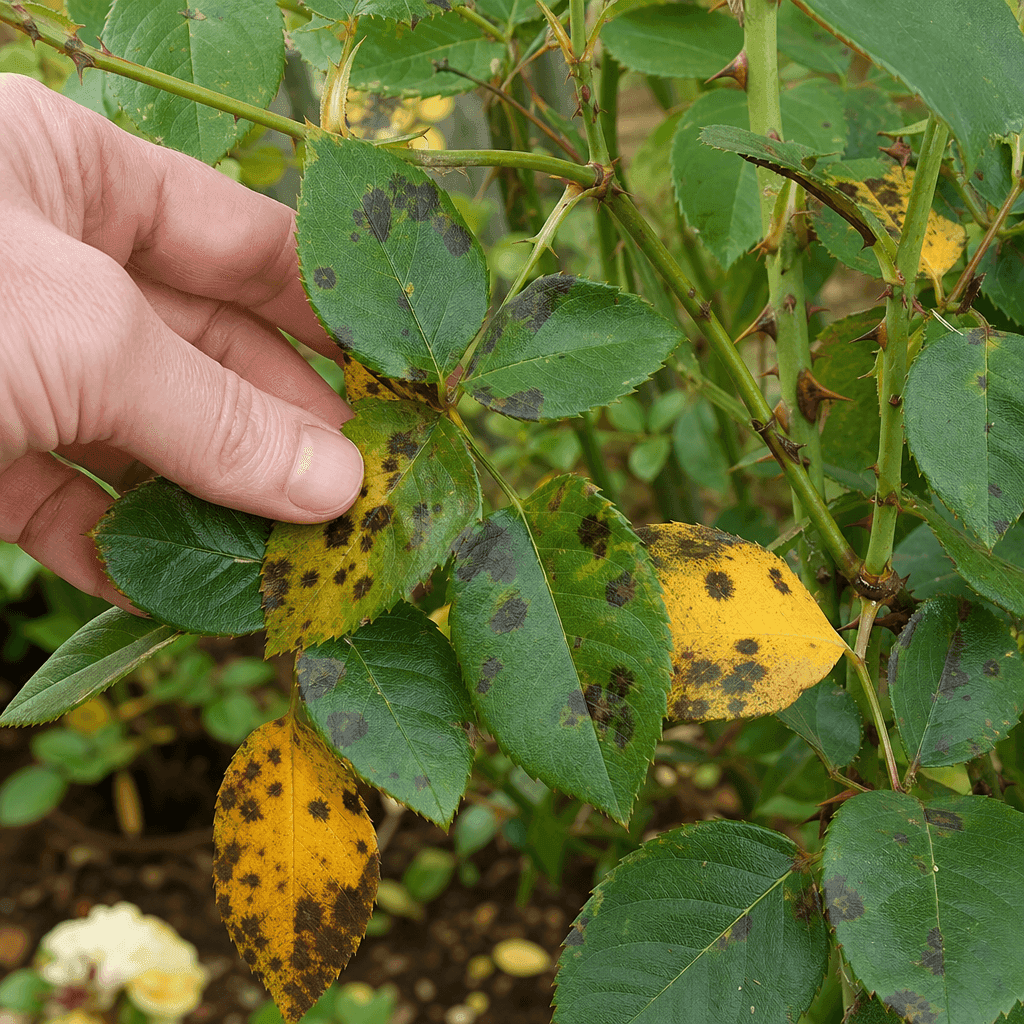
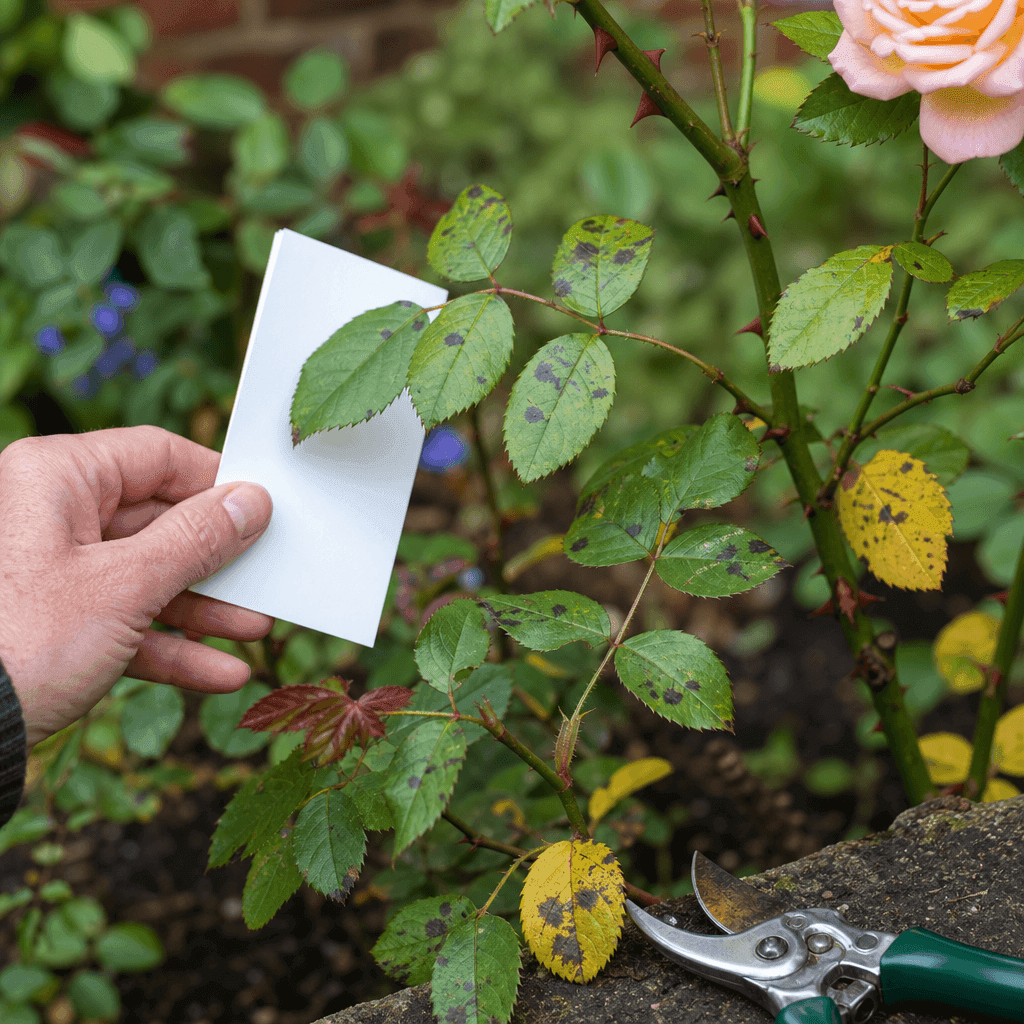
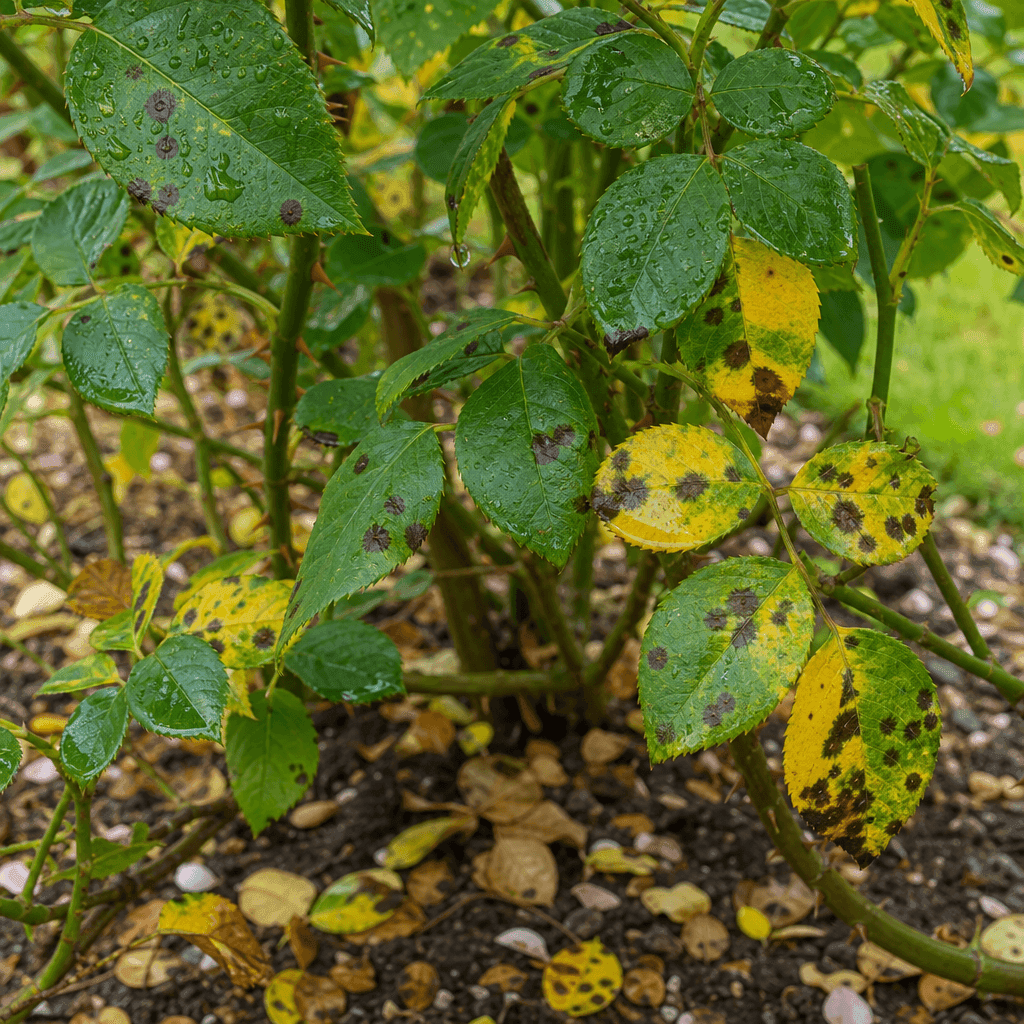
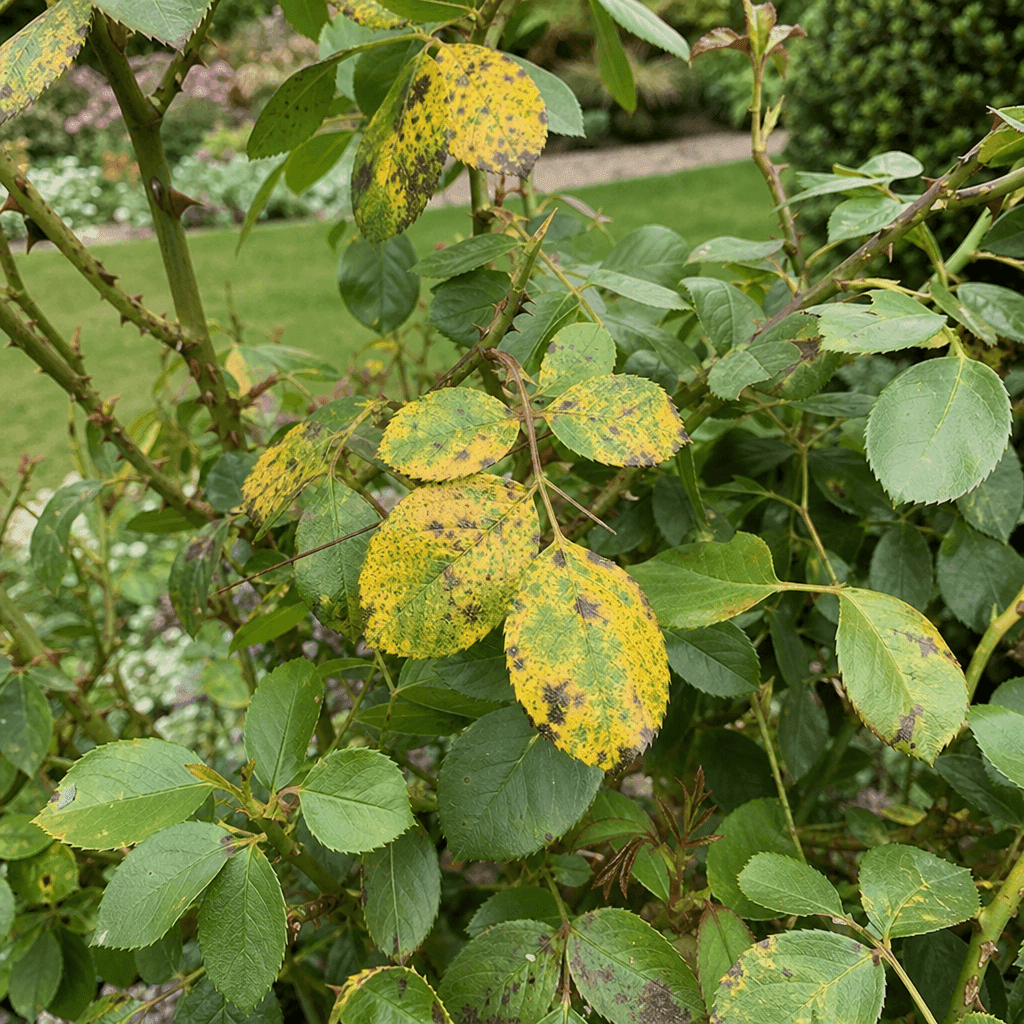
Most likelyRose black spot is the most prevalent fungal disease of roses in the UK, and one of the most common fungal plant diseases gardeners face. The RHS describes the symptoms as circular, purple-black spots up to 15mm across on the upper surface of leaves, often with fringed margins and a yellow halo, causing the leaves to fall prematurely. The fungus overwinters on fallen leaves and on infected stems, releasing spores in wet spring weather. Warm, wet summers make outbreaks significantly worse. Repeated severe infection weakens the plant. The RHS does not recommend routine fungicide use — cultural control is more sustainable.
- Circular, dark spots with characteristic fringed or feathery margins on upper leaf surfaces.
- Yellow discolouration around the spots leading to early leaf fall.
- Worst after warm, wet weather from spring onwards.
- Fallen leaves beneath the rose show the same spots.
- Remove and bin (do not compost) all affected leaves, both on the plant and fallen below it.
- Mulch the base of the rose with 5–8cm of composted bark or garden compost to prevent rain splashing spores from soil onto leaves.
- Prune to improve airflow within the canopy — good air movement dries leaves faster and reduces infection.
- In spring, cut out any infected stems showing black spots or dark streaks.
- Water at the base, not over the foliage.
- Feed with a balanced rose fertiliser to maintain vigour — a well-fed rose tolerates infection better.
Stop it coming back:Choose varieties with good black spot resistance — the RHS trial ratings include many modern shrub and English roses with high resistance. Even resistant varieties may show occasional spots but will not defoliate.
rely on fungicide sprays as the primary control — repeated use can lead to resistance, and sprays need applying before infection to be effective.
Rose aphids (Macrosiphum rosae and related species)
Most likelyThe rose aphid, Macrosiphum rosae, is the most common rose pest in UK gardens — our dedicated guide to identifying and treating aphids on roses covers control in more detail. The RHS notes it reaches up to 3.5mm in length, varies from pink to green, forms dense colonies on soft new growth and flower buds, and produces large quantities of sticky honeydew that can coat leaves below and encourage sooty mould. Populations build rapidly from April onwards. They are usually controlled naturally by ladybirds, lacewings, parasitic wasps and birds — which is why the RHS advises against routine insecticide use that kills these predators.
- Small green, pink or black insects clustered on shoot tips, buds and young stems.
- Sticky honeydew deposits on lower leaves.
- Possibly followed by black sooty mould on sticky surfaces.
- Distorted or cupped new leaves and flower buds.
- Rub off aphid colonies by hand or with a damp cloth — this works well for small outbreaks.
- Knock off with a strong jet of water from a hose.
- Encourage natural predators: avoid insecticides that kill ladybirds, lacewings and hoverflies.
- If infestation is severe and predators are not controlling it, use a soap-based insecticide or a neem-oil spray in the evening to minimise harm to bees.
- Avoid high-nitrogen feeds that produce the lush, soft growth aphids prefer.
Stop it coming back:A plant fed with balanced nutrients and not over-watered produces harder growth that is less attractive to aphids. Planting companion plants such as marigolds and alliums near roses attracts hoverflies and other aphid predators.
spray insecticide when bees are visiting the flowers — treat in the evening and avoid spraying open blooms.
Rose powdery mildew
Most likelyRose powdery mildew is caused by the fungus Podosphaera pannosa and is one of the most visible and widespread rose diseases in the UK; our full guide to treating powdery mildew on roses covers prevention in depth. The RHS describes the symptoms as a white, powdery fungal growth on leaves and shoots with possible discolouration — yellowing, reddening or purpling — of the affected parts. Unlike black spot (which is favoured by wet weather), powdery mildew thrives in warm, dry conditions with high humidity — the classic UK summer pattern. Plants under drought stress are most vulnerable.
- White, powdery coating on the upper and/or lower surfaces of young leaves.
- Affected shoots may be distorted; buds may fail to open cleanly.
- Worst on new growth during warm, dry spells.
- More severe on plants with dry roots — even if the weather is wet, a rose in a sheltered, dry spot can be affected.
- Remove and bin badly affected leaves and shoot tips.
- Keep roots evenly moist — drought stress greatly increases susceptibility.
- Mulch the base to reduce moisture loss.
- Improve airflow by pruning overcrowded stems.
- Avoid high-nitrogen feed that promotes the soft, susceptible growth mildew exploits.
- In future, choose mildew-resistant rose varieties.
Stop it coming back:Water regularly at the base during dry spells — mildew on roses is strongly linked to dry roots. A consistent feeding and mulching programme through the season significantly reduces outbreaks.
wet the foliage when watering roses — overhead watering during humid weather encourages both mildew and black spot.
Rose rust (Phragmidium mucronatum)
PossibleRose rust is a fungal disease that, while less common than black spot or powdery mildew, can be very disfiguring. The RHS describes the symptoms as orange or black spore pustules on the undersides of leaves, orange pustules on distorted stems, and orange-yellow patches on the upper leaf surfaces. The spores are distinctive bright orange in summer, turning dark brown-black by autumn. The disease needs living rose tissue to survive so it is not spread by infected dead material in the same way as black spot. Cool, wet springs favour outbreaks.
- Bright orange dusty pustules (spore masses) on the undersides of leaves.
- Corresponding pale yellow or orange patches on the upper surface of the same leaves.
- Possible orange spots or distortion on young stems.
- Pustules turn brown-black by late summer and autumn.
- Remove all affected leaves and bin them — do not compost.
- Cut out any stems with pustules, cutting back to healthy wood.
- Improve airflow through the plant.
- Feed and water to maintain plant vigour.
- No fungicide is reliably effective against rose rust for home gardeners; cultural control is the main approach.
Stop it coming back:Rose rust is the least serious of the main rose diseases in the UK, says the RHS, and rarely kills a vigorous plant. Improving overall plant health through good feeding, mulching and watering is the best long-term prevention.
confuse rust with aphid damage or black spot — rust pustules are distinctly orange and powdery on the leaf undersides, which is quite different from both.
Rose dieback and canker
PossibleBranch or stem dieback is common in roses and is usually caused by a combination of physical damage (from pruning, wind or frost) and secondary fungal infection, most often Paraconiothyrium fuckelii (rose canker). The RHS notes that any factors causing stress and reduced vigour — waterlogging, drought, nutrient shortage, frost — can trigger dieback, and that canker fungi enter through wounds and spread into living tissue. Dieback in spring after a hard winter is very common and usually recoverable.
- A shoot or branch dies back from the tip, with brown or black discolouration moving down the stem.
- There may be a sunken, discoloured canker around a pruning cut or wound where dieback began.
- The dead stem is brown in the centre rather than white and green (white centre = healthy).
- The problem often begins at or just below an old pruning cut.
- Cut back to healthy, white-centred wood — cut at a 45-degree angle just above an outward-facing bud.
- Sterilise pruning tools with methylated spirit or garden disinfectant between cuts and between plants.
- Remove all cut material from the site — do not compost.
- Feed the rose with a balanced fertiliser to promote recovery and new growth.
- Ensure good drainage — waterlogged roots increase susceptibility to dieback significantly.
Stop it coming back:Make clean cuts at the correct angle, just above a bud, with sharp, sterilised tools. Avoid leaving long stubs, which are the most common entry point for canker fungi. Prune in dry weather when possible.
cut into the same wound repeatedly to try to find the 'end' of the canker — make one clean cut to healthy wood and sterilise the tools immediately.
Rose replant disease (rose sickness)
PossibleRose replant disease, also called rose sickness or replant disorder, occurs when a new rose is planted in soil where another rose previously grew. The RHS describes the symptoms as very poor establishment, dieback and a lack of healthy fine feeder roots despite adequate care. The cause is believed to be a build-up of soil pathogens — particularly fungal root diseases and plant-parasitic nematodes — during the life of the previous planting. It is very common in UK gardens where roses have been grown for decades in the same beds.
- A new rose is performing extremely poorly in the same spot where a previous rose stood.
- The plant grows very little in its first year despite correct watering, feeding and pruning.
- Roots are sparse, with few healthy white fibrous roots.
- There is no obvious drainage problem or pest damage to explain the poor growth.
- Remove at least 60cm x 60cm x 60cm of soil from the planting hole and replace with fresh soil or compost from another part of the garden.
- Alternatively, move the rose bed to a fresh area of the garden.
- Apply mycorrhizal fungi (available as granules to add to the planting hole) — evidence suggests this helps new roses establish despite replant disease.
- Feed regularly with a balanced rose fertiliser in the first two seasons.
- As a last resort, some gardeners have success with biochar or soil sterilisation.
Stop it coming back:If planning a new rose bed, avoid areas where roses have grown continuously for five or more years. Incorporate generous amounts of well-rotted organic matter into new planting holes.
assume a newly planted rose that fails to thrive is simply in need of more water or feed — if replant disease is involved, those fixes will not help until the soil is changed.
Nutrient deficiency
Less likelyRoses are heavy feeders and can develop nutrient deficiencies in poor, sandy or very alkaline soils, or in older garden beds where nutrients have been depleted over many seasons. The most common deficiencies in UK rose beds are magnesium (causing older leaves to turn yellow between the veins), manganese (interveinal yellowing on younger leaves, especially on alkaline soils), and iron (yellowing new growth on chalky soils). General pale growth can also indicate nitrogen shortage.
- Older leaves show yellowing between green veins — points to magnesium deficiency.
- Younger leaves show interveinal yellowing — more likely manganese or iron shortage, especially on chalky soil.
- Overall pale, weak growth in a plant that is otherwise healthy — may be nitrogen shortage.
- The soil has not been fed or mulched for several years.
- Apply Epsom salts (magnesium sulphate) at 20g per litre of water as a foliar spray for magnesium deficiency.
- For iron or manganese, use a chelated trace element fertiliser, especially on alkaline soils.
- Apply a balanced rose fertiliser (formulations like Growmore or a dedicated rose feed) in spring and again after the first flush of flowers.
- Mulch with well-rotted compost each spring to improve soil nutrient content and structure.
Stop it coming back:Routine spring and post-flowering feeding, combined with an annual mulch of organic matter, prevents most nutrient deficiencies in established rose beds.
apply excessive nitrogen feed — it promotes the lush, soft growth that aphids and powdery mildew thrive on, and can reduce flowering.
Still not sure?
Work down these branches — the first one that matches is your answer.
What not to do
- Spray fungicide routinely without identifying the specific disease — black spot sprays do not work on rust and vice versa.
- Compost rose leaves affected by black spot or rust — bin them to remove overwintering spores.
- Prune roses with unsterilised tools and spread canker fungi between plants.
- Plant a new rose in exactly the same hole as the old one without replacing the soil.
- Feed roses heavily with nitrogen — it produces soft, aphid and mildew-prone growth.
Common questions
What are the most common rose diseases in the UK?
Black spot is by far the most common, followed by powdery mildew. Rose rust is the least serious of the three main fungal diseases. Rose dieback and canker are widespread physical and fungal problems. For pests, aphids are the most frequently encountered.
How do I treat rose black spot?
The most effective approach is cultural control: remove and bin all affected leaves (do not compost), mulch the base to prevent spore splash, improve airflow through pruning, and keep the plant well watered and fed. The RHS does not recommend routine fungicide use. Future plantings should use black-spot-resistant varieties.
Why does my rose keep getting powdery mildew?
Powdery mildew on roses is strongly linked to dry roots — even in wet weather, a rose in a sheltered, dry spot is vulnerable. Ensure consistent watering at the base, mulch to retain moisture, and avoid high-nitrogen feeds. Improving airflow through the canopy also helps.
Why is my newly planted rose not growing?
If the rose was planted where another rose previously stood, replant disease is very likely. Remove and replace the soil in the planting hole with fresh soil from another part of the garden, and use mycorrhizal fungi at planting. If this is a new site, check for waterlogging, poor drainage or rabbit/pest damage.
How do I tell rose black spot from rose rust?
Black spot causes circular dark spots with yellow halos on the upper leaf surface, and the leaves fall early — see our guide to rose leaves with yellow and black spots for confirmation. Rust causes bright orange, dusty pustules on the undersides of leaves, with corresponding yellow patches above. Rust is always orange — black spot is black or dark brown.
Are rose aphids harmful to the plant?
A moderate aphid colony on an otherwise healthy rose causes little lasting harm — natural predators usually catch up within a few weeks. Heavy, persistent infestations can distort buds and new growth and reduce vigour. The RHS recommends hand removal and encouraging predators before resorting to insecticides.
When should I spray roses for pests and diseases?
The RHS does not recommend routine preventative spraying. React to confirmed problems only, and choose the most targeted control — soap spray for aphids, leaf removal for black spot. Always spray in the evening to avoid harming bees and other pollinators.