Quick diagnosis
Match the row to what you’re seeing, then jump to the fix.
| What you see | Likely cause | Confidence | How to confirm | What to do now | Urgency |
|---|---|---|---|---|---|
| Leaves curl inward at the edges; tips may also brown; worse in winter | Low humidity | High | Check with a humidity meter — below 40% is too low; centrally-heated rooms often drop to 30%. | Place on a pebble-and-water tray, group with other plants, or use a humidifier near the plant. | Medium |
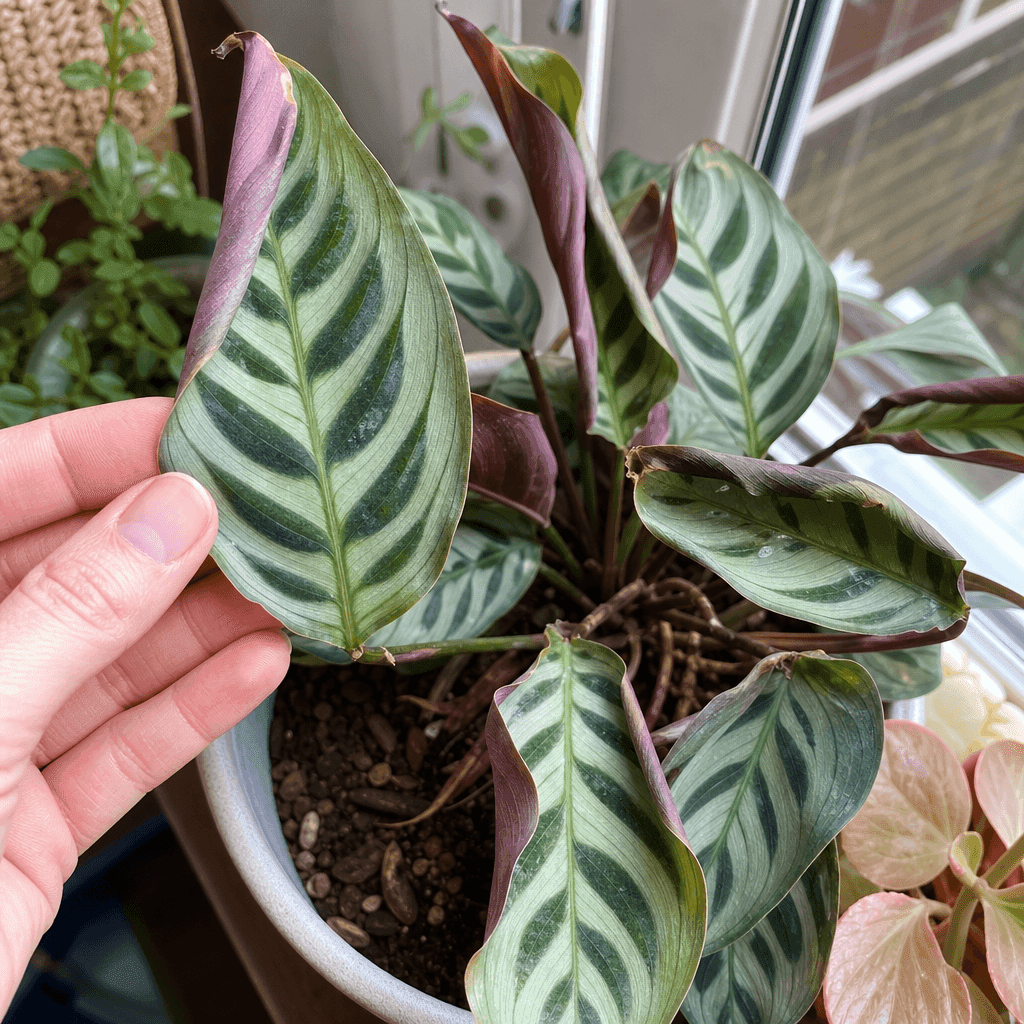
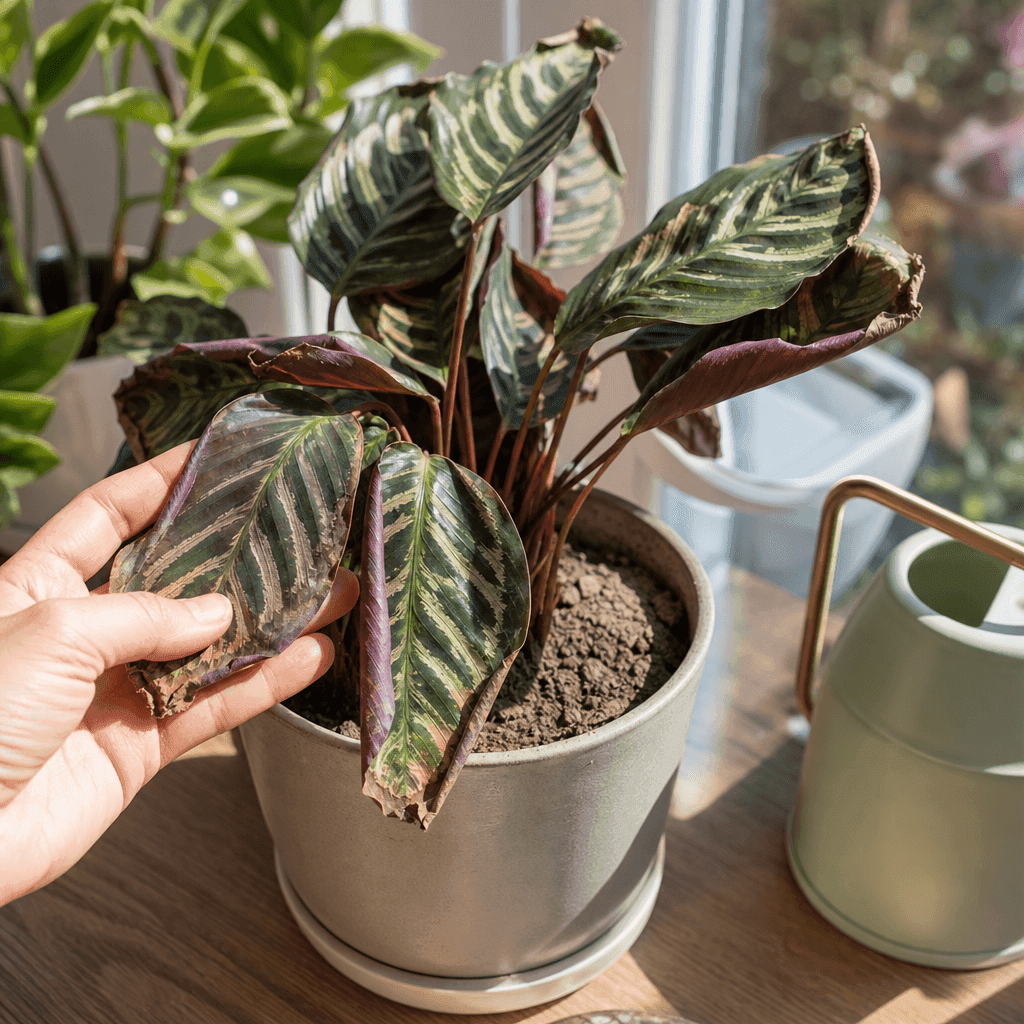
| Leaves curl tightly inward; compost feels dry 2–3 cm down; pot feels light | Underwatering | High | Water thoroughly and see whether leaves begin to uncurl within 24 hours. | Soak the rootball fully until water drains; establish a routine check-before-watering habit. | High |
| Persistent curling and brown leaf tips that do not improve after watering or humidity changes | Fluoride or mineral build-up from tap water | Medium | Check whether tap water is being used regularly; symptoms may have developed over weeks. | Switch to rainwater, filtered water or distilled water; flush the compost with clean water. | Low–medium |
| Leaves curl or wilt near a window, door or air vent; worse after a cold night | Cold draught or temperature stress | Medium | Hold your hand near the plant — can you feel cold air movement? Calatheas need 18–27°C. | Move the plant at least 30 cm from cold glass; keep away from air-conditioning or exterior doors. | Medium |
| Persistent curling in a plant not repotted for 2+ years; roots emerging from drainage holes | Root restriction (pot-bound) | Medium | Tip the plant out gently — a mass of circling roots with little compost confirms pot-bound stress. | Repot into a container one size up in spring using peat-free houseplant compost. | Low–medium |
| Leaves droop and curl while the compost stays wet; possible sour smell | Overwatering or root damage | Low | Press the compost — if wet below the surface after several days without watering, check roots. | Allow compost to partially dry; check for mushy brown roots and repot if needed. | High |
The causes, in detail
Low humidity
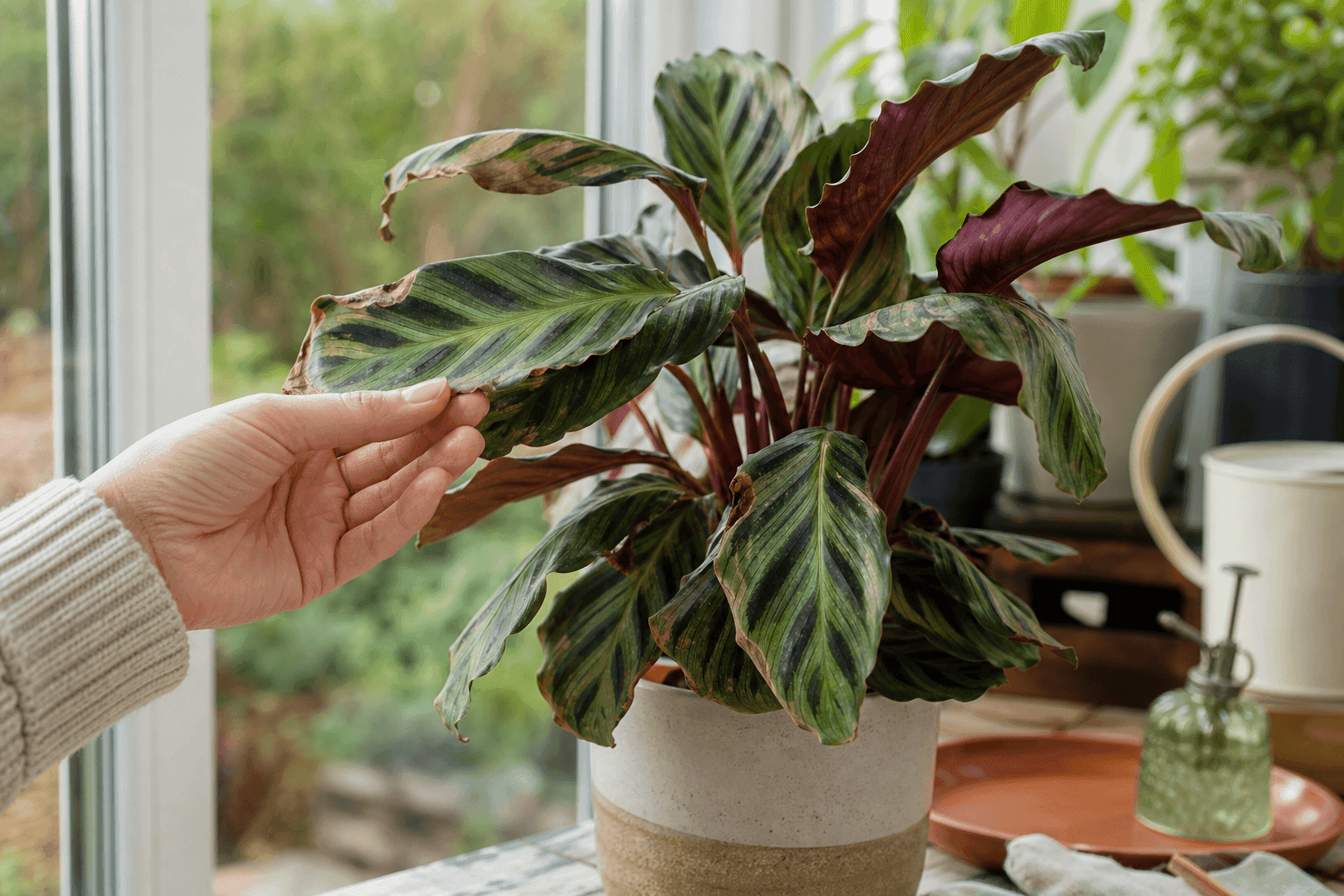
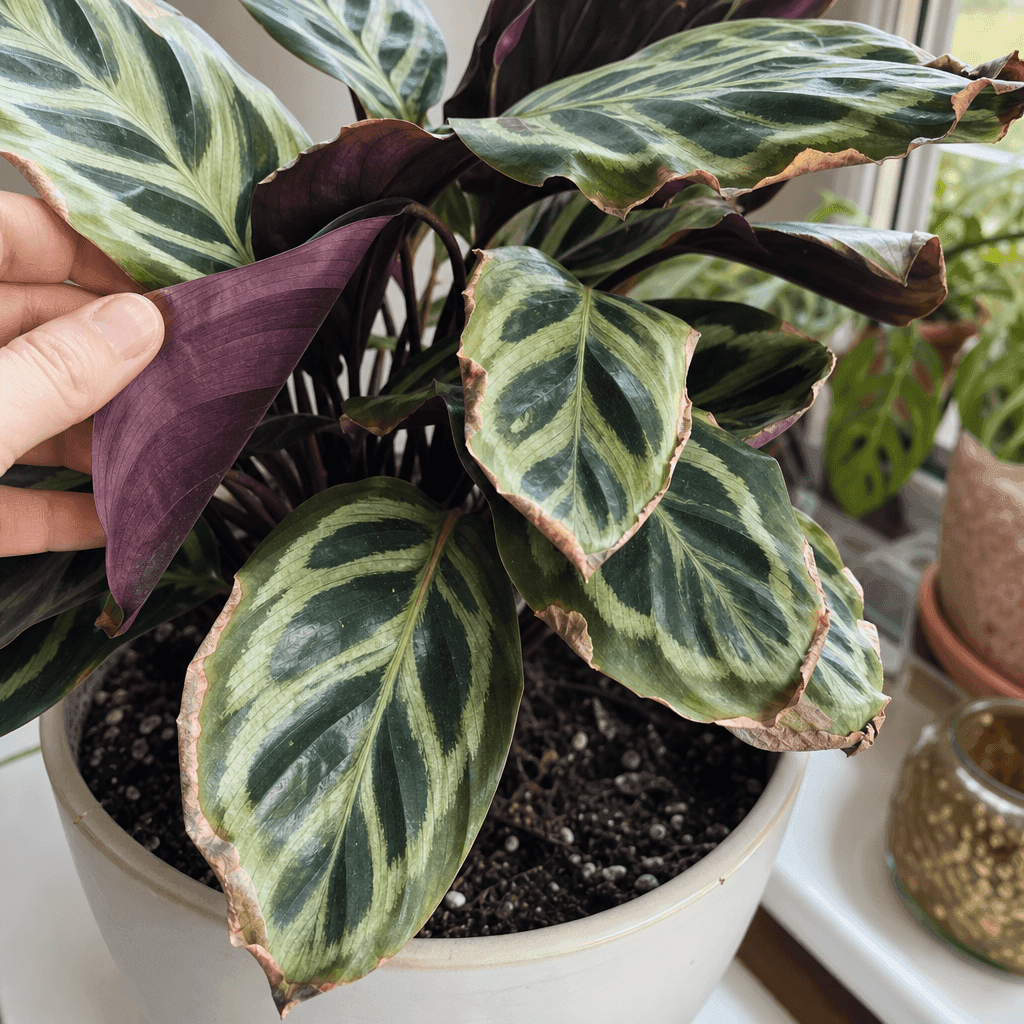
Most likelyCalatheas are native to tropical rainforest understories in South America and need relative humidity of 50–65%. In a UK home with central heating running from October to March, indoor humidity can fall to 30% or lower — well below what calatheas tolerate. As Plants for All Seasons notes, calatheas absorb moisture through their leaves as well as their roots, and in very dry air the leaves curl at the edges and tips to slow water loss. This is the single most common cause of curling in UK-grown calatheas.
- Use a small humidity meter (hygrometer) — available cheaply online — and check the reading near the plant.
- Curling is worse in winter and near radiators or air vents.
- Misting briefly reverses curling for a few hours but it returns quickly — this confirms low humidity.
- Place the pot on a shallow tray filled with pebbles and water so the base of the pot sits above the waterline — evaporation raises local humidity.
- Group calatheas and other tropical houseplants together to create a shared humid microclimate.
- Use a small cool-mist humidifier positioned 30–60 cm from the plant — this is more reliable than misting.
- Move the plant away from radiators, underfloor heating vents and air-conditioning units.
- Avoid misting as the main solution — it raises humidity only briefly and can encourage fungal spots on leaves.
Stop it coming back:A well-sited calathea at adequate humidity will produce flat, open leaves. If humidity drops again in winter, symptoms will return — consistency matters more than one-off fixes.
mist the leaves repeatedly as a humidity fix — frequent misting wets the foliage and can trigger fungal leaf-spot on these dense-leaved plants.
Underwatering
Most likelyCalatheas prefer evenly moist compost — not soaking, but never bone dry. When the compost dries out too much, calathea leaves curl inward and may feel limp; this is the plant's mechanism for reducing water loss through the leaf surface. The compost should feel barely moist at 2–3 cm depth; if it feels dry, the plant is already stressed. Calatheas in warm, centrally-heated rooms and terracotta pots dry out faster than those in cooler conditions or plastic pots.
- Push a finger 2–3 cm into the compost — if it feels dry rather than barely moist, underwatering is likely.
- The pot feels noticeably light when lifted.
- Leaves uncurl partially within 12–24 hours of a thorough watering.
- Water thoroughly by pouring slowly over the surface until water drains freely from the drainage holes.
- Allow the surface to approach dryness before the next watering — test with a finger rather than following a fixed schedule.
- In summer or warm rooms, calatheas may need watering twice a week; in winter once a week or less.
- If the compost has become hydrophobic (water runs straight through), bottom-water by placing the pot in a few centimetres of water for 20–30 minutes.
Stop it coming back:Existing curled or damaged leaves may not fully recover their shape, but new leaves will emerge flat if conditions are corrected.
water on a fixed schedule rather than by feel — in cooler UK winters calatheas need far less water than in summer.
Fluoride and mineral salts from tap water
PossibleCalatheas are notably sensitive to fluoride, chlorine and dissolved mineral salts in tap water. UK tap water is fluoridated in many areas (particularly the Midlands and parts of the North) and is often hard, carrying calcium and magnesium salts. These accumulate in the compost and leaf tissue over weeks and months, eventually causing curling, persistent brown tips and edges that do not respond to adjustments in watering or humidity — the same mineral sensitivity behind brown leaves on peace lilies and other tropical houseplants. Bloomingexpert and Haws UK both list fluoride sensitivity as a leading cause of calathea brown tips and curling.
- Symptoms developed slowly over several weeks or months of tap-water use.
- Brown tips and curling persist despite correct watering and adequate humidity.
- A white crust of mineral salts may be visible on the compost surface or pot rim.
- Switch to collected rainwater — free and the best option for UK growers — stored in a watering can or butt.
- Alternatively use filtered water (reverse osmosis removes fluoride; standard jug filters remove chlorine but not fluoride) or distilled water.
- Flush the existing compost by watering slowly and heavily with clean water, using two to three times the pot volume, to rinse accumulated salts out through the drainage holes.
- If salts have built up severely, repot into fresh peat-free compost in spring.
- Leaving tap water out overnight reduces chlorine but does not remove fluoride.
Stop it coming back:Once you switch to rainwater or filtered water, new growth should emerge without the browning and curling caused by mineral accumulation.
rely on leaving tap water out overnight to fix fluoride sensitivity — chlorine disperses but fluoride does not.
Cold draught or temperature stress
PossibleCalatheas require temperatures between 18°C and 27°C and dislike sudden cold. In UK homes, south- or west-facing windows can become very hot in summer, while east- or north-facing windows turn cold at night in winter. Single glazing, draughty sash windows and exterior doors create localised cold air movement that causes calathea leaves to curl and wilt at the edges nearest the draught. Air-conditioning in summer can produce the same effect.
- The curling is worst on leaves closest to a window or door.
- Hold your hand near the plant on a cold evening — feel for a cold draught.
- Symptoms appeared or worsened after the plant was moved to a new location or after the heating was adjusted.
- Move the plant at least 30 cm away from cold glass or draughty frames.
- Avoid placing calatheas between a radiator and a cold window — the temperature fluctuation stresses them.
- In summer, move the plant away from air-conditioning vents.
- Use a thermometer near the plant overnight — below 15°C causes visible leaf stress in most calathea species.
Stop it coming back:A stable temperature, away from external walls and cold glass, will keep calatheas comfortable through a UK winter.
place the plant directly on a cold windowsill in winter — the pot and roots chill quickly and root function deteriorates.
Root restriction and pot-bound stress
PossibleCalatheas are not fast growers, but after two or more years in the same pot the roots may fill the compost completely, leaving little space for water retention. A pot-bound calathea dries out rapidly, cannot take up water efficiently, and frequently shows curling leaves despite appearing to be watered correctly. Roots emerging from drainage holes or circling visibly around the base of the compost confirm the problem.
- The plant has not been repotted in two or more years.
- Roots are emerging from drainage holes or visibly circling the compost surface.
- The compost dries out within a day or two of watering.
- Repot in spring (March to May) when the plant is entering active growth.
- Choose a pot one size larger — roughly 2–3 cm bigger in diameter — not much larger, as excess compost holds moisture and risks root rot.
- Use a peat-free houseplant or tropical compost with added perlite for drainage.
- Water lightly after repotting and keep the plant out of direct sun for a week while it settles.
Stop it coming back:Check every spring whether repotting is needed; calatheas generally need moving on every two to three years.
pot up into an oversized container to avoid repotting too often — a very large pot holds excess water and increases the risk of root rot.
Overwatering or root damage
Less likelyCalatheas can also curl and droop when overwatered, because damaged, oxygen-starved roots cannot take up water effectively — so the plant shows the same stress response as underwatering despite the compost being wet. This is less common than low humidity or underwatering in UK conditions but can occur when calatheas are watered on a fixed schedule without checking the compost, or when they sit in pots without adequate drainage.
- The compost feels wet or soggy below the surface several days after the last watering.
- There is a sour or musty smell from the compost.
- Roots are brown and mushy rather than pale and firm.
- Stop watering immediately and allow the compost to partially dry out.
- Check that drainage holes are clear and the pot is not sitting in a saucer full of water.
- If the smell is strong or roots are rotting, repot into fresh compost, trimming dead brown roots cleanly.
- Resume watering only when the top 2–3 cm of compost feels dry.
add more water when leaves are curling without first checking the compost moisture — in wet conditions, more water makes the root problem worse.
Still not sure?
Work down these branches — the first one that matches is your answer.
What not to do
- Mist the leaves repeatedly as a humidity solution — it wets the foliage and risks fungal spotting.
- Water on a fixed schedule rather than checking the compost first.
- Leave the plant on a cold windowsill in winter — the root zone chills and stops working.
- Assume curling means underwatering without checking the compost — in wet compost, more water makes it worse.
- Use tap water if your area has hard or fluoridated water — switch to rainwater or filtered water.
Common questions
Why do calathea leaves curl inward?
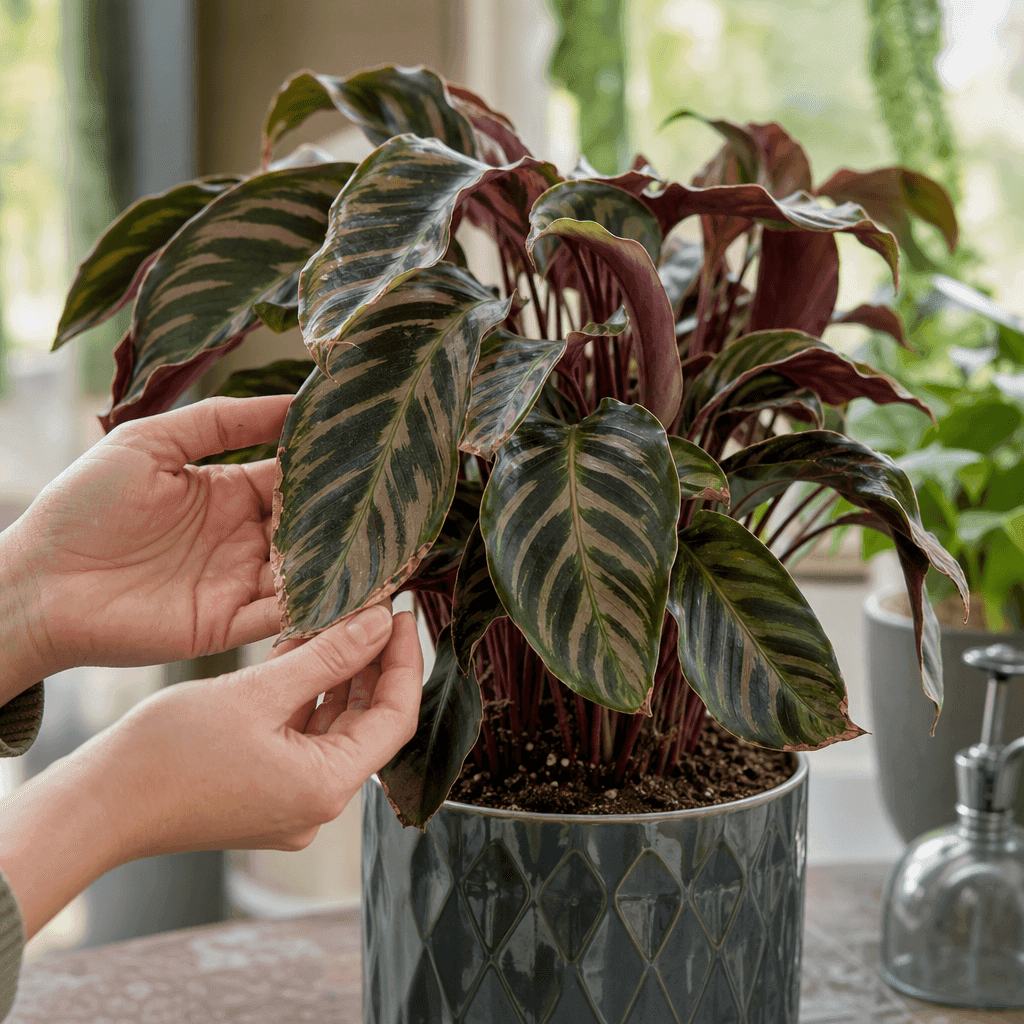
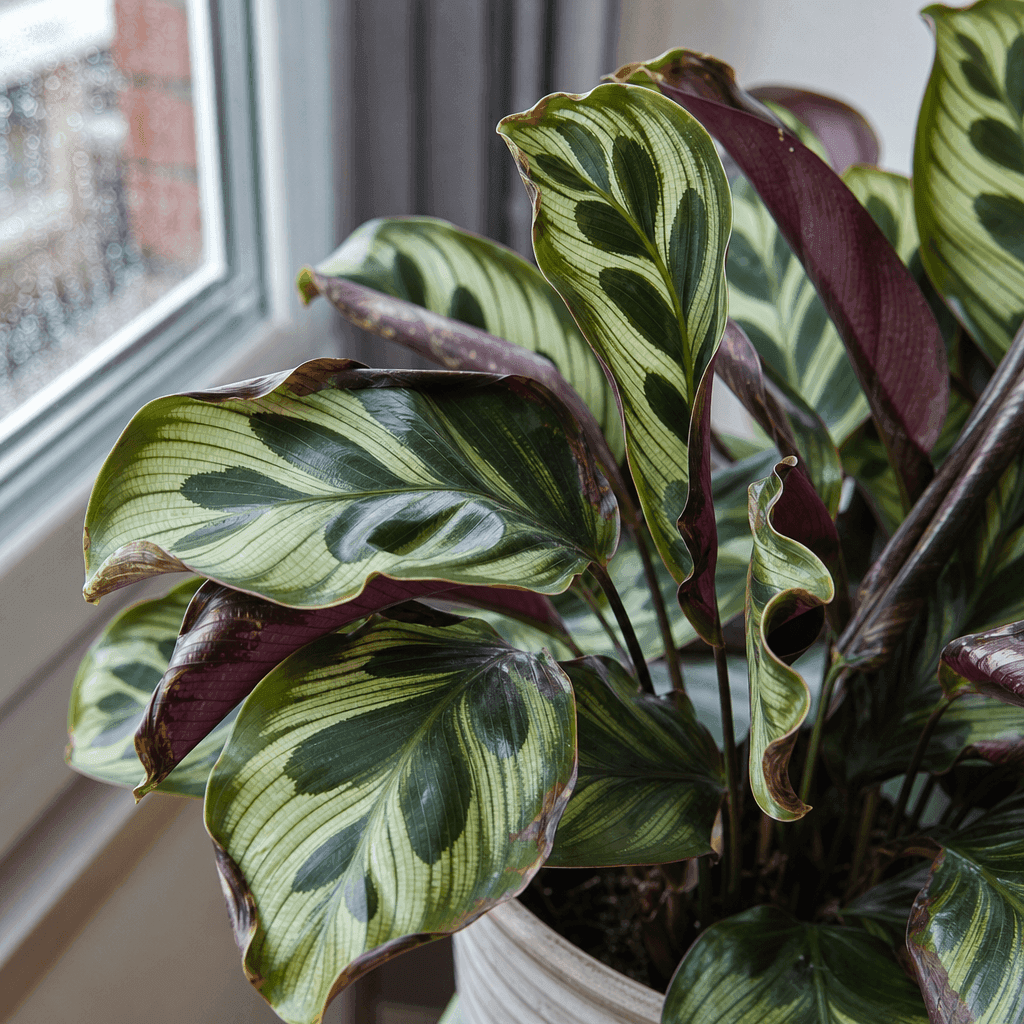
Curling inward is usually the plant's response to low humidity or underwatering — both cause the leaves to roll to reduce water loss, the same protective response seen when hydrangea leaves curl in dry spells. It can also be caused by fluoride accumulation from tap water or cold draughts near windows. Check humidity first, then compost moisture.
Will curled calathea leaves unfurl?
Some curled leaves will partially unfurl once humidity is raised and watering is corrected. However, leaves that have been curled for a long time or that have brown, crispy edges will not fully recover. Judge improvement by whether new leaves emerge flat and healthy.
How often should I water my calathea in the UK?
There is no fixed frequency. Check the compost with a finger: water when the top 2–3 cm feels barely dry. In a warm room in summer this may be twice a week; in a cool room in winter it may be once a week or less.
Is tap water bad for calatheas in the UK?
Many UK areas have hard or fluoridated tap water, and calatheas are particularly sensitive to fluoride, which accumulates in leaf tips and causes persistent browning and curling. Rainwater is free and the best option; filtered or distilled water also works. Leaving tap water overnight removes chlorine but not fluoride.
What humidity does a calathea need?
Calatheas prefer 50–65% relative humidity. UK homes with central heating often drop to 30% in winter, which is too low. A pebble-and-water tray, grouping plants together, or a small humidifier are all effective. Misting helps briefly but is not reliable on its own.
Should I repot a curling calathea?
Only if the plant is pot-bound — roots circling the base or emerging from drainage holes, and compost drying out very rapidly. If the plant was repotted recently, root restriction is unlikely to be the cause.
Why does my calathea curl in winter?
Winter combines two common stressors: lower humidity from central heating and cold draughts from windows. Move the plant away from cold glass, check it is at least 18°C overnight, and raise humidity with a pebble tray or humidifier.
Can overwatering cause calathea leaves to curl?
Yes, though it is less common than underwatering. Waterlogged roots cannot take up water, so the plant shows curling and wilting despite wet compost. If the compost is soggy and there is a sour smell, root rot may be the cause and needs treating before the plant declines further.