Quick diagnosis
Match the row to what you’re seeing, then jump to the fix.
| What you see | Likely cause | Confidence | How to confirm | What to do now | Urgency |
|---|---|---|---|---|---|
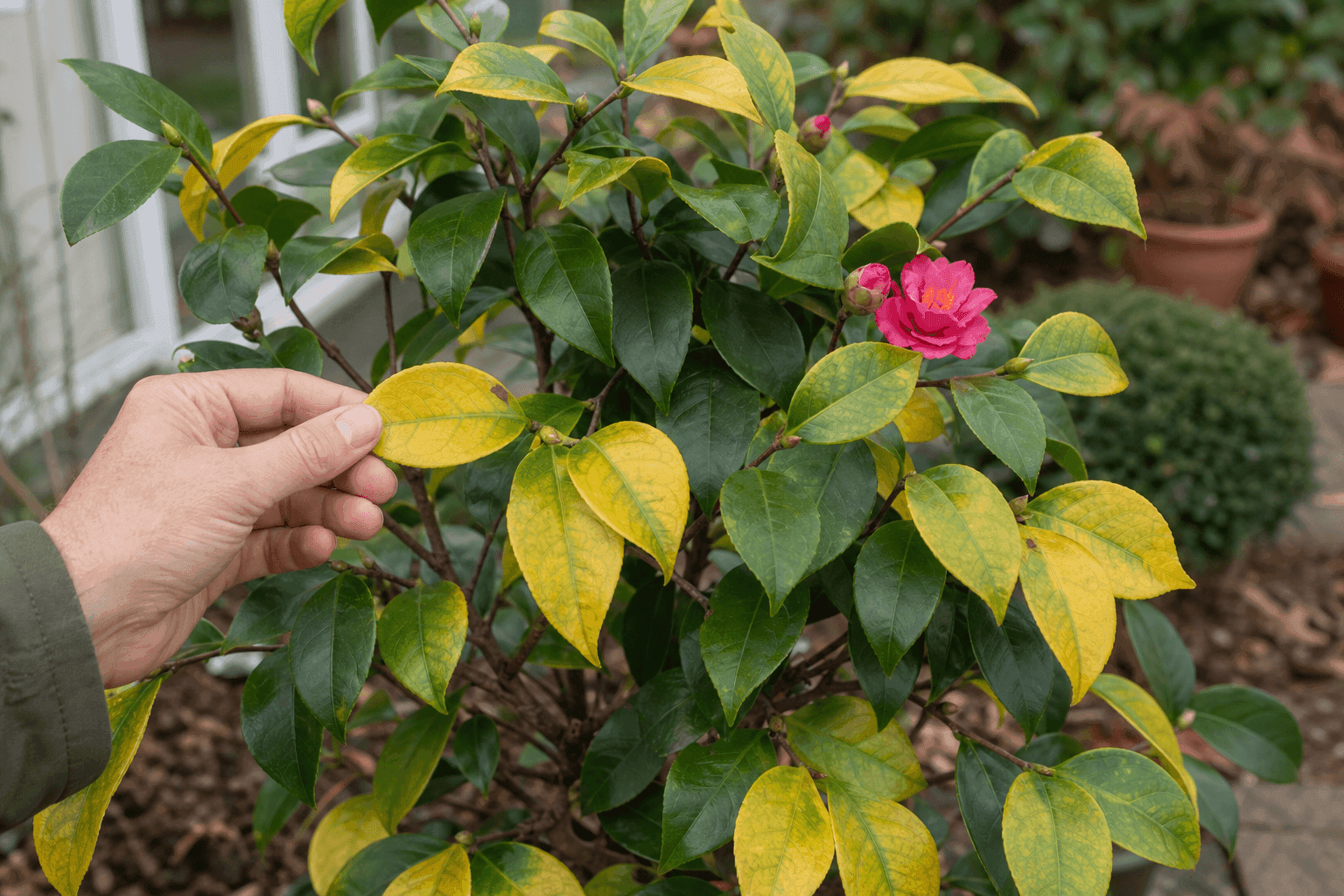
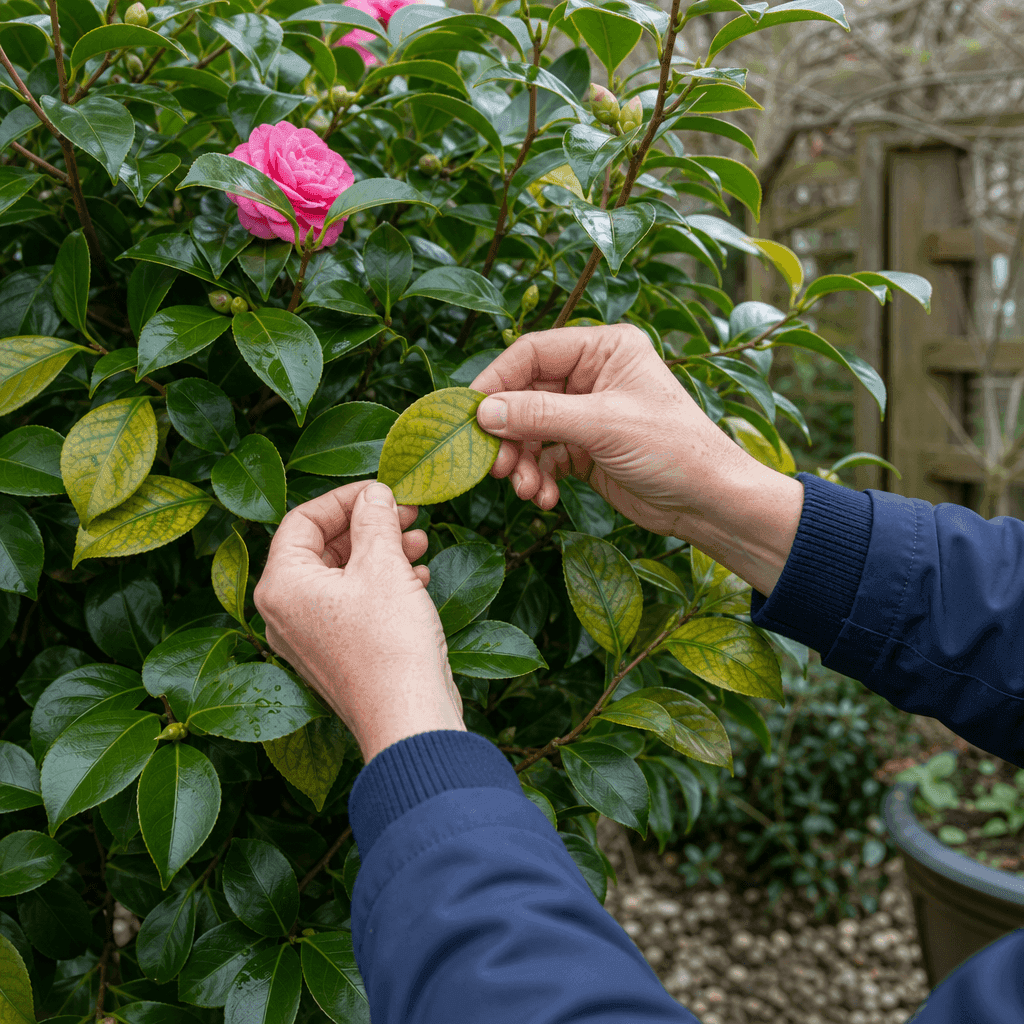
| Young leaves yellow with green veins remaining; worst on new growth at shoot tips | Lime-induced iron/manganese chlorosis | High | Test soil pH — camellias need 5.5–6.5; check if tap water (hard) is used for watering | Switch to rainwater; feed with ericaceous fertiliser; apply sequestered iron | Medium |
| Older inner or lower leaves turning yellow and dropping in spring or early summer | Normal seasonal leaf shedding | High | New growth at shoot tips is healthy and dark green; only old leaves affected | Rake up and remove fallen leaves; no other action needed | Low |
| Whole leaves uniformly yellow or pale; wilting despite wet soil; poor vigour | Waterlogging and root suffocation | Medium | Soil or compost stays wet for days; pot drainage blocked; heavy clay soil | Improve drainage; do not water again until compost partially dries; repot if needed | High |
| Leaves yellowing and wilting; compost or soil dry; worst in late summer | Drought stress | Medium | Soil dry 5 cm down; pot feels light; plant in a dry spot under eaves or trees | Water deeply with rainwater; mulch 5 cm deep; check bud formation in late summer | Medium |
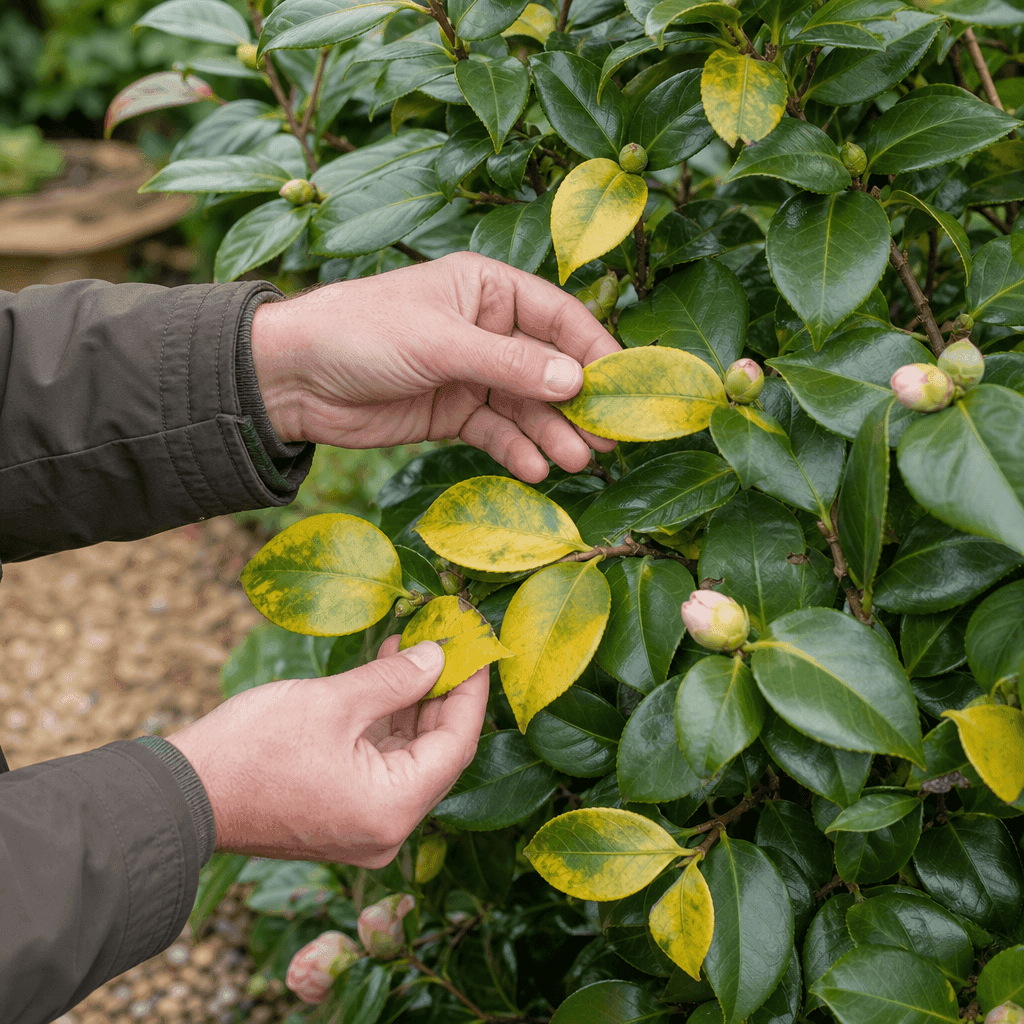
| Irregular yellow blotches or ringspots; leaves deformed; colour breaking on flowers | Camellia yellow mottle virus or other virus | Low | Mottled irregular pattern (not interveinal); different leaves show different amounts; no soil test improvement | No cure; remove severely affected plants to prevent spread; do not propagate from them | Low–medium |
The causes, in detail
Lime-induced iron and manganese chlorosis
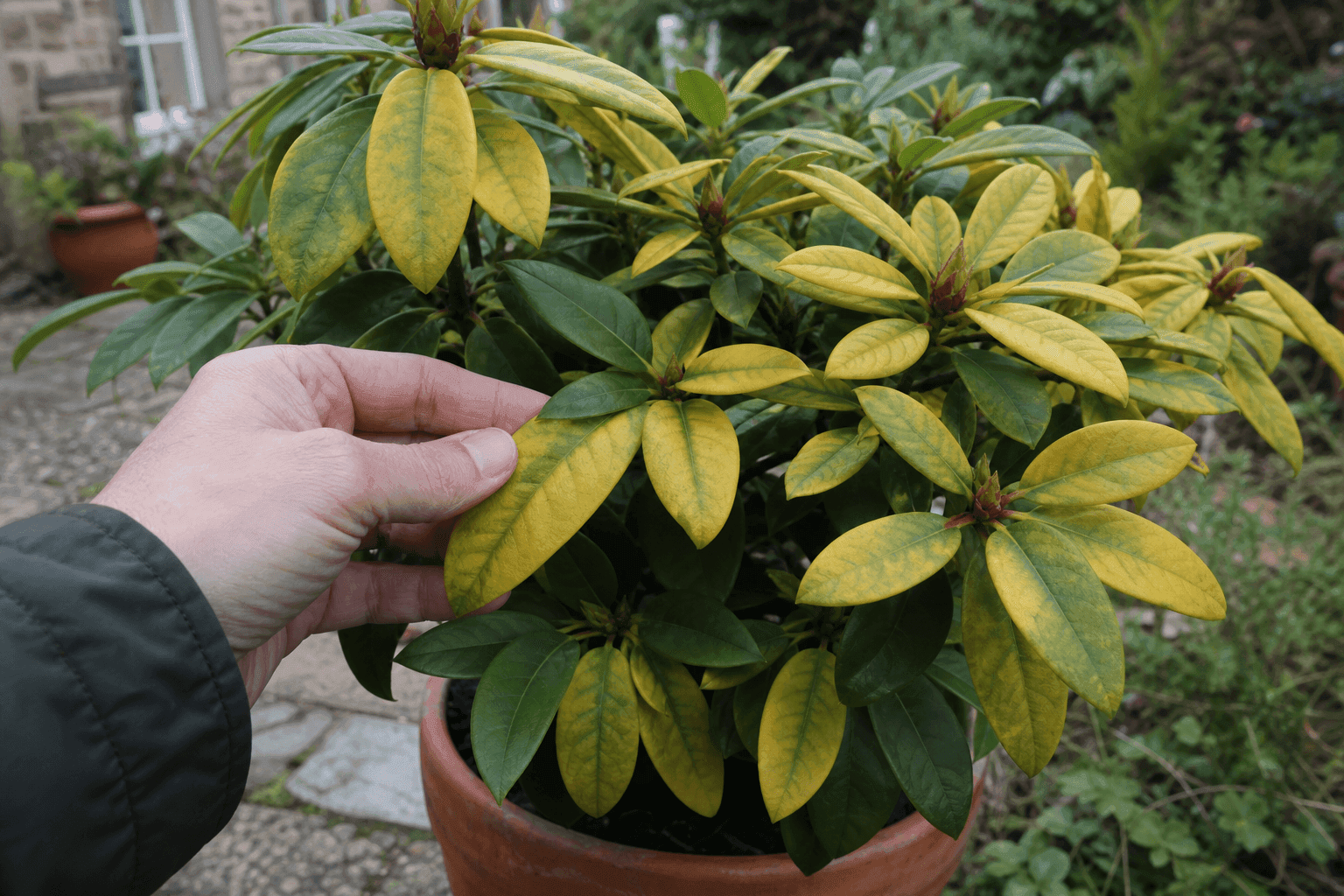
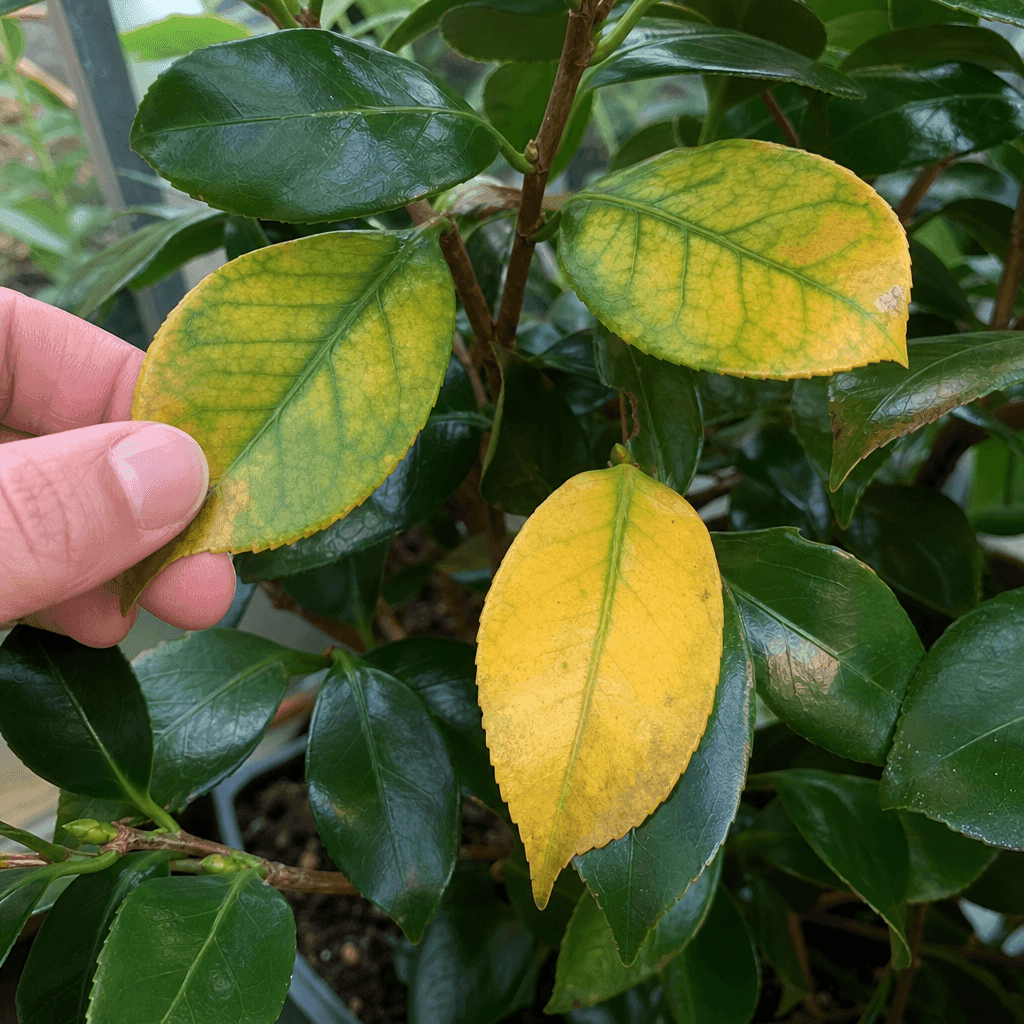
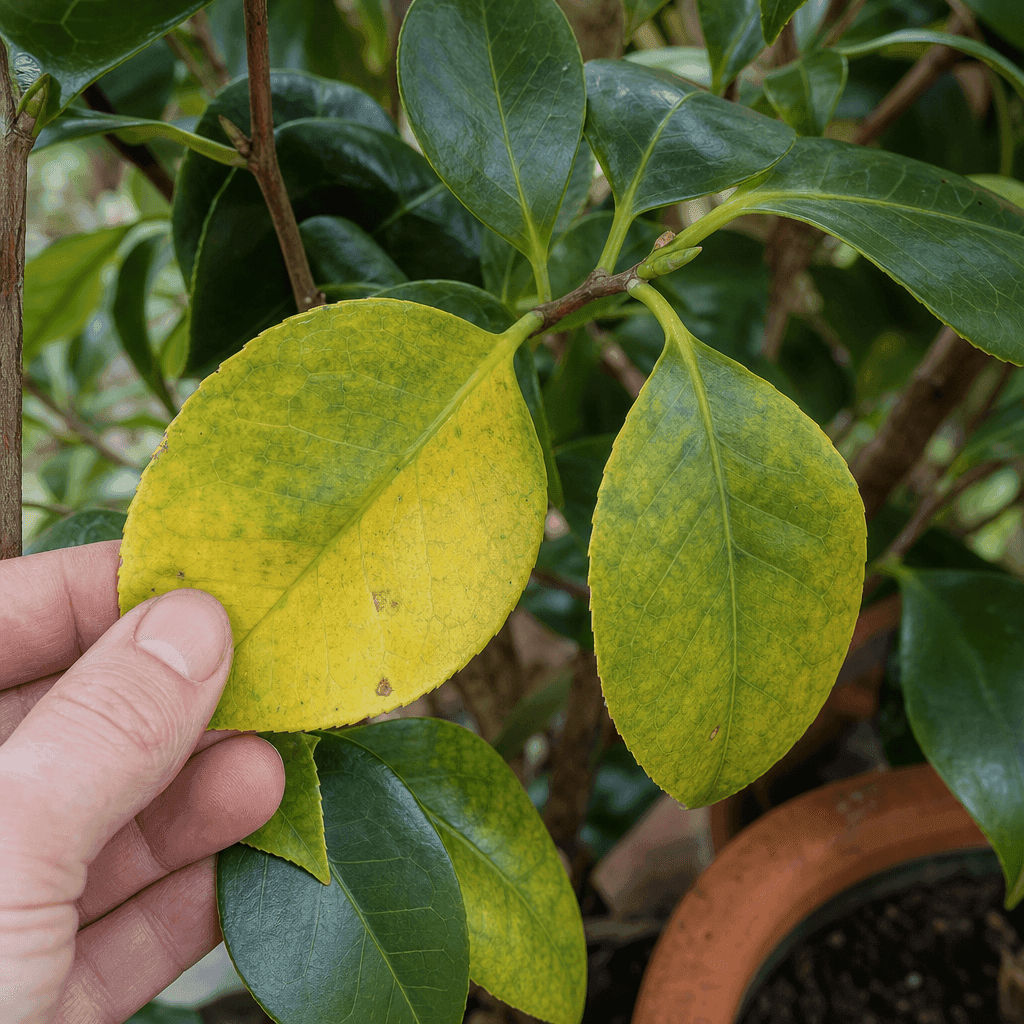
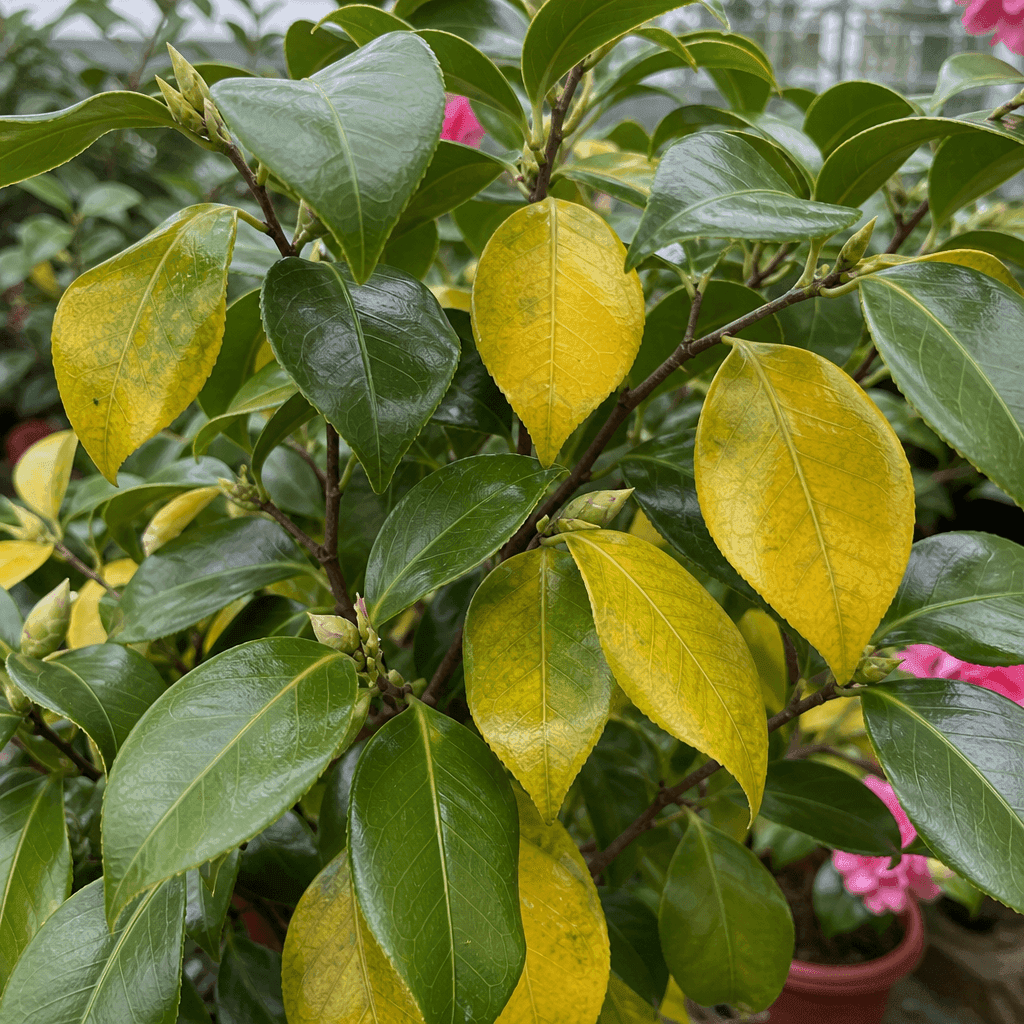
Most likelyThe most common cause of yellow leaves on camellias in UK gardens is lime-induced chlorosis — high soil or water pH locks out iron and manganese, so the plant cannot make chlorophyll. The classic pattern is yellowing between the veins (interveinal chlorosis) on the newest leaves, while the veins themselves stay green. The RHS explains that being ericaceous plants, camellias suffer iron and manganese deficiency when the soil pH rises above about 6.5. In many UK areas, hard tap water is alkaline enough to raise compost pH over time, particularly in containers.
- Yellow leaves with green veins remaining, worst on the youngest leaves and shoot tips.
- Test the soil or compost pH — any reading above 6.5 for a camellia is problematic.
- Check whether tap water rather than rainwater is used for a container camellia.
- No improvement after several deep waterings — distinguishes chlorosis from drought.
- Switch to rainwater for watering container camellias; collected rainwater is naturally slightly acidic.
- Apply a sequestered (chelated) iron product according to label directions — this is the fastest route to greening chlorotic leaves.
- Feed with an ericaceous fertiliser (one formulated for acid-loving plants such as rhododendrons and azaleas — the same group that suffers rhododendron yellow leaves from the same pH lock-out) in spring and again after flowering.
- For border camellias, mulch with composted pine needles, composted bracken, or ericaceous bark to acidify the root zone gradually.
- If the soil is confirmed alkaline, consider moving the camellia to a container of ericaceous compost — this is often the most reliable long-term fix.
Stop it coming back:Once greening begins on new leaves, continue using rainwater and ericaceous feed each spring. Already-chlorotic leaves rarely recover their full green colour, but new growth should emerge healthy.
apply general-purpose fertiliser to a camellia with chlorosis — many contain lime or have a neutral to alkaline reaction that will worsen the pH problem.
Normal seasonal leaf shedding
Most likelyCamellias are evergreen but not immortal — they shed their oldest leaves, typically in spring or early summer when new growth is pushing through. This natural turnover is commonly confused with disease or deficiency. The RHS notes that yellowing confined to old leaves near the base and inside of the plant in spring is usually normal, and can have a number of harmless causes including the plant redirecting resources to new growth.
- Only the oldest, innermost leaves are yellowing — not new shoot-tip growth.
- Yellowing is happening in spring or early summer alongside vigorous new growth.
- The plant looks generally healthy with good colour on new leaves.
- Rake up and remove fallen leaves from around the base to reduce disease risk.
- No other action is needed — this is not a problem to correct.
drench the plant in feeds or treatments in response to normal leaf turnover — it can cause real problems where none existed.
Waterlogging and root suffocation
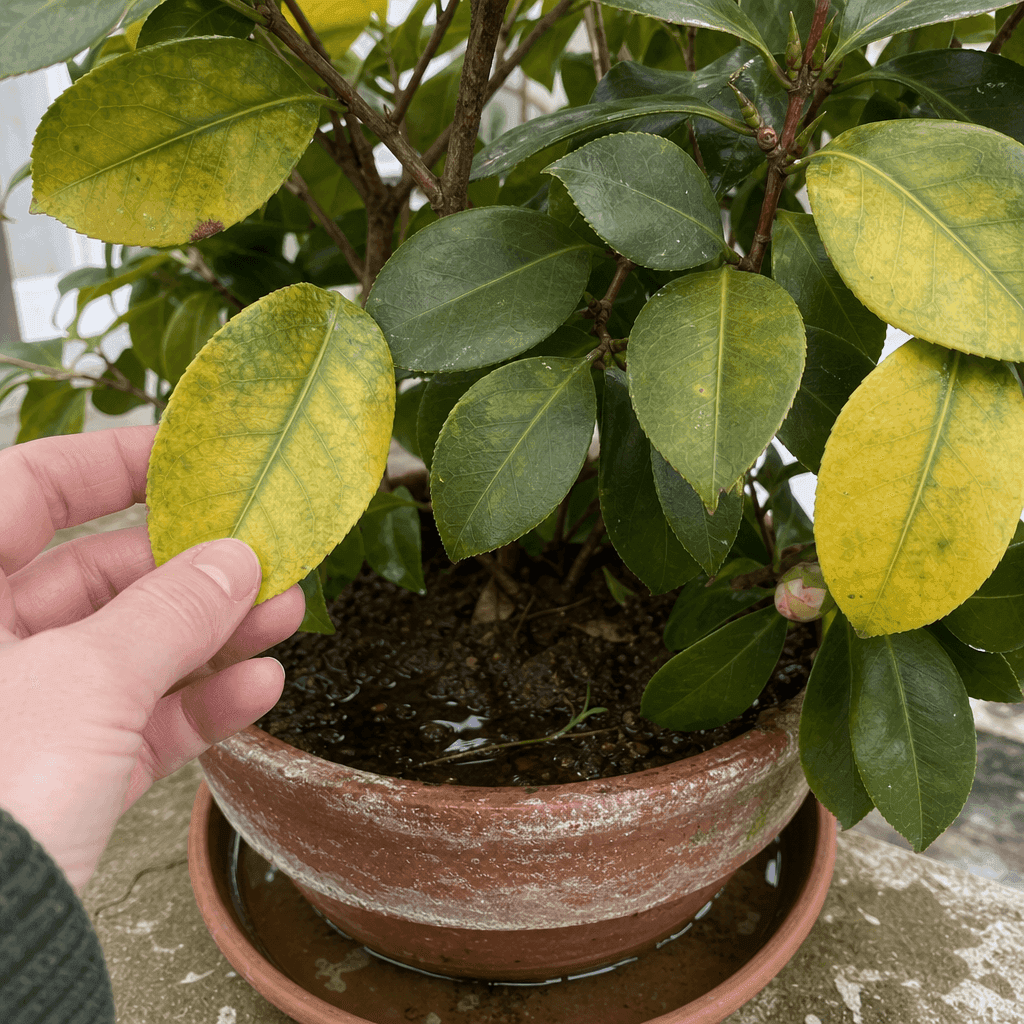
PossibleCamellias need consistent moisture but cannot tolerate permanently wet roots. In waterlogged soil or a pot with blocked drainage, the roots become oxygen-starved and begin to rot, which stops them from absorbing nutrients. Once decay sets in, follow a proper root rot treatment to salvage the plant. Leaves then yellow uniformly — not just between the veins — and the plant wilts even when the soil is wet. This is a common problem in UK winter when camellias in containers sit in saucers or on blocked drainage, or when border plants are in heavy clay or low-lying spots.
- Soil or compost stays wet for several days after rain or watering.
- Whole leaves turn uniformly pale or yellow, not just between the veins.
- Pot drainage holes are blocked or the plant sits in a saucer of water.
- Roots look brown and mushy rather than firm and pale when inspected.
- Stop watering immediately and let the compost partially dry before watering again.
- Clear blocked drainage holes and raise pots on feet.
- If the compost smells sour, repot into fresh ericaceous compost in a pot with clean drainage.
- In the border, improve the soil around the plant with organic matter and consider raising the planting slightly.
water more to try to fix yellowing before checking whether the soil is already wet — waterlogging looks just like drought at a glance.
Drought stress
PossibleAlthough camellias prefer consistent moisture, they can suffer drought stress, particularly in late summer when bud set is occurring. Missing watering at this critical time causes bud drop and leaf yellowing. Camellias under eaves, next to walls, or under tree canopies are especially vulnerable because rainfall does not reach the roots. The horticulture.co.uk guide emphasises that consistent summer moisture is essential for healthy bud formation in camellias.
- Compost or soil is dry 5 cm below the surface.
- Pot feels noticeably lighter than usual.
- The plant is positioned under eaves, next to a wall, or in a spot where rain is intercepted.
- Dry spells in late July to September — the critical bud-formation period.
- Water deeply with rainwater (or soft water) until the full root zone is moist.
- Apply a 5 cm mulch of composted bark or leaf mould, kept clear of the main stem, to retain moisture.
- In dry summers, water container camellias every 2–3 days during August and September.
- Move the plant away from walls or eaves where rainfall is intercepted.
use hard tap water to rehydrate a drought-stressed camellia — this compounds alkalinity problems over time; use rainwater wherever possible.
Camellia yellow mottle virus
Less likelyCamellia yellow mottle virus causes distinctive irregular yellow or creamy-white blotches on leaves, sometimes with colour-breaking (streaks of a different colour) in the flowers. The RHS confirms this is a genuine virus infection, distinct from chlorosis, and notes it can also cause leaf deformation. Affected plants decline over time and there is no chemical cure. The virus can be spread by propagation from infected material, so garden hygiene is important.
- Irregular, angular yellow or creamy blotches on leaves — not a neat interveinal pattern.
- Different leaves show different amounts of discolouration.
- Flowers may show colour-breaking or streaking.
- Sequestered iron and ericaceous feed do not improve the yellowing.
- There is no cure for camellia virus.
- Remove and destroy severely affected plants to prevent spread to other camellias.
- Do not propagate (take cuttings) from a plant showing virus symptoms.
- Sterilise pruning tools between plants.
propagate from a plant you suspect has a virus — the virus passes into cuttings and layers.
Still not sure?
Work down these branches — the first one that matches is your answer.
What not to do
- Water a camellia with hard tap water long term — it raises pH and causes chlorosis.
- Apply general-purpose fertiliser that contains lime or has a neutral/alkaline reaction.
- Assume all yellowing means the plant needs feeding — check soil moisture and pH first.
- Compost leaves from a plant suspected to have a virus — bin them instead.
- Allow a container camellia to sit in a saucer of water over winter.
Common questions
Why are my camellia leaves turning yellow with green veins?
Yellowing between the veins (interveinal chlorosis) on a camellia almost always means lime-induced iron or manganese deficiency. The soil or compost pH is too high (above 6.5) for the plant to access these trace minerals. Apply sequestered iron and switch to rainwater for watering.
Why are the older leaves on my camellia going yellow in spring?
This is almost certainly normal seasonal leaf shed. Camellias shed their oldest leaves in spring and early summer when new growth pushes through. If new leaves look healthy and green, no action is needed beyond removing the fallen leaves.
Can I grow a camellia in an alkaline garden?
Yes, but it needs to be in a container. Plant it in ericaceous compost, water with rainwater, and feed with ericaceous fertiliser in spring. Growing directly in alkaline border soil is very difficult to correct long term. See our full camellia care and problem guide for more on positioning and aftercare.
How do I treat camellia chlorosis?
Apply a sequestered (chelated) iron product — these contain iron in a form the plant can absorb even at slightly higher pH. Also switch to rainwater for irrigation and use an ericaceous feed. For border plants, acidify the root zone by mulching with composted pine needles or bracken.
My camellia leaves are yellow all over, not just between the veins. What is wrong?
Uniform whole-leaf yellowing is less typical of chlorosis and more likely to indicate waterlogging, severe drought, or natural leaf drop. Check whether the soil is wet or dry and act accordingly. If you are still unsure, our guide to why plant leaves turn yellow walks through every common cause step by step.
Will yellow camellia leaves go green again?
Severely chlorotic leaves rarely recover their full green colour, but if the underlying cause (usually pH or watering) is corrected, new leaves should emerge healthy and green. Remove badly yellow leaves once they begin to drop.
Is yellowing on camellias contagious?
Nutrient-related chlorosis and drought stress are not contagious. Camellia yellow mottle virus is spread by propagation (cuttings and layers) and possibly by insects, so do not propagate from plants showing irregular blotchy yellowing.